The higher-than-expected earnings rebound of many listed corporates in Africa’s most populous economy has unlocked a total of N1.7 trillion in payouts to shareholders, marking the strongest rise in recent years, BusinessDay analysis has found.
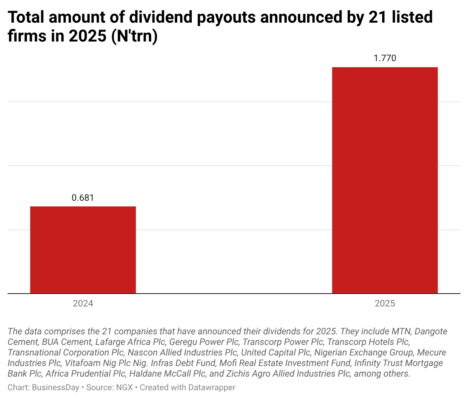
As of March 13, a total of 21 listed companies on the Nigerian Exchange Limited (NGX) have announced dividends for the year 2025, amounting to N1.7 trillion, as corporate earnings more than doubled.
Five dividends have already been paid, while the remaining are scheduled through to July 2026 and beyond.
BusinessDay Market Intelligence’s review of company reports and dividend announcements shows that the N1.7 trillion payout from interim and final dividends is one of the largest in Nigeria’s capital market history, significantly up from the N681.3 billion given to shareholders in 2024.
The surge in dividends comes amid sweeping economic reforms, including foreign exchange liberalisation, subsidy removal, and tightening monetary conditions, which initially triggered economic volatility but are now translating into stronger revenues and earnings for many firms.
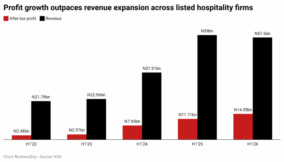
The combined revenue of the companies analysed rose to approximately N13.44 trillion in 2025, from N9.76 trillion in 2024, while profit increased to N3.17 trillion, compared with the N571 billion recorded a year earlier.
The strong earnings cycle reflects how companies have adjusted to the new policy environment through pricing power, operational efficiency, and expansion into new revenue streams.
“The results we are seeing indicate that Nigerian corporates are adapting quickly to reforms,” said a Lagos-based equity analyst at a leading investment house. “Higher revenues and improved profitability are now feeding directly into shareholder returns, which is positive for investor confidence in the Nigerian market.”
Cement giants dominate payouts
Nigeria’s cement producers accounted for the largest share of dividend distributions, reinforcing their dominance in the country’s industrial sector.
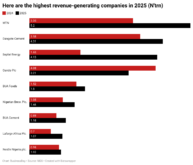
Dangote Cement emerged as the biggest dividend payer among the firms analysed, declaring N753.8 billion in total dividends for 2025, up from N502.6 billion in the previous year. The company increased its dividend per share to N45 from N30, supported by revenue growth to N4.31 trillion and profit exceeding N1 trillion.
The company’s performance reflects sustained demand for cement across infrastructure and construction projects, as well as improved operational efficiency across its African operations.
Similarly, BUA Cement significantly increased its dividend payout, distributing N333.6 billion, compared with N69.4 billion the previous year. The company increased its dividend per share to N10 from N2.05, supported by revenue growth to N1.18 trillion.
Analysts say BUA Cement’s strong earnings were driven by expanded production capacity and improved pricing amid inflationary pressures.
Lafarge Africa, another major player in the sector, also delivered solid returns to investors, paying N96.6 billion in total dividends despite reducing its dividend per share to N6 from N12.
The company’s revenue rose to N1.07 trillion, while profit surged to N272 billion, reflecting strong cement demand and improved cost management.
Collectively, the cement sector alone accounted for more than N1.18 trillion in dividend payouts, representing the largest contribution to shareholder returns among the firms analysed.
Telecom sector resumes dividend payouts
The telecommunications sector also delivered one of the most significant shareholder payouts.
MTN Nigeria declared N419.9 billion in total dividends, equivalent to N20 per share, even as the company navigated regulatory challenges and currency volatility.
The telecom giant’s revenue surged to N5.2 trillion in 2025, up from N3.35 trillion in 2024, reflecting strong growth in data consumption, digital services, and fintech offerings.
The company also returned to profitability with N1.1 trillion in profit, compared with a N400 billion loss recorded the previous year, when foreign exchange losses weighed heavily on its balance sheet.
Power sector gains momentum
Nigeria’s power generation companies also posted improved financial performance, reflecting rising electricity tariffs and operational improvements.
Transcorp Power declared N41.2 billion in dividends for 2025, slightly higher than the N37.5 billion paid in 2024, supported by revenue growth to N398 billion.
The company recorded a profit of N91 billion, up from N80 billion in the previous year.
Similarly, Geregu Power, one of Nigeria’s listed power generation companies, paid N22.5 billion in dividends, maintaining its dividend growth trajectory as revenues rose to N184 billion.
Financial services firms reward investors
At the time of this report, banks are yet to disclose their dividend payouts for the year; however, United Capital, one of Nigeria’s investment banking and asset management firms, declared N18 billion in total dividends, double the N9 billion paid the previous year.
The company’s revenue rose to N58 billion, while profit increased to N28 billion, driven by strong growth in asset management and investment banking services.
Similarly, Nigerian Exchange Group (NGX Group) maintained its dividend payout at N3.92 billion, reflecting steady earnings from trading fees, listing revenues, and market data services.
Consumer goods firms maintain payouts
Consumer goods companies also contributed to shareholder returns.
Nascon Allied Industries, a major salt and seasoning producer, declared N16.2 billion in total dividends, triple the N5.4 billion distributed the previous year.
The company’s revenue rose to N152 billion, while profit increased to N33 billion, supported by strong consumer demand and improved pricing.
Meanwhile, Vitafoam Nigeria declared N4.5 billion in total dividends for the financial year ended September 2025, reflecting stable performance in the foam manufacturing segment.
Emerging players and smaller firms
Investment and real estate funds, including the Nigerian Infrastructure Debt Fund (N4.68), MOFI Real Estate Investment Fund series 1 & 2 (N13.4), and FrontiersFund (N18), also contributed to dividend distributions per share. While Haldane McCall, a real estate firm, distributed N1.56 billion to shareholders during the period.
In the oil and gas sector, Seplat is the only dual-listed company offering both a final ($0.05) and special dividend ($0.033), appealing to investors seeking FX-diversified income.
Transnational Corporation of Nigeria declared N20.3 billion in dividends, while its hospitality subsidiary, Transcorp Hotels, distributed N13.5 billion.
Africa Prudential, a share registration and investor services company, distributed N2 billion in dividends, while Infinity Trust Mortgage Bank paid N1.45 billion.
Pharmaceutical firms such as Mecure Industries also recorded a modest payout of N1.28 billion, reflecting profitability in the sector. Zichis Agro Allied Industries Plc is the only agriculture firm that has declared a dividend of N120 million during the period.
Reforms reshape corporate earnings
The removal of fuel subsidies and the liberalisation of the foreign exchange market initially triggered inflationary pressures and currency volatility.
However, analysts say the reforms are gradually creating a more transparent and market-driven economic environment.
For corporates, this has meant improved access to foreign exchange, clearer pricing signals, and stronger incentives for investment.
“The growth is mainly reflective of the stability and slight appreciation of the naira. 2024 was quite bad for most firms because of FX,” said Tunde Abioye, a research analyst at FBNQuest.
“The trend is sustainable as long as the naira remains stable. However, the year-on-year growth might not be in the same magnitude as this year, because last year was helped by base effects and several firms that implemented price increases,” Abioye said.
Adebayo Adebanjo, equity research analyst at CardinalStone Research, said, “It’s going to be sustainable going into the future. If you look at how the books of these companies have performed over the last two years, the biggest drag has been FX losses and the impact of higher operating costs. Their revenues have still been growing even in those periods, so they’ve shown that pricing has never been a problem.”
He added, “While we might not see the same rate of increase in prices going forward, there will still be some level of price increases. So there will be a combination of slower price increases, lower operating expenses, and the absence of foreign exchange losses. All of these factors together should lead to much stronger earnings going forward.”
Implications for the capital market
Investors expect the surge in dividend payouts to bolster their interest in Nigerian equities.
Dividend-paying stocks remain particularly attractive to institutional investors seeking steady income alongside capital preservation.
Companies with a consistent track record of cash payouts and strong balance sheets can offer both reliability and peace of mind in a volatile market environment.
To qualify for a dividend, an investor must own the company’s shares before a specific cutoff date called the ex-dividend date.

Join BusinessDay whatsapp Channel, to stay up to date
Open In Whatsapp