Nigeria’s hospitality sector is emerging as one of the corporate beneficiaries of the country’s improving macroeconomic environment, with listed hotel operators delivering the highest earnings growth in five years, despite elevated inflation, high interest rates, and lingering pressure on household spending.
An analysis of the half-year financial statements of Nigeria’s publicly listed hospitality firms – Transcorp Hotels Plc and Ikeja Hotel Plc- shows the two hospitality firms posted a combined profit after tax of N14.60 billion in the first six months of 2026, a 24.8 percent increase from N11.79 billion recorded during the corresponding period of last year.
Unlike manufacturers, brewers, and many consumer goods companies that continue to battle weak consumer demand, hotels appear to be benefiting from a recovery in corporate activity as businesses gradually adjust to Nigeria’s reform economy.
The combination of exchange-rate stability, stronger corporate earnings, and increased investment activity is translating into more board meetings, annual general meetings, conferences, training programmes, and business travel, all of which are boosting occupancy levels and ancillary revenues.
According to a 2025 Nigeria real estate report by Ubosi Eleh & Co., Nigeria’s hospitality industry is projected to reach $2.61 billion by 2029, driven by rising domestic tourism and increased investment.
It stated, “By 2029, the projected market revenue will be in the range of US $2.61 billion, with the number of users in the hotel markets topping 18.78 million. Simply put, the hospitality industry remains optimistic and dynamic, with a positive outlook for years to come.
“Recovering from the COVID-induced slowdown, bookings have steadily improved, and with the rise in costs of living and attendant inflation, room rates have actually gone up. We project another five to 10 percent increase in room rates in the major hotels as the cost of running their facilities profitably increases.”
Trevor Ward, managing director of W Hospitality Group, in an interview on CNBC Africa, said Nigeria’s hospitality sector is expected to remain stable in 2026, with hotel occupancy forecast to hover around 70 percent.
He notes that although occupancy rates edged down, revenue per room increased, driven by higher pricing. Ward adds that investment in Nigeria’s hospitality sector remains challenging, but falling inflation and a more stable currency are helping to revive domestic investor interest.
In his business outlook for the hospitality industry in 2026, Peter Idoko, general manager, Legend Hotel Lagos Airport, Curio Collection by Hilton, noted that the Nigerian hospitality industry would remain resilient and rate-driven, with demand led by corporate, government, and diaspora travel.
Idoko also noted that performance would increasingly be concentrated in well-branded and professionally managed hotels.
As a pre-election year with an increase in political activities, Brian Efe, a finance/hospitality expert, said that 2026 will be an interesting year for the hospitality industry.
“The increase in political activities means more travel and more meetings. Occupancy is expected to increase, and the average rate will also increase month-on-month,” Efa said
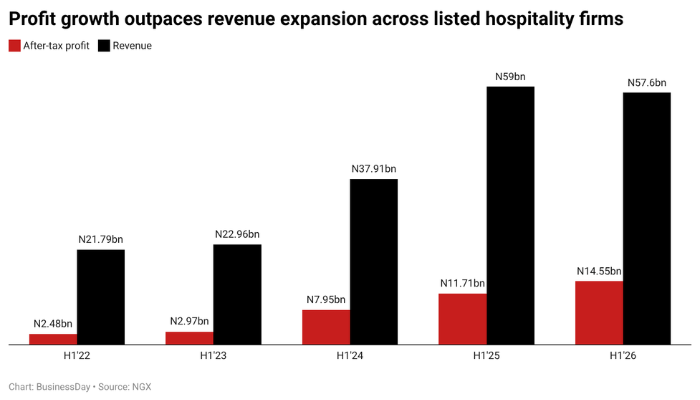
Profit growth outpaces revenue expansion
Transcorp Hotels remained the industry’s earnings leader after reporting N10.54 billion profit after tax for the six months ended June 2026, representing a 21.4 percent increase from N8.68 billion recorded in the corresponding period of 2025. Profit before tax rose to N13.69 billion from N12.23 billion, while operating profit climbed to N14.76 billion from N13.75 billion.
Interestingly, the earnings growth came despite revenue declining marginally to N44.43 billion from N46.93 billion, as food and beverages, events, and conferences reported a decline in sales.
Despite the decline, management extracted greater value from operations through tighter cost controls and improved operational efficiency.
Cost of sales fell by eight percent to N10.45 billion, while operating expenses declined to N19.35 billion from N22.19 billion, helping cushion the impact of significantly higher finance costs arising from new borrowings. Finance costs increased to N3.06 billion from N1.84 billion, yet stronger operating efficiency enabled the company to preserve profitability.
Ikeja Hotel, owner of the Sheraton Lagos Hotel, also delivered an impressive performance.
Revenue rose by 9.2 percent to N13.25 billion, while profit after tax surged by more than 30 percent to N4.06 billion, compared with N3.11 billion in the first half of 2025. Profit before tax increased to N6.12 billion from N4.67 billion, supported by stronger finance income and improved operating margins.
The figures suggest Nigeria’s premium hospitality market has retained considerable pricing power even as inflation continues to erode consumer purchasing power.
According to the National Bureau of Statistics (NBS), Nigeria’s inflation declined to 15.91 percent in June, compared to 15.93 percent in May. However, in Africa’s most populous country, inflation remains high compared to Kenya’s 6.4 percent and South Africa’s five percent inflation.
Hotels demonstrate pricing power
The sector is also benefiting from one competitive advantage unavailable to most manufacturers: the ability to adjust prices almost immediately. Hotels can reprice room rates daily depending on demand, seasonality, and occupancy levels.
Conference charges, banquet services, restaurants, event halls, and recreational facilities can also be repriced without lengthy production cycles or inventory replacement challenges.
Manufacturers, by contrast, often delay price increases because of distribution contracts, retailer negotiations, and competitive pressures. This pricing flexibility helps explain why hospitality companies continue expanding margins despite elevated operating costs.
According to the hospitality firms’ performance, room service dominated over 50 percent of their combined revenue for the first half of the year, followed by food and beverage, which dominated 25 percent, and events and conferences, 2 percent.
Collectively, Transcorp Hotels and Ikeja Hotels reported over N57 billion in turnover for the period under review, as consumer patronage rises.
The 2025 Nigeria real estate report by Ubosi Eleh & Co. further disclosed that the Lagos market has over 3300 hotels with estimated room availability at about 70,000 rooms. The international brand and brand-name hotels enjoy greater patronage in every way.
It said, “The BON Hotels group, which has 10 operational BON hotels in Nigeria, intends to open another 22 hotels and residences in the next few years. Immediate locations include Kano, Ibadan, Warri, Asaba, and Port Harcourt.
“In examining the outlook for the hospitality industry, we have also noted the impact of short lets, like Airbnb, on the hospitality industry in major cities like Lagos, Ibadan, and Abuja. These cities are home to thousands of short lets with prices going as high as N600,000.00 per night in places like Ikoyi and Victoria Island in Lagos.”
In a recent notice, Transcorp Hotels disclosed that it continues to strengthen its portfolio of iconic assets.
Adding that, “Transcorp Hilton Abuja remains one of the company’s flagship properties, while Transcorp Centre, one of West Africa’s largest purpose-built event and conference venues, is fast becoming a landmark for business, tourism, and world-class events in Nigeria. Since its launch, the venue has hosted several landmark gatherings, further cementing its position as a premier venue for high-profile corporate and social gatherings.”
Strong balance sheets support expansion
Both companies also entered the second half of the year with relatively healthy liquidity positions.
Transcorp Hotels increased cash and bank balances to N17.44 billion, while total assets expanded to N197.48 billion from N159.91 billion at year-end 2025. The company secured additional borrowings during the period to support ongoing investments, with non-current borrowings increasing significantly, reflecting expansion financing rather than operational distress.
Ikeja Hotel strengthened its cash position to N36.80 billion, one of the strongest liquidity profiles among listed hospitality companies, while total assets rose to N82.16 billion. Capital work-in-progress also more than tripled, suggesting continued investment in upgrading facilities and expanding operational capacity.
The balance-sheet improvements indicate that operators remain confident about future demand rather than merely managing through short-term economic challenges.
A bright spot in Nigeria’s services economy
The hospitality industry’s resilience mirrors broader strength across Nigeria’s services sector.
Data from Nigeria’s gross domestic product disclosed that the services sector recorded a growth of 4.31 percent in the first quarter of 2026 from 4.33 percent in the same quarter of 2025.
In terms of share of the GDP, the services sector contributed more to the aggregate GDP in the first quarter of 2026 at 57.73 percent compared to the corresponding quarter of 2025 at 57.5 percent. Hotels occupy a unique position within this ecosystem because they function as an economic barometer.
When companies reduce travel, delay investments, and cancel conferences, hotels typically feel the effects almost immediately. Services have increasingly become the country’s primary growth engine as financial services, telecommunications, technology, transportation, and professional services outperform agriculture and manufacturing.
Hotels occupy a unique position within this ecosystem because they function as an economic barometer.
According to reports, Nigerian companies spend billions of naira on travel and lodging, with major firms on the Nigerian Exchange (NGX) crossing N170 billion and top commercial banks alone spending nearly N100 billion in the first nine months of 2024.
However, the industry’s outlook is nevertheless not without challenges. Higher financing costs remain a concern, particularly for operators undertaking large capital projects. Transcorp Hotels’ finance costs rose sharply during the period, highlighting the impact of elevated borrowing costs on expansion programmes.
Energy costs also remain volatile, with hotels among Nigeria’s largest commercial consumers of electricity and diesel due to round-the-clock operations. Security concerns, exchange-rate volatility, and inflation continue to influence travel decisions, particularly among international visitors. Competition is also intensifying as international hotel brands deepen their presence across Lagos, Abuja, and emerging commercial centres.

Join BusinessDay whatsapp Channel, to stay up to date
Open In Whatsapp