…Operating cash flows have surged across sectors, revealing the corporate side of Nigeria’s economic adjustment.

Three years after President Bola Tinubu launched the most ambitious economic reforms in decades, the balance sheets of Nigeria’s largest listed companies show that corporate cash generation has surged far faster than profits.

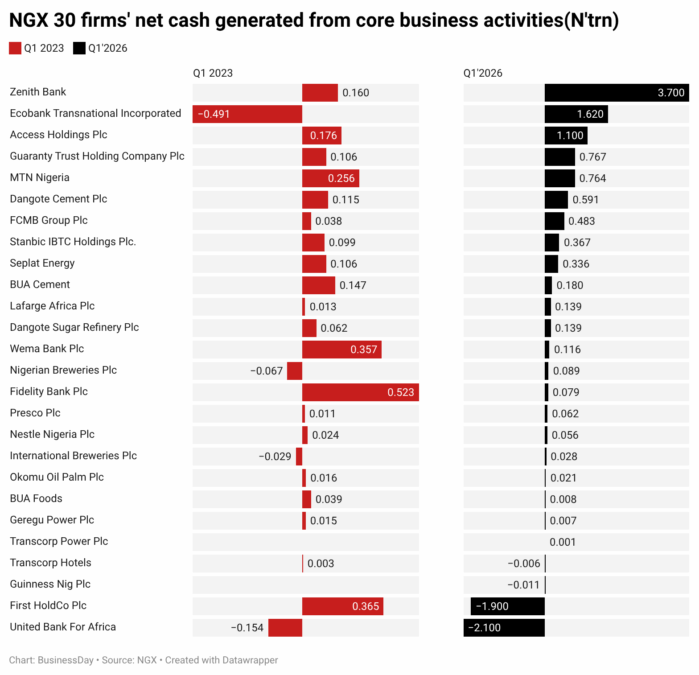
An analysis of 27 companies listed on the Nigerian Exchange shows that aggregate operating cash flows among many of the country’s biggest firms rose to N6.6 trillion in the first quarter (Q1) of 2026, a 247 percent increase from N1.9 trillion reported in Q1 2023, the last comparable quarter before the reforms took effect in May of that year.

In profit, these firms reported N3.08 trillion in Q1’26, compared to N1.16 trillion in Q1’23, representing a 165 percent rise.

The firms surveyed include Dangote Cement Plc, BUA Foods, MTN Nigeria, BUA Cement, Seplat Energy, Lafarge Africa Plc, Zenith Bank, Guaranty Trust Holding Company Plc, First HoldCo Plc, Geregu Power Plc, Presco Plc, Stanbic IBTC Holdings Plc, Nigerian Breweries Plc, Nestle Nigeria Plc, Transcorp Hotels Plc, and International Breweries Plc.

Others include United Bank for Africa, Transcorp Power Plc, Ecobank Transnational Incorporated, Okomu Oil Palm Plc, Access Holdings Plc, Fidelity Bank Plc, Wema Bank Plc, Dangote Sugar Refinery Plc, Unilever Nigeria Plc, Guinness Nig Plc, and FCMB Group Plc.

The improvement comes despite an economy that has experienced steep currency depreciation, persistent inflation, and sharply higher borrowing costs since 2023. The contrast highlights one of the most important economic realities of the reform era: while households have faced a significant squeeze in purchasing power, many large corporations have emerged with stronger cash-generating capacity.

For investors, that distinction matters.

Profits can be influenced by accounting treatments, exchange-rate gains, fair-value adjustments, and other non-cash items. Operating cash flow is harder to manipulate because it reflects actual cash generated from business operations. For investors, stronger cash generation matters because it improves a company’s ability to pay dividends, service debt, and fund future expansion.

Read also: Here are 30 companies employing the most workers in Africa

The numbers suggest that many of Nigeria’s largest firms are emerging from the reform era with stronger cash positions than they had before the policy changes began.

The reforms that shaped corporates in  Nigeria

The most significant reforms introduced by the Tinubu administration were the removal of fuel subsidies and the unification of the foreign exchange market in 2023. These were later complemented by tighter monetary policy, tax reforms, electricity tariff adjustments, and efforts to improve fiscal revenues.

The reforms initially triggered severe disruptions.

According to the National Bureau of Statistics (NBS), the national average retail price for Premium Motor Spirit (petrol) across Nigeria was N264.29 per litre before subsidy removal to N1,288.54 in March 2026

Logistics costs surged, production expenses increased, and the naira depreciated from around N460/$ in early 2023 to above N1,500/$ by the first quarter of 2026. Following exchange-rate liberalisation.

On the other hand, inflation accelerated to a decade high of 22.04 percent in March 2023, forcing companies to reprice products repeatedly.

Yet the same reforms also eliminated several distortions that had constrained businesses for years.

According to Muda Yusuf, chief executive officer of the Centre for the Promotion of Private Enterprise (CPPE), the first three years of President Bola Tinubu’s administration were largely focused on restoring macroeconomic stability after inheriting significant fiscal, monetary, and foreign exchange challenges, noting that the benefits of the reforms have yet to translate into broad-based welfare gains.

He said fiscal conditions were also strained by entrenched Ways and Means financing and a fuel subsidy regime that had become a major source of fiscal leakages and economic distortions.

Yusuf identified fuel subsidy removal and exchange rate unification as the two major reforms underpinning the administration’s economic stabilisation agenda.

However, he noted that both reforms came with significant adjustment costs. “The immediate consequence of the reforms was a significant inflationary shock. Energy prices surged, transportation and logistics costs escalated, production expenses increased sharply, and the depreciation of the naira amplified imported inflation pressures,” Yusuf said.

Read also: Here are ten listed companies with the highest unclaimed dividends in 2025

According to him, the reforms contributed to declining real incomes, worsening poverty conditions, and a cost-of-living crisis. Despite the challenges, Yusuf said there was evidence of macroeconomic recovery.

He stated that external reserves had improved significantly, gross reserves were approaching $50 billion, the balance of trade remained in surplus, investor confidence had strengthened, and exchange rate volatility had moderated since 2025.

Why cash is growing faster than profits
The surge in operating cash flow reflects more than higher sales. It reveals how Nigeria’s largest companies have adapted to the reform environment.

Firms with strong market positions have been able to pass rising costs to consumers through higher prices. Banks benefited from elevated interest rates and stronger treasury income. Export-oriented companies and firms with dollar-linked revenues gained from currency depreciation, while several businesses improved working-capital management after years of foreign-exchange shortages.

The result is that cash generation has grown faster than accounting profits. Across many sectors, the reforms created short-term pain for consumers but improved liquidity conditions for dominant corporations.

Cement giants emerge as major winners

No sector illustrates the transformation better than cement.

In Q1 2023, Dangote Cement generated N115 billion in net operating cash flow. Three years later, the figure has jumped to N591 billion.

The increase of more than 413 percent significantly outpaced profit growth over the same period.

The company has benefited from stronger pricing power, higher selling prices, and the ability to pass rising costs to consumers. Revenue rose from N406 billion in Q1 2023 to N1.19 trillion in Q1 2026, while profit surged by 194 percent.

Even more impressive is the fact that operating cash flow exceeded profit by N270 billion in Q1 2026, indicating that earnings are being converted into real liquidity.

Read also: Companies seeking new tax incentives face multi-agency approval process

Lafarge Africa recorded an even more dramatic turnaround.

The company generated just N13 billion in net operating cash flow in Q1 2023. By Q1 2026, that figure had increased to N139 billion despite periods of negative cash flow in between.

BUA Cement also recorded stronger cash generation relative to its pre-reform position. Net operating cash flow increased from N147 billion in Q1 2023 to N180 billion in Q1 2026, while profit surged by 2578 percent to N176 billion in Q1 2026.

The performance of the cement producers illustrates a broader trend across the economy. Companies with strong pricing power have largely been able to pass rising energy, logistics, and production costs to consumers, protecting margins and strengthening cash generation despite a difficult operating environment.

MTN becomes one of Nigeria’s largest cash machines

Among non-financial companies, MTN Nigeria stands out as the biggest beneficiary of the reform environment.

The telecommunications giant generated N256 billion in its net operating cash flow in Q1 2023. By Q1 2026, that figure had risen to N764 billion.

The company added more than N500 billion in additional operating cash generation within three years.

Revenue rose from N568 billion in Q1 2023 to N1.49 trillion in Q1 2026, while profit increased from a loss-making position in parts of the reform period to N356 billion.

Telecom operators have benefited from rising data consumption, tariff adjustments, and a business model that allows rapid conversion of revenues into cash.

Unlike many manufacturing companies, MTN carries relatively low inventory risk, enabling stronger cash conversion.

Banks show the biggest cash-flow explosion

The most dramatic gains occurred within the banking sector.

GTCO generated N106 billion in operating cash flow in Q1 2023. By Q1 2026, the figure had risen to N767 billion.

Zenith Bank’s net operating cash flow rose from N160 billion in Q1 2023 to N3.7 trillion in Q1 2026.

Ecobank moved from a negative operating cash flow of N491 billion in Q1 2023 to a positive N1.62 trillion in Q1 2026.

Stanbic IBTC improved from N99 billion to N367 billion. FCMB grew from N38 billion to N483 billion.

The trend reflects how higher interest rates, foreign exchange market reforms and stronger treasury operations have transformed the earnings capacity of banks.

The banking sector may be the clearest corporate beneficiary of the reform cycle. Elevated interest rates boosted yields on government securities, while exchange-rate liberalisation created new trading and treasury opportunities. Together, these factors helped drive a surge in sector-wide liquidity.

The floating exchange rate created new trading opportunities while higher yields boosted interest income. At the same time, deposit growth expanded liquidity across the sector.

However, the gains were not universal.

UBA moved from a negative N154 billion operating cash flow in Q1 2023 to a deeper negative N2.1 trillion in Q1 2026 despite generating N146 billion in profit.

First HoldCo generated a positive operating cash flow of N365 billion in Q1 2023 but reported a negative N1.9 trillion in Q1 2026.

Access Holdings recorded positive operating cash flow growth from N176 billion in Q1 2023 to N1.1 trillion in 2026, although the figure was lower than the N3.1 trillion achieved in 2025.

These divergences highlight the complex nature of cash flow measurement in banks, where customer deposits and funding movements can create large fluctuations.

Agribusiness quietly thrives

One of the less discussed winners of the reform era is agribusiness.

Presco generated only N11 billion in operating cash flow in Q1 2023. By Q1 2026, operating cash flow had risen to N62 billion.

Okomu Oil Palm increased cash generation from N16 billion to N21 billion over the same period.

The depreciation of the naira made imported edible oils more expensive, increasing demand for locally produced alternatives and improving margins for domestic producers.

These companies have benefited from a policy environment that increasingly rewards local production over imports.

Consumer firms recover after initial pain
The consumer goods sector endured some of the harshest impacts of the reforms.

Higher transport costs, weaker consumer purchasing power, and rising production expenses squeezed margins across the industry.

However, recent numbers indicate that some companies are beginning to recover.

Nigerian Breweries moved from a negative operating cash flow of N67 billion in Q1 2023 to positive N89 billion in Q1 2026.

International Breweries improved from negative N29 billion to positive N28 billion.

Dangote Sugar increased net operating cash flow from N62 billion to N139 billion while returning to profitability after posting losses in 2025.

The recovery suggests that firms are gradually adjusting pricing structures and restoring operational efficiency after absorbing the initial shocks of reform.

Yet the reform story is not one of universal corporate success. The ability to convert economic disruption into stronger cash generation has varied significantly across sectors and business models.

Not everyone benefited

The reforms have not produced universal winners.

BUA Foods generated N39 billion in operating cash flow in Q1 2023 but only N8 billion in Q1 2026 despite reporting higher profits.

Nestlé Nigeria saw operating cash flow increase from N24 billion to N56 billion over the three-year period, but performance weakened relative to the stronger gains recorded elsewhere.

Transcorp Power experienced a decline from N16 billion in Q1 2025 to N1 billion in Q1 2026.

These examples highlight the continuing pressure of high financing costs, elevated working capital requirements, and weaker consumer demand.

The mixed performance reflects the uneven impact of the reforms. Companies with strong pricing power, dominant market positions, or access to dollar-linked revenues generally strengthened cash generation. Firms exposed to weak consumer demand, higher financing costs, or rising working-capital requirements faced a more difficult adjustment.

More from our Market Intelligence Column

Chinwe Michael is a financial inclusion advocate and economy journalist who uses compelling storytelling to drive awareness. With a background in Banking and Finance and experience across accounting, media, and education, she applies sharp analysis and attention to detail to every piece. She simplifies complex financial and economy concepts into engaging content for Africa and global audience. Chinwe also doubles as a speaker with global recognition for her expertise.

Join BusinessDay whatsapp Channel, to stay up to date

Open In Whatsapp