Across Nigeria, health care workers responsible for keeping hospitals, clinics, maternity wards, laboratories, and emergency units operational are doing so under increasingly challenging circumstances. Poor welfare, repeated labour disputes, chronic shortages, and rising insecurity all highlight a fragile reality in many areas, where caring for patients now also involves facing personal danger.
The warning signs have been clear for months. The Joint Health Sector Unions (JOHESU) strike, which began on 15 November 2025 and lasted 84 days, disrupted public health services across the country before it was suspended in February 2026. Resident doctors also repeatedly considered industrial action, including another nationwide strike notice in April 2026, before suspending it following government engagement.
This matters because it shows that Nigeria is not facing an isolated labour dispute. It reflects a persistent failure to provide safe, fair, and workable conditions for health care workers. When government hospitals are disrupted or stretched beyond capacity, routine consultations, diagnostics, surgeries, drug refills, antenatal care, and emergency treatment all become less reliable.
Health worker shortages make childbirth and emergency care unsafe
These disruptions are especially dangerous in Nigeria where maternal deaths remain high and large gaps in care persist across both infectious and non-communicable diseases. The maternal health implications alone should force urgent action. Recent estimates indicate Nigeria’s maternal mortality ratio was 993 deaths per 100,000 live births in 2023, while the global target under the Sustainable Development Goals is fewer than 70 by 2030.
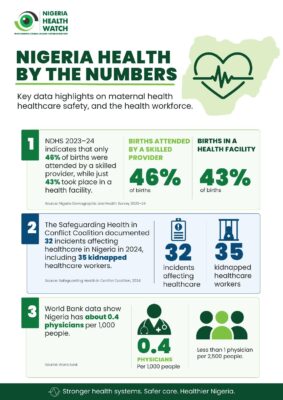
The Nigeria Demographic and Health Survey (NDHS) 2023–24 indicates that only 46% of births were attended by a skilled provider and just 43% took place in a health facility. In that context, disruptions in staffing, referral, emergency obstetric care, blood access, and post-partum management are not minor system inefficiencies. They represent failures that can be a matter of life and death.
Yet the crisis facing health care workers is about pay, and also about their safety. Nigeria’s National Policy on Health Workforce Migration recognises the safety of health care workers as a key concern. It emphasises the need for safer working conditions, protective equipment, health insurance, regular health checks, psychosocial support, cooperation with security agencies, emergency response systems, and the elimination and criminalisation of violence against health care workers.
Weak protection for health workers is worsening Nigeria’s care crisis
The National Policy on Health Workforce Migration is in place; what remains weak is its implementation. That implementation gap is becoming increasingly dangerous. In January 2026, the Nigerian Medical Association in Edo raised an alarm after the abduction of two doctors. The Safeguarding Health in Conflict Coalition documented 32 incidents affecting healthcare in Nigeria in 2024, including 35 kidnapped health care workers.
The reports show that health care workers were abducted from health facilities while travelling to remote outreach sites and in public spaces, causing some community health services to become inoperable for long periods. When health care workers are unsafe, patients face the consequences. Even when facilities stay open, staff may avoid high-risk shifts, refuse remote assignments, or leave the public system entirely.
World Bank data show that Nigeria has about 0.4 physicians per 1,000 people. The World Health Organization (WHO) continues to classify Nigeria among those experiencing severe workforce pressures. The problem is not just a shortage of doctors; it is a combined shortage and an uneven distribution of doctors, nurses, and midwives, worsened by migration, poor incentives, weak retention, and difficult working conditions.
Nigeria must retain, protect, and properly support the workforce it depends on
Nigeria has policies, but it requires more consistent implementation.
One: – Welfare agreements should be reliably implemented, not only after prolonged strikes.
Two: – Staff safety must be incorporated into service planning, particularly in high-risk zones.
Three: – Governments should invest in secure transport arrangements, improve facility-level risk assessments, and establish rapid response systems where workers face threats.
Four: – Rural retention packages should include more than salary alone. Housing, supervision, career development, and security are also important.
The Midwives Service Scheme showed that sending workers to underserved areas can improve access, particularly for antenatal care. However, better results depend on the broader system supporting those workers, including referral networks, emergency transport, accommodation, supplies, and compensation.
Recently, the Federal Government announced initiatives to strengthen the capacity of nursing and midwifery training. While these initiatives are positive, training more workers alone without providing retention and support will not solve the problem. For too long, Nigeria’s health system has depended on health care workers’ commitment to compensate for poor implementation and repeated neglect.
A health system cannot be considered functional when those expected to sustain it are underpaid, unprotected, and increasingly unsafe. Protecting health care workers is central to safeguarding patients. It is one of the clearest tests of whether Nigeria is truly committed to universal health coverage.
Oko and Dr. Ekeh write from Abuja

Join BusinessDay whatsapp Channel, to stay up to date
Open In Whatsapp