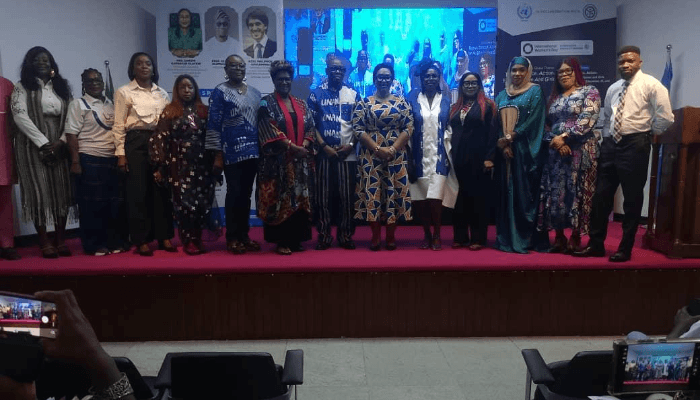
The United Nations Association of Nigeria (UNA-Nigeria) has highlighted the importance of empowering women and girls through digital education, artificial intelligence, and health equity.
UNA-Nigeria emphasised this at a one- day forum it hosted with the Nigeria Institute of International Affairs in Lagos to mark the 2026 International Women’s Day (IWD).
Speaking at the event, which held under the theme, “Rights. Justice. Action: Empowering women and girls through digital education, Al, and health equity,” president of UNA-Nigeria, Oluremi Olutimo affirmed that digital innovation and technology can bridge gender gaps, enhance access to opportunities, and promote women’s rights.
Olutimo who is a professor said: “We inhabit a period marked by swift technological progress, where digital education and artificial intelligence are reshaping the modalities of learning, labor, and healthcare access.
“Nonetheless, substantial segments of women and girls still encounter significant barriers to these emerging opportunities. This situation necessitates not only reflection but also tangible intervention.”
Stating that the theme of the event, encapsulates a clear commitment, he added that the notion of rights underscores the imperative that all women and girls should have equitable access to education, technology, and healthcare.
To him, justice calls for addressing and dismantling systemic obstacles that impede inclusion and equity.
Explaining further the professor added: “Action highlights the need to transition from discourse to deliberate and measurable initiatives that foster enduring improvement.’’
He regretted that despite notable progress worldwide, gender-based disparities persist in access to education, digital resources, healthcare, and positions of influence.
“Such inequalities constrain opportunities and impede holistic, inclusive development.
“The triad (Rights, Justice, Action) reflects an integrated commitment. Rights affirm the essential entitlements of women and girls to education, health, safety, and societal participation. Justice demands fair systems and structures, ensuring that policies, technologies, and institutions actively address and rectify gender-based disparities. Action signifies the necessity of moving beyond rhetoric to the implementation of practical, sustainable measures.
“Digital education serves a transformative function by equipping women and girls with
competencies essential for engaging fully in contemporary economic and social spheres.
“Concurrently, artificial intelligence presents a nuanced landscape of potential benefits and challenges. When inclusively designed, Al can enhance access to information, healthcare, and economic prospects; yet, if inadequately regulated, it risks perpetuating existing biases and exacerbating inequalities’’.
In his goodwill message, Secretary General of the World Federation of United Nations Associations, Aziel Philippos Goulanddris commended UNA-Nigeria, saying that the forum would positively impact the lives of women and girls in Nigeria.
Speaking earlier, the Permanent Secretary, Office of Sustainable Development Goals, (SDGs), Kaphaya Olayemi, stated that empowerment must go beyond rhetoric to actionable commitments that improve lives.
Olayemi, described gender equality as “the unfinished business of our time,” warning that persistent social and structural barriers continue to hinder progress.
Enumerating key pillars necessary for advancing women’s rights, she said they including; legal protection, access to justice, economic inclusion, and institutional reforms.
To her, rights must not remain theoretical but must be reflected in everyday realities.
“Rights must not only exist on paper but must be experienced in the daily lives of women and girls,” she said.
She highlighted several initiatives by the Lagos State Government aimed at bridging gender gaps, particularly in the digital economy.
These according to her include; programmes designed to improve women’s access to financial services, digital tools, vocational training, and entrepreneurship support.
She also noted efforts such as skills acquisition centres under the Ministry of Women Affairs and Poverty Alleviation, digital literacy training for women, and financial inclusion partnerships with fintech firms to expand access to banking services among grassroots women.
On her part, former Executive Director of the Nigerian Network of NGOs, Yemisi Kuti, challenged women to take greater responsibility as drivers of societal transformation, stressing that empowerment must begin from the home through deliberate efforts to raise a generation grounded in values of respect, equity, and self-reliance.
Kuti, urged mothers and families to intentionally raise boys and girls with a strong sense of justice and mutual respect, noting that women are not victims but central actors in human development.
“Equipping children with life skills, ethical values, and a culture of shared responsibility is critical to achieving the Sustainable Development Goals,” she said.
Also speaking at the event, Chika Nwaozuzu, called for urgent collaboration among governments, institutions, and individuals to bridge the digital divide and promote inclusive participation in artificial intelligence and health systems.
Nwaozuzu, emphasised that while technology continues to shape the future, many people remain excluded, stressing the need for deliberate policies that ensure no one is left behind.
High point of the forum was a panel discussion on the theme of the event.

Join BusinessDay whatsapp Channel, to stay up to date
Open In Whatsapp