As fashion contents are largely experimental, designer Tobechukwu Asikoko expands contemporary design with travel and indigenous narratives.
With designs full of youthful energies, Asikoko brings his native identity of southeastern Nigeria into global trend. In some of his designs, the edible value of kolanut, as an essential part of the designer’s native home, comes as an asset in celebrating creativity.
Critical view of Asikoko’s fashion pieces on display may generate debate about content application complexity. However, his approach to haute couture comes with shades of tastes that attempt to load so much into every piece. For some creative professionals, particularly fashion designers, the simpler, the better. In Asikoko’s designs, the creative strength seems to be in combined aesthetics and critical complexity.
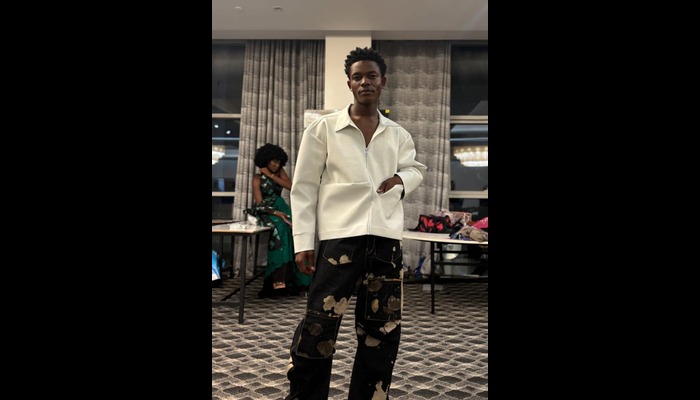
In a two-piece design of white leather jacket and bleached black denim trouser, Asikoko creates a complex moment as the top wear comes with multiple pocket compartments. As a contemporary design, the pockets in the jacket include faux and ‘hidden’ ones for convenience mobility, especially for personal effects. Whoever chooses fashion simplicity may not go for such compartments of pockets.
And in aesthetic expression, the denim pants benefit from asymmetrical designing with the placement of the cargo pockets in front of it. This much marks Asikoko’s identity in creating both functional and aesthetics importance of design.
Tobe Asikoko, as the fashion line is known, seems to thrive in an uncommon approach to fashion tastes, while the works on display appear populist. Perhaps a more objective view of the works suggests the colour nods of elegance of which the Asikoko brand represents. Quite a number of his designs take the narrative of colour application through the relativity realm.
For the two-piece leather jacket and trouser, Asikoko seems to engage the denim pants in bleached tone to represent the rottenness and actual shape of kolanut. Carving the shape of the kolanut by using a stenciling process, the design is bleached in solution onto the denim.
Further connecting the kolanut factor into the theme of the two-piece is the travel part. For the people of southeastern Nigeria, kolanut is always a major item in welcoming guests or visitors. Asikoko’s two-piece, interestingly, is also inspired by travel and tour subjects.
Capturing the beauty and challenges of traveling, Asikoko leverages on the trouser’s aesthetics of unfinished hem, depicting exhaustiveness as part of travel. And when travel comes with its excitement, the savouring appears endless, with fantasy, so the denim pants explain.
Still on appropriating kolanuts for fashion, Asikoko extends the novelty to another two-piece. Unlike the previous pieces with white top and denim pants, the next one comes in black leather jacket, and matching shorts.
The designer’s kolanuts narrative seems more layered on the all leather jacket and shorts. Here, the actual kolanut is physically applied from cut outs of its fractals with etchings of lines and shapes abstracted from the lines on the nut.
Asikoko, again, brings the travel factor into conceptualising with the sleeves of the jacket, being held together by buttonsnot form detachable, but shortened. The composite of patterns generated for the wear represent choices and preferences for travelers and tourists.
Fashion makes little sense without the human convenience factor as the short comes with multiple pocket layers, including faux and hidden ones to eliminate whatever heat the leather material generates. Also, the short keys into the travel narrative with patterns nodding to abstractions of map routes.
The travel theme of Asikoko’s focus extended to Gambia International Fashion Week 2025, where he showed collections titled Unity and Movements. At the Gambia show, the collection captured travel subjects such as maps, flight routes, British tea culture, Gambian Attaya, and Nigerian (West Africa) Kolanut.
UK-based fashion designer, Tobe Asikoko started his design line in 2019 before leaving Nigeria. In the UK, he obtained a Masters Degree in Design with Advanced Practice at Teesside University in Middlesbrough, where he created several fashion projects. Among his works are hosting Fashion Spayce, a fashion programme on Tuxtra, Teesside University’s online radio station.

Join BusinessDay whatsapp Channel, to stay up to date
Open In Whatsapp