The Think Art Festival held its fifth edition of art competition in December 2025, themed ‘Reflection,’ with Success Chris Abah emerging as the first-prize winner. The festival is an annual show that began in 2021 as the first-ever virtual art contest in Abuja. The maiden edition attracted over 65 entries from 12 schools, and the competition has since become a creative hub for emerging student artists, transforming into what the organisers describe as a “borderless canvas”. Reflection, the theme for 2025 edition, explored the concept of reflection as a metaphor, beyond its literal sense. Acting as an invisible engine for the exhibition, the theme was not merely a call for symmetry, but an invitation for artists to tell stories of “struggle and triumph”, resulting in diverse interpretations from the participants.
Founded in 2021 by Armstrong Agoreyo with a vision to make creativity accessible across borders, Think Art Festival virtual art competition, which is open to children between the ages of 7 and 17 from public and private schools in Nigeria and the United Kingdom has become an international nurturing ground for young talents in primary and secondary schools. Consequently, “Reflections: Sharing Our Journey”—the 2025 curatorial vision, focused on easing up the financial and geographical barriers that often militate against talent and opportunity.
Seeing this competition from the perspective of Social Constructivism, gives one a deeper insight into the significance of this festival, particularly the idea that a child’s creative development is deeply tied to their social environment and the opportunities provided for “scaffolding” their talent. The Think Art Festival operates as a “Zone of Proximal Development,” where the transition from a “small school competition” to a global platform allows students to reach heights they could not attain in isolation. By providing a structured theme like “Reflection,” the festival encourages a phenomenological approach—asking children to describe the “essence” of their lived experience and their perceived future. This isn’t just art for art’s sake; it is an exercise in identity formation and cognitive mapping.
The entries for 2025 were evaluated against a high standard by a panel of jurors who bridge the gap between academic rigour and modern practice. Emmanuel Chinonso Brendan, an Abstralism painter from the University of Benin, brought to bear a decade of studio experience as an academic. Meanwhile, Baraka Carberry, a UK-based multidisciplinary artist whose work interrogates diversity through bold patterns and floral representations, complemented this by bringing the perspective of a full-time studio artist to the table. Guided by the objective of the competition, the jurors deployed their critical expertise to select winning works that align with the organisers’ formal and conceptual understanding of the theme ‘Reflection’ and its resonance with a diverse audience.”
The winners of the competition interpreted “Reflection” from different perspectives. For instance, Grace Sonoola, who clinched the bronze award, painted a vibrant blue and green landscape that captures the mirror image of a mountainous shoreline on cerulean water, to explore the duality of the actual and mirrored realms. The Silver Award was granted to Damilare Michael for the acrylic painting Blossom into a New Arisen, which took a socio-political turn. By depicting children planting a tree that transforms into a majestic city-in-bloom, Michael reflected on a vision of Nigeria thriving through peace and collective growth. The use of strawboard added an organic texture that grounded this vision of national renewal in authenticity.
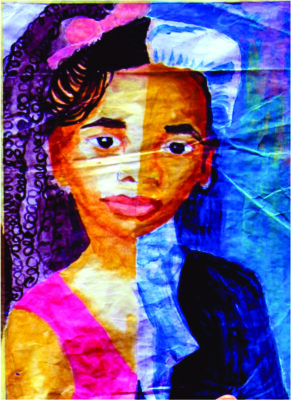
However, the heart of the 2025 festival lies in the story of the Gold Award winner, 10-year-old Success Chris Abah. Her winning painting redefined reflection as a “thought process” rather than a visual phenomenon. “To me, reflection is not just how we see ourselves,” Abah explains. “It is a thought process that helps one to become fully aware of themselves… what we want to become, our environment, and every other factor that affects our existence”. Depicting a girl child split between her present reality and her dream of becoming a lawyer, Abah used the image of a legal wig and coat to show that a girl child is capable of dreaming. In her interview, Abah explained that reflection deepens self-understanding and purpose. She also noted that her journey to the top prize of ₦120,000 was one of diligent preparation —a process that was both challenging and exciting.
From a broader perspective, this festival aligns with the “Democratization of Art” movement. By providing a virtual space to navigate the politics of representation which traditional galleries often deploy in their selection to exclude unknown artists, Think Art serves as a disruptive force that breaks through this barrier to foster elite talent in emerging markets. This echoes recent disruptions in the global artworld occasioned by a shift in geopolitics, which has afforded the Global South the opportunity to contribute in shaping contemporary art discourse.
This shift has implications for the competition. According to the top prize winner, for instance, “My dream is to become a lawyer. But I can build a side business/career with my art” —an assertion that underscores the idea of collapsing discipline boundaries in current scholarship. Furthermore, she stated, “When my mother received the prize money, I heard her say she will use it to pay for my second term school fees. She felt so financially relieved and I felt so happy about it.” This highlights the socioeconomic benefit that aligns with the festival’s idea of creating tangible opportunities. There is also the case of significant contribution by past winners, as epitomised by Nnemeka Enejere, the 2022 winner, whose winning work that explored the idea of sustainable energy, was inspired by the collapse of Nigeria’s national grid at the time. Such instances highlight a critical intersection where art meets survival and social utility.
Ultimately, the Think Art Festival has become a barometer for the collective psyche of the Nigerian youth. It is a space where children “practice drawing to overcome their fears” and learn the value of “showing up for tasks diligently”. By giving young artists a platform to reflect, it helps them to discover their true identity and ability. Consequently, the Think Art Festival is no longer merely an idea; it has evolved into an investment in a child’s vision, symbolising a blueprint for tomorrow’s society.
Kanu, an art historian, critic, and curator, writes from the University of Nigeria, Nsukka.

Join BusinessDay whatsapp Channel, to stay up to date
Open In Whatsapp