The “Olodo Syndrome” is a deep-seated systemic choice to reward short-term appearance over long-term structural integrity. When a society systematically separates rewards from actual performance, mediocrity stops being an accident and becomes a rational survival strategy.
When structure is treated as a scam, individuals stop building for scale and begin optimising for transactional “vibes” and internal extraction. This essay explores the sequential, self-reinforcing downward spiral of this cognitive inversion—from the highest layers of national governance down to the micro-family unit.
Pillar 1: Macro Governance & Financial Stagnation
The structural decay begins at the absolute top, where the fundamental rules of institutional design are explicitly reversed.
a. The Gatekeeping Inversion (Politics vs Labour)
The fundamental rule of any healthy system is that the complexity of a job should dictate the qualifications required to execute it. The current system flips this logic on its head:
- The Public Leadership Standard: Under Sections 131 and 65 of the Nigerian Constitution, managing a multi-trillion Naira economy, crafting complex fiscal policies, and regulating international trade only requires a Senior Secondary School Certificate (SSCE).
- The Youth Labour Market Standard: Meanwhile, a fresh graduate entering the corporate workforce faces brutal corporate filters: entry-level roles routinely demand a maximum age cap of 21–26, a mandatory First Class or Second Class Upper degree, and unearned years of prior experience.
- The Systemic Paradox: The citizens with the least verified competence are structurally empowered to make macro policies that dictate and constrain the lives of the most highly vetted, educated, and qualified professionals.
b. Institutional Banking Failures vs. Value Chain Silos
Because the governing layer lacks deep analytical capacity, the financial system avoids real economic production entirely, favouring risk-free, isolated silos over value-chain integration.
- The Policy Graveyard: For decades, central interventions like the Small and Medium Industries Equity Investment Scheme (SMIEIS)—which mandated banks to set aside 10% of profit before tax for SME equity—and funding models from the Bank of Industry (BOI) failed to bridge the country’s SME financing gap. Traditional commercial banks lock these funds behind impossible physical collateral requirements averaging 180% of the loan value, keeping SME lending at a dismal 1% or less of total bank credit.
- The Corporate Silo Blindspot: Most companies operate like isolated islands, refusing to share data or pool resources. By fiercely guarding small, high-margin corners out of mutual distrust, they completely miss out on blended finance—the strategic use of development capital from DFIs and impact investors to de-risk private investments. Blended finance requires institutional transparency and consortium-building, which siloed operations are too fragmented to attract.
- The Lazy Revenue Model: Instead of building the analytical capacity to de-risk and fund productive local value chains, traditional banks survive on the easiest possible routes: buying risk-free, high-yield Government Treasury Bills (crowding out private sector credit), squeezing retail customers with exorbitant account maintenance fees, and chasing foreign exchange (FX) round-tripping.
- The Agile Fintech Disruption: Where century-old banks saw “unlendable risk,” agile fintech platforms saw a data void. By processing alternative digital footprints, transaction volumes, and micro-merchant behaviour, fintechs captured the massive retail and micro-merchant ecosystem in less than a decade. They proved that the financing gap was never an SME viability issue; it was a structural capacity and laziness problem within traditional banking.
Pillar 2: The Middle-Class Performance & Gullibility Loop
The middle class, which should serve as the intellectual engine and primary oversight of the nation, replicates the performative, low-effort nature of the macro layer, trading financial mobility and critical thinking for emotional signalling and political gullibility.
a. The Performance of Wealth & The Status Trap
While the poorest in society compromise their choices out of immediate survival for food and cash, the highly educated middle class falls into a far deeper trap: they are the easiest to deceive because they falsely believe they are too smart to be manipulated.
- The Premium Illusion: Trapped in a desperate need to signal that they are distinct from the lower class, the elite trade financial mobility for surface-level aesthetics. They will willingly pay a 300% markup to buy frozen, imported fish inside a brightly lit, air-conditioned suburban grocery store grid rather than buying fresh options from the local open market, mistaking convenience for wealth.
- The Geography of Status: They pay exorbitant rents in city hubs they cannot afford, yet a single tuition hike throws them into financial panic because there is zero long-term liquidity or asset planning. They optimise for immediate retail therapy, designer clothes, and vacations while failing to mathematically plan for future structural expenses like college.
b. The Political Gullibility Loop
This vulnerability to performative illusions extends directly into politics, where the middle class consistently prioritises emotional slogans and fairy tales over cold data:
- The 2015 “Change” Fantasy: The middle class voted overwhelmingly for Muhammadu Buhari’s “Change” agenda in 2015, willfully swallowing historical fairy tales when a simple check of economic and track-record precedents showed the math didn’t add up.
- The Rejection of Practical Growth: Conversely, they completely rejected the economic performance metrics of the Olusegun Obasanjo and Atiku Abubakar administration—the most stable and prosperous growth years for the modern Nigerian middle class—simply because they bought into the sweeping, unanalyzed narrative that “PDP is bad.”
- The Messiah Complex vs. Blind Mandates: Today, this same class chases the fantasy of Peter Obi as a standalone messiah, completely ignoring the structural reality that he has failed to keep even a single political party structure unified or stable. At the exact same time, other segments of the middle class blindly chant “On Your Mandate We Shall Stand,” completely oblivious to the reality that Lagos does not work for everyone, and that corporate brilliance or technical smarts do not automatically translate to macro-economic prosperity.
The Generational Case Study
One day, a future generation will dissect our history. Our grandchildren will look back at these exact years in history books, reading a grim case study on self-inflicted structural destruction—a collapse born entirely out of the arrogance of education and performative enlightenment.
c. Professional Ethical Decay (”Vendor-Founder” Sabotage)
When a middle class prioritises looking rich over being rich, they are forced to subsidise their performative lifestyles through internal corporate rot, mistaking parasitic behaviour for sharp business acumen.
- The Parasitic Loop: Under the loud banner of being “shrewd,” “sharp,” or “smart,” professionals running corporate divisions actively undermine the entrepreneurs who hired them. They use their insider access to set up secret shadow vendor companies, awarding supply contracts to themselves at highly inflated rates.
- Bleeding the System: They take kickbacks from external suppliers, compromise on delivery standards, and bleed visionary entrepreneurs blind. They treat this internal theft as a badge of clever survivalism, failing to realise that by killing the host company, they are systematically destroying the very institutional scale that could create real, long-term equity and career mobility for them.
Pillar 3: The Social & Institutional Blindspots
The structural decay is solidified when societal metrics of morality, success, and spiritual alignment are entirely divorced from accountability and truth.
a. Intellectual Submission to Charismatics
The systemic collapse becomes absolute when the most exposed and intellectually sound minds choose to outsource their thinking to completely unaccountable gatekeepers.
- The Inversion of Intellect: Highly educated professionals, corporate executives, and men of immense intellectual standing walk into religious centres to sit and learn from overzealous leaders who operate with borderline extremist rhetoric and zero internal oversight.
- The Regulatory Void: Because society has built zero independent regulatory frameworks, ecclesiastical courts, or charity commission oversight to audit these organisations, these leaders display a profound lack of basic ethical judgment. If they operated under the legal, tax, and compliance frameworks of Western or Asian jurisdictions, a large percentage would face severe prison sentences for financial manipulation. Locally, their lack of structural restraint is shielded by blind devotion.
b. The Historical Taboo Trap (Vices over Taboos)
We have built a hypocritical social fabric that wastes immense intellectual energy policing historical choices while ignoring destructive, active social evils.
- The Historical Reality: The modern middle class is fiercely fixated on enforcing Westernised versions of society building, completely ignoring that the vast majority of our lineage—our fathers, grandfathers, and great-grandfathers—built large, functional, and deeply structured economic units through communal harmony, a sharing economy, and honest, value-based living, leveraging natural herbs and deep spiritual understanding.
- The Misdirected Morality: Rather than examining our history objectively to build a society anchored on radical, transparent truth, we hyper-focus on policing relationship choices. Meanwhile, the truly catastrophic, institutional vices destroying the fabric of the community—rape, sodomy, systemic gender-based violence, and hidden incest—are quietly swept under the rug to maintain the superficial appearance of a moral society.
Pillar 4: The Domestic Inversion
The final collapse happens at the foundational unit level: the family, where domestic pairings actively penalise economic ambition to protect fragile, unearned authority.
a. The Sentimental Family Blueprint
Young professionals are routinely pressured by religious and societal circles to marry purely based on immediate emotional sentiment and reproduce instantly under the unbacked cliché that “every child comes with their own blessings”. There is zero strategic assessment of shared economic capacity, fiscal alignment, or long-term durability.
When the brutal reality of inflation, multi-million Naira tuition fees, and medical bills inevitably hits, the marriage breaks under the financial strain. Lacking the wealth to manage the crisis, individuals resort to an escape mechanism, lazily blaming it on “human nature” or “culture”. Replicating the lifestyle without the capital infrastructure is a design for multi-generational financial ruin.
b. The Suppression of Female Ambition
This domestic structure maintains stability by actively punishing high performance and scaling capacity:
- The Aesthetic Economy: The middle-class performance trap manifests heavily in how women are socialised to trade deep capability for immediate social validation. Society increasingly rewards the appearance of a Brazilian Butt Lift (BBL) over rigorous technical training. Even those women who do not subscribe to plastic surgery often willingly reduce their intellectual capacity in social settings, sitting at tables populated by men, completely disengaged from conversations on business infrastructure while focusing on ordering pasta and champagne instead of asking for a portion of the deal being brokered.
- The Ceiling on Scale: Highly successful, brilliant women who are happily married and thriving are routinely pressured to downsize their companies or suppress their professional ambition. The justification is always the same: “the husband is the head of the house,” meaning the woman’s professional growth must never eclipse the man’s ego.
- The Chaos Loop: By forcing brilliant women to play small, the system structurally ensures that insecure, low-capacity men continue to govern family wealth and macro institutions. The ultimate result of weak, men ruling home and state is the very structural chaos and institutionalised mediocrity we live in today.
- The ‘Ms. versus Mrs.’ Syndrome: Men do not need to share their marital status to be relevant in a room; their currency is often beer, sports, and transactions. It is always interesting to observe how women use marital labels that often diminish their own individuality. In the 16th century, ‘Mr.’ and ‘Mistress’ were reserved for captains of industry; men and women held equal stature. Over time, these meanings shifted.
Even in the scriptural account, the pronouncement regarding a woman’s desire for her man was a consequence of a curse—a punishment. Ever wondered what a true blessing is?
Genesis 3:16
“To the woman he said, “I will surely multiply your pain in childbearing; in pain you shall bring forth children. Your desire shall be for your husband, and he shall rule over you.”
The Master Summary
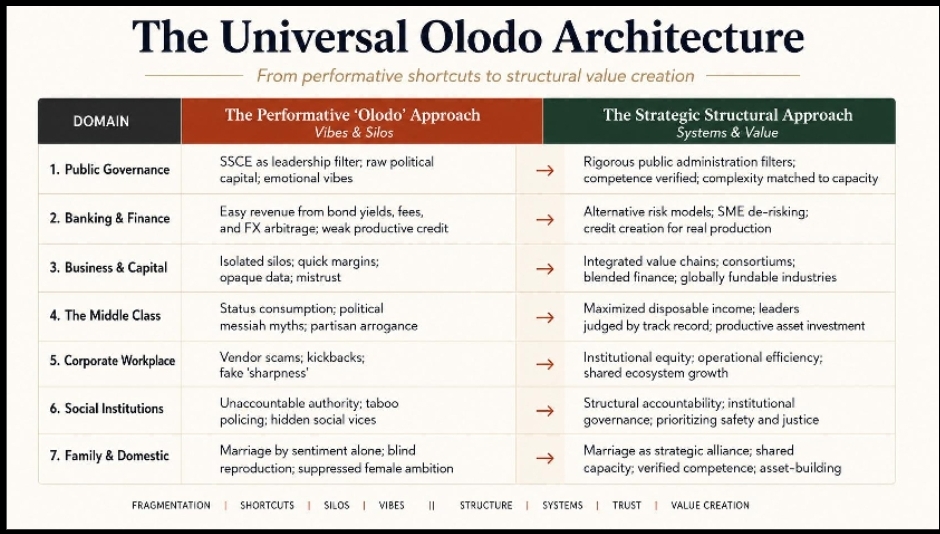
Conclusion: Reclaiming the Legacy of Mastery
What we observe across these sequential layers is evidence of Structural Anomie—a state where a society heavily promotes the signs of success (wealth, luxury apartments, and premium signalling) but completely corrupts or shuts down the legitimate, structured pathways to achieve them. When structure is treated as a scam, the public concludes that depth doesn’t matter, and the middle class becomes content to vibe its way through both the economy and politics.
To break this cycle, we must look past the modern definition of fame and look back at our own history.
When the modern generation hears the name “Peller”, they associate it entirely with a TikTok streamer performing viral, internet stunts for engagement and clicks. And to be fair, he is doing something right with what he has been given and is teaching those not paying attention to the digital economy to see the opportunity in content creation.
But the original legacy of that name, “Peller”, represents the absolute opposite of the Olodo Syndrome.
The true Professor Peller (Moshood Folorunsho Abiola) was a master of absolute dedication and global execution. He did not build his immense wealth and international acclaim on unstructured “vibes” or accidental virality. He traveled to India in 1964, spending 18 months in a rigorous school of magical arts to master the complex physics, mechanics, and psychology of stage illusion. He brought that high-level technical training back to West Africa, performing world-class, deeply calculated acts like the Invisible General and the Escaping Box for global heads of state. He was a master of his craft who treated entertainment as an exact science requiring precision, discipline, and absolute structure.
The transition from celebrating the rigorous, globally trained Professor Peller to glorifying unstructured, chaotic digital noise as the pinnacle of success is the ultimate proof of our cultural shift. A nation, an economy, or a household cannot vibe its way into sustainable development. It is time to return to an era where influence, fame, and wealth are the direct byproducts of mastery, structure, and undeniable competence. – TheGewel Notes, 2026
.Ajiboye, chief curator of 16Stories, is a systems-change practitioner with 25 years’ experience across civic innovation, social impact, and enterprise development, including executive roles at Acumen, Change.org, and Growth Firms Alliance.

Join BusinessDay whatsapp Channel, to stay up to date
Open In Whatsapp