…CBN warns election-related spending may trigger inflation
Long before the Independent National Electoral Commission (INEC) officially fires the starting gun for the 2027 general election, government spending across Nigeria is already beginning to wear the colours of campaign politics.
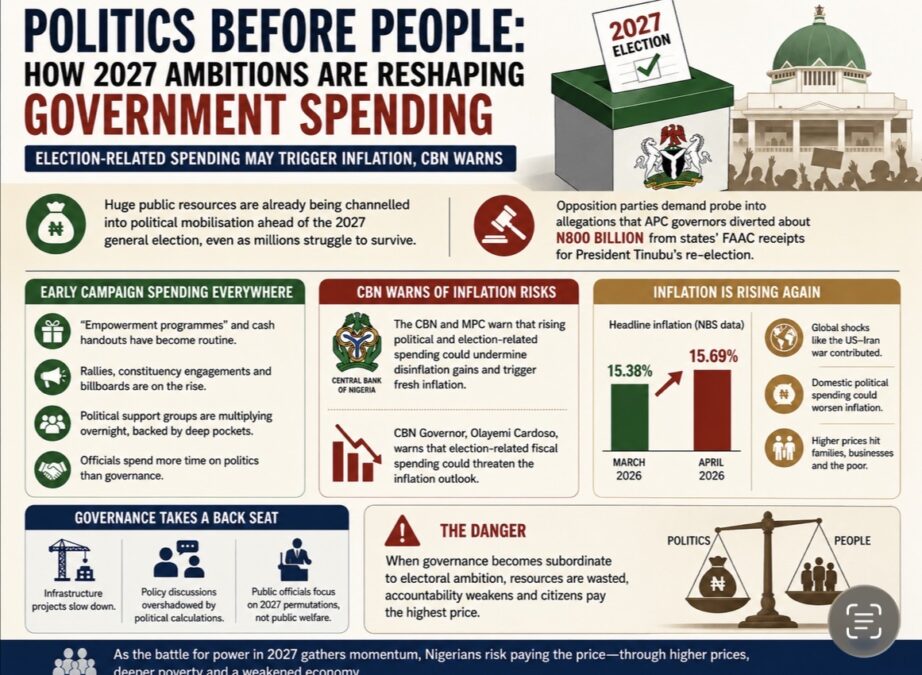
In many states, “empowerment programmes” have suddenly become a weekly ritual. Governors and political office holders now move from one distribution ceremony to another, handing out buses, tricycles, sewing machines, cash grants and food packages to carefully assembled crowds. Local government chairmen are organising rallies disguised as constituency engagements. Billboards bearing the smiling faces of political actors are quietly resurfacing along major highways. Political support groups are multiplying overnight, backed by suspiciously deep pockets.
Behind the public theatre lies a more consequential reality, enormous public resources are gradually being redirected toward political mobilisation ahead of 2027.
At the federal level, the tempo of political consultations has intensified sharply. Ministers, lawmakers and governors are increasingly consumed by coalition meetings, endorsement rallies and strategic alignments. Across the states, government officials who should ordinarily be preoccupied with governance are now investing significant time and resources in securing political relevance before the next election cycle fully opens.
Economic hardship versus political spending
For many Nigerians, the timing is difficult to ignore. The country is battling one of its worst economic crises in decades. Food prices remain high. Energy and transportation costs continue to rise. Millions of households are struggling to survive under declining purchasing power. Yet, while citizens grapple with economic hardship, political spending is accelerating with remarkable speed.
Opposition parties recently heightened public concerns after demanding a probe into allegations that governors elected on the platform of the All Progressives Congress (APC) diverted about N800 billion from their respective states’ Federation Account Allocation Committee (FAAC) receipts for the purpose of President Bola Ahmed Tinubu’s reelection.
Whether or not the allegations are eventually proven, they have reinforced growing fears that public funds are already being deployed toward political objectives several months before the election.
The concern is not merely political; it is economic.
Read also: Disinflation reversal may renew pressure on Nigerian households
Analysts warn that heavy election-related spending often injects massive liquidity into the economy without corresponding productivity growth, creating inflationary pressures that ordinary citizens eventually pay for through higher prices.
CBN raises inflation concerns
That warning is now coming directly from Nigeria’s economic managers.
The Central Bank of Nigeria (CBN) and members of the Monetary Policy Committee have cautioned that rising political and election-related spending ahead of the 2027 general elections could undermine the country’s fragile disinflation gains and trigger fresh inflationary pressures.
The warnings were contained in the personal statements of MPC members released by the apex bank on Thursday. The MPC, at its 304th meeting held on February 23 and 24, 2026, reduced the Monetary Policy Rate by 50 basis points from 27 percent to 26.5 percent, while retaining other key monetary parameters.
The reduction had offered some hope that inflationary pressures were beginning to moderate after months of painful economic adjustments. But officials now fear that political spending may reverse those gains.
Olayemi Cardoso, CBN governor, had earlier warned in the MPC communiqué that election-related fiscal spending could threaten the inflation outlook despite the current moderation in prices.
Muhammad Abdullahi, CBN deputy governor for Economic Policy, also identified election spending as a major risk factor.
He said, “As political activities intensify ahead of the 2027 elections, increased fiscal injections and consumption spending could elevate demand-side inflation.”
Abdullahi added that “the fiscal deficit has already increased significantly, and election-related spending is likely to exacerbate this trend in 2026 and early 2027.”
According to him, stronger fiscal-monetary coordination would be needed to manage the liquidity impact of rising government spending.
A familiar pattern
The warning reflects a pattern Nigerians know too well. Election seasons in Nigeria have historically coincided with aggressive government spending, contract awards, patronage politics and cash-fuelled mobilisation. Politicians often justify such expenditures as social interventions or constituency projects, but economists argue that much of it is driven by electoral calculations rather than genuine development priorities.
The result is usually predictable: more money circulates within the economy, consumer demand rises rapidly, and inflation surges.
For citizens already struggling under economic pressure, the implications are severe.
Inflation, which slowed down considerably in 2025, is already beginning to rise again. According to data released by the National Bureau of Statistics on Friday, headline inflation increased from 15.38 percent in March to 15.69 percent in April.
Analysts partly attributed the increase to disruptions caused by the US-Iran war, which has rattled global economies and affected energy prices worldwide. However, many economists believe domestic political spending could further intensify inflationary pressures in the coming months.
For ordinary Nigerians, inflation is not an abstract economic concept debated in policy circles. It is visible every day in the market.
It is the trader who increases the price of rice twice within one month. It is the transport fare that rises without warning. It is the family forced to reduce meal portions because salaries can no longer sustain basic needs. It is the small business owner struggling to keep generators running amid rising energy costs.
Yet, even as these pressures deepen, the political class appears increasingly focused on 2027.
Governance takes the back seat
Governance itself is beginning to suffer. Across many states, infrastructure projects are slowing. Policy conversations are increasingly overshadowed by political calculations. Public officials spend more time discussing permutations, defections and alliances than addressing the worsening social conditions confronting citizens.
The danger is not only economic; it is institutional.
When governance becomes subordinate to electoral ambition, state resources are often deployed inefficiently, public accountability weakens and policy continuity suffers. Long-term development priorities are sacrificed for short-term political gains.
For many Nigerians, there is a growing sense that the country has entered another election cycle where politics dominates everything else, including governance, economic stability and public welfare.
And if the warnings from the Central Bank prove accurate, citizens may once again pay the price for a political class already consumed by the battle for power in 2027.

Join BusinessDay whatsapp Channel, to stay up to date
Open In Whatsapp