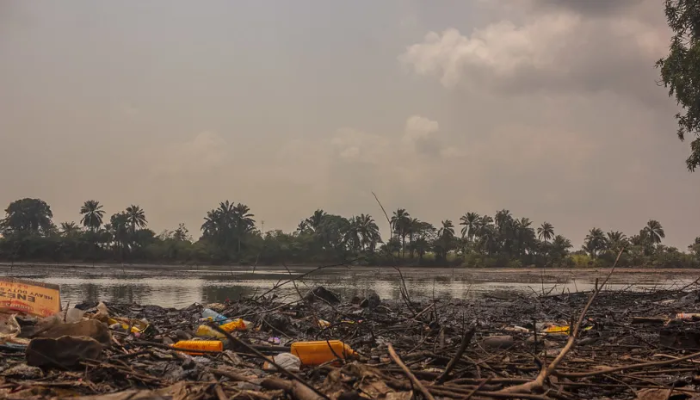
Nnimmo Bassey, executive director, Health of Mother Earth Foundation, and a foremost environmental expert, delivered a paper at the Correspondents Week in Port Harcourt last week. The paper warned that the region was at the brink of explosion because of the volume of crude oil polluted into the swamps and mangrove forests, on land and in the waters.
He said the Niger Delta is the most polluted region of the world, warning that failing to clean up the region meant that oil money is blood money.
He raised the issue of oil ending without cleanup and urged the people to rise now and demand cleanup.
Details:
When we speak about Niger Delta environment, we talk about our lived experience, not stuff out of books. That is why we must congratulate the Correspondents’ Chapel of the Rivers State Council of the Nigerian Union of Journalists (NUJ) for calling our attention to urgent need to launch a cleanup campaign of the Niger Delta.
I feel completely at home in the presence of Journalists. This is such a serious topic that everyone ought to be concerned about it.
Truth be told, not everyone is concerned about the Niger Delta environment; whether the Niger Delta is clean, whether you die today or tomorrow. Not everybody cares. I have fought for the environment in the media space.
Population has stolen our mothers;
Read also: NNPC accuses Dangote refinery of seeking fuel monopoly in court filing
Life expectancy in Niger Delta is now 41:
People in the Niger Delta are now expected to die at age of 41. This is what oil has given them. That is why those of us who have crossed that age bracket are called living ancestors. It’s so low that nobody can imagine it. Some people still live up to 90, but this is the average. In Nigeria, life expectancy is 56 years for women and 53 for men, which is not too far from the Niger Delta rate.
We must begin to question this reality. If you attend some events these days in the oil region, you only meet young people, especially women. I attended an event and saw that 80% were young women. Their men have since died. One woman told me: Pollution has stolen our mothers.
Go to many communities in the Niger Delta over weekends, like festival of funerals. And you see billboards and posters for a life well spent. And the person was hardly 30 years old. What is a life well spent at that age? I wonder.
Let me tell us that what is going on is not accidental. The challenges were the environmental pollution, the political misbehavior, and all the ills we see around us. They don’t just happen. By 1937, the whole of Nigeria was concession to Shell. It was then called Shell D’Archy. The whole country was one oil block. Think about that. It was by 1955 that other IOCs were calling to begin to bid for certainty.
Extractive activity in the Niger Delta is a colonial construct. It was before colonialism and colonialism never does anything for the benefit of the colonists. The people don’t matter. The environment doesn’t matter. And so that mindset is still running today in the Niger Delta under the new colonial atmosphere that we live in.
In Africa today, there’s a big rush for the most sensitive ecosystems on the continent. The world is thinking about migrating or shifting, transiting from fossil fuels, but we are basically announcing that we’re going to increase our production of oil to 4 million barrels per day.
Colonialism and oil extraction:
So, colonialism believes in reckless exploitation. There’s an assault on sensitive ecosystems in Africa, and it’s very interesting. Africa has a right to extract fossil fuels for development of the continent. I can’t say that’s a powerful political statement. That’s a beautiful statement, but question is; develop the continent based on whose standards. Who are you trying to be like? And why? How did they get to where they are today? And what did they do to other people to get there? Are you going to repeat all the patterns that helped to develop what you are looking at as a mis-development? The answer is no. You cannot repeat it. You cannot repeat slavery. You cannot repeat colonialism in the way it was in those days. It’s not like it. But the question I also ask all the time, I want to put on the table now.
Nigeria was configured to export its soul:
When people say we are going to extract oil, gas, and maybe gold and diamonds to develop the continent, I ask them to prove it to me. And you look at the practical map of this continent. All the railway lines, the pipelines, the major highways, they are going from the hinterland where there are resources to the seaport. The seaport is not there to develop the region, it’s meant for export.
Uganda is developing a very heavy crude that will be heated 10 times before it gets to the export terminal in Tanzania. It’s going to put the water sources for Africa, 40 million Africans at risk for the oppression of that project, displacing communities, impoverishing the people, all for export.
Nigeria built a gas pipeline led by Chevrolet and the rest in those days to take gas from Nigeria to Benin, to Togo, to Ghana. None of these pipelines are supplying gas to Africa.
Even when they get to Ghana, they’re all feeding transnational companies and factories. And so we need to think about the benefits of extractivism; is like the process of subtraction is never for addition. You extract. You’re not adding.
The assault on sensitive ecosystems is an assault on the deltas in Africa. When a location is named a world heritage location, it means nobody should tamper with it in a destructive manner, but they are extracting and destroying those pristine locations.
There is assault everywhere, and our leaders have said, this is the only way we can raise revenue to develop our continent, to develop our countries. This is 70 years of oil in Nigeria, how developed is the Niger Delta? Throwing money on problems never solve those problems.
You put poison in one hand, then you put antidote in the other hand. Who are you helping? If you don’t stop the pollution, the hospitals are of no use. But we celebrate those shiny hospitals.
Now is time for audit of Niger Delta environment:
We’ve been struggling with organic cleanup and it’s very appropriate that now is the time not just to talk about cleanup of the whole Niger Delta but to actually commence the processes of auditing the environment in terms of health impact, in terms of pollution impact and then putting aside money to begin to clean up the area. The short-hand way to measure the pollution in the Niger Delta is to compare it one oil spill in Alaska, USA in 1989 to be equivalent of one year in the Niger Delta. That means about 260,000 barrels of crude oil equal to one year in Niger Delta. The cleanup was a massive project. Till today, some of the biodiversity are yet to return to the full level.
All oil companies are complicit, not one exemption. There are communities that have shown us how to fight against pollution by stopping it from continuing or from starting. One set of people is the Yasuni people in Ecuador, in Latin America. Another is Ogoni in Nigeria. Such places have high cancer cases but the extractive companies make all the gains. I say, give me one example of any community in Niger Delta that has been developed because of oil. Which community?
Ogoni has become a big example to others across the world that communities can stand up and say no. Communities now can say, come let’s have a discussion and agree. Come and mine, come and extract, but these are our conditions, this is what we’re going to get. Every oil well has a lifespan. Nigeria’s early oil wells have been abandoned, not decommissioned, not dismantled. They are still polluting the environment at work. If you go there, you see oil still coming out. You see pollution there. So, the NUJ can demand that all the oil wells no more in use must be properly decommissioned. They must keep those wastes properly, dismantle them, and then restore the environment. We demand restoration to all the losses.
Blood money:
Now, have all these things happened without the knowledge of the oil companies? Is pollution accidental? No. The more they pollute, the more they are property increased. They have to spend the money they make from it to maintain the environment. If they don’t spend in maintaining the environment, then they will take everything as profit.
One of the problems in this country is a lack of accountability; lack of responsibility is giving to oil companies what can certainly be called blood money. Blood of the people.
See four reports so far issued in recent times to show that everyone knows about the level of pollution, that the environment is degraded by oil companies, and why they should be cleaned up. From 1991 to 1997, Shell established and paid for a survey but did nothing with the report. How many of you heard about it? The top experts. They carry out the research, but the report has never been issued. No official and formally released reports. It is because they saw the truth. And they were prepared to put it under the table.
Pollution: IOCs that change ownership are still liable:
International Oil Companies (IOCs) that have changed names and ownership are still responsible for the damage done in this country, to this region. If they claim there was divestment, we say no, we don’t accept it. The legacy of pollution rests upon the ancestors and those who are their offspring.
Second report is the Ogoni report by the UNEP, made for by the polluters, of course. We all know what that report says, that almost all the water forests in Ogoni are contaminated with hydrocarbons. At Ogale area, the groundwater is contaminated to the level of 900% higher than normal with carcinogens above world health standards. In some places, the soil has been polluted up to five meters, when the report was done. In some places, the pollution has gone as deep as 10 meters. So every year you leave the pollution, it’s getting worse. It’s getting deeper.
And so at groundwater, our safety is heavily compromised by the irresponsible behavior of polluters and our government. We know our government and the polluters are in unholy weather.
Another report is the Bayelsa State Oil and Environment Commission report, which was titled environmental genocide, the true cost of oil in Bayelsa, Nigeria. You can find all these reports online. You will see what was discovered by the panel the implications.
It’s a brief report, but it shows how dangerous oil pollution can be. It shows there’s a capital pollution case in Bayelsa State far above anywhere else in the world. In other places, it is taken seriously.
But here, it makes you want to cry. In Ororo -1, all are aware, spill is still ongoing some six years after. It is still burning. Shallow water, 10 meters deep, it’s not very deep water. But the oil spill that occurred in the Gulf of Mexico, was in water that was more than 1 kilometer deep.
What of the one that is burning in a creek near here? Since 2024. Has it been stopped? In the middle of communities. What is happening today in the oil region is that oil is bubbling all over the communities. Fire is breaking out. Gas flare everywhere all across the Niger Delta.
Routine gas flaring. Gas flaring cannot really be avoided in this sector. But what is routine? Day and night. Every day for years. It is a crime. Every gas flay scene is a crime scene. A gas flare has been legal in Nigeria since 1984. It was outlawed in 1984. When Buhari was a military leader of this country, it was outlawed. So they pay a tiny token, which is nothing. They can pay in advance and continue to flare the gas forever.
Some places have a lot of health issues; blood disorders, bronchitis, asthma, skin diseases. And they’re all over the energy area.
And so you Journalists have taken upon yourself a big task. Our people seem to have normalized the horrors. People have gotten used to the pollution. It’s the job of journalists to help inform and remind our people that pollution is not our friend. Pollution is killing our people quickly. Sometimes, our regulatory agencies underquote the spill or waste.
Some illogical things are being said by officials and regulators. In fact, the Bayelsa report showed that some of the figures moved by NOSRA of pollution are actually less than what the oil companies themselves are reporting.
Doesn’t that sound interesting? I think that’s because of hell, and the government and oil companies have refused to repent.

Join BusinessDay whatsapp Channel, to stay up to date
Open In Whatsapp