The back-to-back meetings of governors in Kebbi and Kaduna last week have underscored one unmistakable reality in Nigeria’s political landscape, the battle for the 2027 general election has quietly begun, with the North once again emerging as the principal political battleground.
Although the meetings were officially convened to discuss governance, security and regional development, political observers believe they also reflected the ruling All Progressives Congress (APC)’s determination to consolidate its hold on the 19 northern states ahead of what is expected to be one of the country’s most competitive elections.
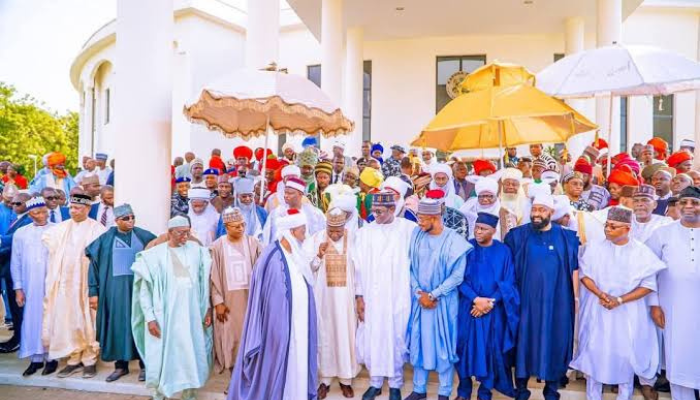
The first indication came in Kebbi State, where first-term APC governors met to review governance performance and strengthen collaboration among states controlled by the party. Barely days later, Kaduna hosted the Northern States Governors’ Forum and the Northern Traditional Rulers Council, where governors resolved to deepen regional cooperation against insecurity and inaugurated a committee to establish a Northern States Security Trust Fund.
The initiative is expected to mobilise resources from governments, the private sector and development partners to support intelligence gathering, logistics, surveillance technology and other measures aimed at addressing banditry, terrorism, kidnapping and communal violence that continue to threaten lives and livelihoods across Northern Nigeria.
Read also: Shettima emerges Tinubu’s running mate as APC predicts landslide victory
For many analysts, security remains the defining issue that could shape voting patterns across the region in 2027.
Across Kaduna, Katsina, Zamfara, Sokoto, Kebbi, Niger, Plateau, Benue, Borno and parts of Adamawa and Taraba, persistent insecurity has disrupted farming activities, forced the closure of schools, displaced thousands of residents and discouraged local and foreign investment. The resulting decline in agricultural production has contributed to rising food prices and weakened rural economies.
Against this backdrop, APC governors appear determined to convince northern voters that they are taking collective responsibility for solving the region’s most pressing challenge.
Governor Uba Sani of Kaduna State, who hosted the Northern Governors’ Forum meeting, stressed the need for a coordinated regional response, arguing that insecurity can no longer be tackled effectively by individual states acting alone. The proposed Security Trust Fund is expected to complement ongoing federal efforts while encouraging greater collaboration among states.
Beyond security, APC governors are increasingly presenting governance as their strongest campaign asset. Several APC-controlled states have embarked on road construction, healthcare expansion, school rehabilitation, agricultural support programmes and revenue reforms aimed at strengthening state finances.
Kaduna has promoted reforms in internally generated revenue, infrastructure renewal and social investments. Borno continues post-insurgency reconstruction efforts. Gombe has maintained a reputation for fiscal discipline, while Kebbi and Kwara have pursued agricultural and infrastructure projects intended to stimulate economic activity.
These initiatives are expected to feature prominently in APC’s campaign narrative as the elections approach.
However, political analysts caution that governance achievements alone may not guarantee electoral success.
Economic realities remain a major concern for millions of Nigerians. High inflation, rising transportation costs, unemployment and the lingering effects of economic reforms have placed enormous pressure on household incomes. While the Federal Government maintains that ongoing reforms will produce long-term economic gains, many voters may ultimately judge political parties by present-day living conditions.
The opposition is already positioning itself to capitalise on these concerns.
The People’s Democratic Party (PDP), despite internal divisions, still maintains formidable political structures in several northern states and retains experienced politicians capable of mounting serious electoral challenges.
The New Nigeria People’s Party (NNPP) remains a major force in Kano, where its grassroots support continues to pose a significant challenge to APC’s ambitions in Nigeria’s most populous northern state.
The African Democratic Congress (ADC) has also gained increasing attention as politicians seeking alternatives to the dominant parties explore new political platforms. Although its organisational reach remains limited compared to APC and PDP, strategic defections could strengthen its position in selected states.
The National Democratic Congress (NDC), Labour Party and Accord Party are equally seeking to expand their influence by attracting younger voters, professionals and citizens dissatisfied with the country’s economic and security situation. While they may struggle to secure widespread victories independently, they could significantly alter electoral outcomes by splitting votes in closely contested states.
Political calculations are also likely to vary across the region.
In Kaduna, religious balancing, zoning and candidate selection will again dominate political discourse. In Kano, the contest between APC and NNPP is expected to remain intense. In Plateau and Benue, security and farmer-herder conflicts are likely to influence voter decisions, while states such as Bauchi, Taraba and Adamawa may witness renewed competition between APC and PDP.
Another factor that may shape the elections is the quality of alliances built before party primaries. Political history suggests that the North often rewards broad coalitions capable of accommodating diverse ethnic, religious and political interests. Whether APC can maintain internal cohesion after its primaries—or whether opposition parties can overcome their own divisions to form effective alliances—may prove decisive.
For now, the ruling party appears to enjoy several structural advantages. It controls a majority of northern state governments, has access to extensive grassroots networks, benefits from incumbency at both the federal and state levels, and possesses stronger organisational and financial capacity than most of its rivals.
Yet recent Nigerian elections have shown that incumbency alone no longer guarantees victory. Voters have become increasingly willing to reward performance and punish perceived failures, particularly where insecurity and economic hardship persist.
The meetings in Kebbi and Kaduna therefore, represent more than routine gatherings of governors. They signal the beginning of an intensive political season in which governance, security and economic performance will become central themes of electoral campaigns across Northern Nigeria.
Whether APC retains its dominance in the 19 northern states will depend largely on developments over the next several months. If security improves, agricultural production rebounds and the economy begins to ease the burden on ordinary Nigerians, the ruling party could strengthen its grip on the region. But if insecurity persists and economic hardship deepens, opposition parties may find unprecedented opportunities to reshape Northern Nigeria’s political map.
As the countdown to 2027 continues, one conclusion is increasingly clear: the contest for the North has begun, and its outcome is likely to determine not only the region’s political direction but also the future of Nigeria’s presidency.

Join BusinessDay whatsapp Channel, to stay up to date
Open In Whatsapp