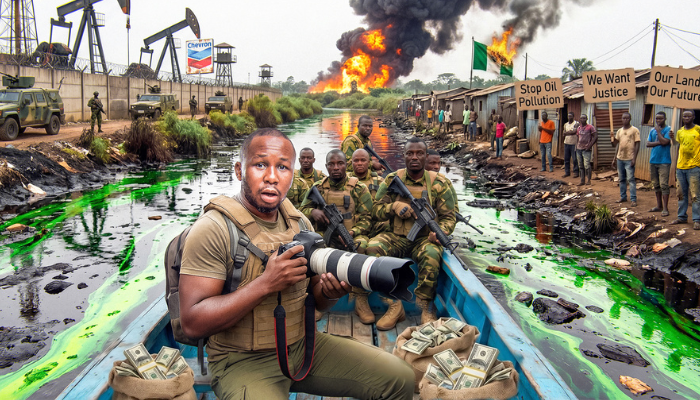
The Niger Delta, Nigeria’s main oil-producing region, remains caught between vast crude oil production and widespread environmental damage that continues to affect millions of residents living across its creeks and coastal communities.
For decades, the region has supplied most of Nigeria’s crude exports, generating billions of dollars in revenue for both the government and multinational oil companies. Yet many communities in the Delta continue to face polluted rivers, damaged farmland, poor healthcare, weak infrastructure and unemployment.
Nigerian filmmaker and content creator Steven Ndukwu recently travelled through the region to document the environmental and human impact of oil extraction. His 30-day journey through several communities has drawn strong reactions online, with over 365,000 viewers across the globe discussing the gap between the region’s natural wealth and the living conditions of its people.
“I can see oil everywhere,” said Ndukwu during his journey through the waterways. “There are particles of oil all around the river. Yet the people living here don’t look wealthy at all.”
The Niger Delta has recorded repeated oil spills over the years, with contamination affecting rivers, fishing settlements and farmlands. According to available field data, Nigeria recorded at least 589 oil spills in 2024, releasing about 19,000 barrels of crude oil into the environment.
Communities that depend on fishing and farming say the spills have destroyed their traditional means of survival. Fishermen report declining catches, while farmers say crops no longer grow properly on contaminated land.
Residents interviewed during the documentary said they have seen little direct benefit from the oil extracted from their communities.
“Oil that we don’t see, we don’t benefit from anything,” one resident said.
The documentary also focused on the spread of illegal refining camps, locally known as “kpo-fire”, across parts of the Delta. The operations involve crude oil being processed in makeshift facilities hidden within creeks and forests.
The refining activities release thick smoke into the atmosphere, contributing to soot pollution that has affected parts of Rivers State, including Port Harcourt. Residents have repeatedly raised concerns about respiratory illnesses and black particles settling on homes, vehicles and household items.
Medical studies referenced in the investigation showed the presence of toxic hydrocarbons and benzene in water sources and within the bloodstreams of some residents living close to polluted areas.
Ndukwu described the environmental conditions he encountered as he travelled deeper into oil-producing areas.
“I am travelling through what is one of the most important oil regions in the entire world, and even before you see anything, you can already sense it in the air,” he said. “It feels like oil is everywhere, not just in the water or the ground, but in the atmosphere itself. You can literally smell it as you move deeper into the creeks.”
He said the contrast between the scale of oil production and the living conditions in nearby communities became more visible throughout the journey.
“As I go further into these communities, I’m seeing something that doesn’t make sense at all,” he said. “This is where the oil that powers global economies actually comes from, yet the people living here don’t look like people who benefit from any of it.”
Oil production in the Niger Delta is dominated by multinational operators, including Chevron and Shell, alongside the state-owned NNPC Limited.
Reflecting on the scale of extraction, Ndukwu questioned why decades of production have not translated into stronger local development.
“When you look at the numbers, you realise how massive this is — millions of barrels every day, hundreds of billions of dollars over decades,” he said. “The oil is still flowing every single day without stopping, without rest. So the question becomes: if this much value is being generated continuously, why does it not reflect in the lives of the people who live on top of it?”
Environmental groups have also raised concerns about multinational companies selling onshore assets to local operators without completing clean-up obligations linked to ageing pipelines and abandoned oil wells.
As global conversations around environmental justice and energy transition continue, the Niger Delta remains central to discussions about how resource-rich regions can balance oil production with public health, environmental protection and long-term economic development.

Join BusinessDay whatsapp Channel, to stay up to date
Open In Whatsapp