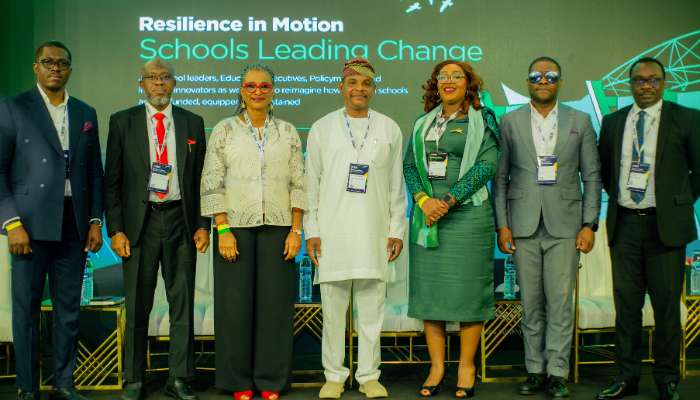
Nigerian education leaders, policymakers and private sector executives have called for stronger collaboration between government and the private sector, arguing that rising operating costs, teacher shortages and the growing demand for digital learning are reshaping how schools must be funded and managed.
The call came at the Nigeria Educational Supplies Summit (NESS) 2026 in Lagos, where stakeholders agreed that building a resilient education system will require sustained investment, stronger partnerships and practical innovation rather than relying solely on government funding.
Speaking at the summit, Jamiu Tolani Alli-Balogun, Lagos State Commissioner for Basic and Secondary Education, described education as a capital-intensive sector that requires long-term support from private investors to achieve meaningful and lasting reforms.
Read also: Africa Prudential launches Sabivest to deepen investment opportunities
“We need assistance majorly from private investors,” Alli-Balogun said. “Whatever we do must factor in sustainability. It is not about introducing programmes that disappear after two or three years, but policies that align with global best practices and stand the test of time.”
Delivering his keynote address under the summit’s theme, “Resilience in Motion: Schools Leading Change,” Ndubueze Mbah, Enugu State Commissioner for Education, challenged education stakeholders to move beyond policy discussions to practical implementation that transforms learning outcomes.
Mbah emphasised the need for education systems to shift “from policy to practice,” encouraging school administrators and educators to adopt practical, future-ready teaching models centred on experiential learning rather than traditional rote methods.
He also showcased Enugu State’s ongoing education reforms, highlighting the rollout of 267 Smart Green Schools designed to bring technology-enabled, project-based learning to every ward across the state. “The initiative combines modern infrastructure, digital tools and curriculum reforms to prepare students for the future economy,” he said.
The commissioner further explained that Enugu State is deploying smart schools and artificial intelligence technologies across its education sector, describing the reforms as a model of how subnational governments can build resilient institutions capable of adapting to economic and educational challenges.
Building on the theme of innovation, Adetola Salau, Special Adviser to the Minister of Education on STEMM and Corporate Sector Engagement and the summit’s Special Guest of Honour, said schools must invest as much in teachers as they do in technology.
“You can have a fantastic computer lab, but if you don’t have teachers who are trained, forget it,” she said, urging school leaders to prioritise teacher upskilling and empower innovative educators to mentor their colleagues.
Salau also called for greater participation of girls in science, technology, engineering and mathematics (STEM), noting that women currently account for only 35% of STEM graduates.
“Schools should strengthen mentorship programmes and intentionally encourage more girls to pursue STEM careers,” she said, adding that practical action, rather than perfect funding, will drive meaningful education reforms.
Earlier, Tayo Osiyemi, Convener of NESS and Chief Executive Officer of SKLD Integrated Services, said the summit was designed to promote resilient schools capable of driving innovation and sustainable change by bringing together educators, policymakers, financiers, suppliers and technology providers to develop practical solutions for Nigeria’s education sector.
According to him, Nigeria has more than 213,000 primary and secondary schools serving over 40 million students and supported by nearly 1.2 million teachers, making it one of Africa’s largest education systems.
“The scale of the sector, combined with rising operating costs, teacher recruitment challenges and cash-flow pressures, makes stronger partnerships between government and the private sector increasingly important,” he said.
Highlighting how the private sector is responding, Temilola Adepetun, Founder of SKLD Integrated Services, said the company has evolved from a back-to-school retail business established in 2000 into an education solutions provider supporting schools, governments and development organisations across Nigeria.
She said the company now supplies school uniforms, learning materials, classroom technology and IT equipment while also serving as a procurement partner to organisations including UNICEF and UNESCO.
Adepetun added that SKLD has partnered with Casio to distribute more than 1,000 calculators to teachers in Lagos State public schools and is expanding access to digital learning through its Digital Laboratory Project.
“The initiative introduces broadband-enabled learning hubs equipped with courses in Artificial Intelligence (AI), robotics, coding, data analytics and 3D printing,” she said. “The first laboratories are being commissioned in Lagos, with additional states expected to benefit as the programme expands.”
According to Adepetun, the project aims to equip students with future-ready digital skills while narrowing the technology gap between urban and underserved communities.
Offering the perspective of school operators, Goodness Morakinyo, Founder and School Director of Valencia Schools, said school leaders must remain focused on their long-term mission despite the country’s economic pressures. He urged school owners not to sacrifice quality in an attempt to reduce costs but instead to communicate their value clearly to parents, make decisions based on reliable data and simplify their operations to improve efficiency.
Morakinyo also encouraged schools to collect regular feedback from parents, understand their financial realities, invest in staff development, embrace technology and empower employees through delegation rather than micromanagement.
“As long as we remain in the business of solving problems, we will remain relevant,” he said, adding that schools that embrace innovation and adapt to changing realities will be better positioned for long-term success.
Stakeholders at the summit agreed that while the government remains central to education development, achieving resilient and future-ready schools will depend on stronger public-private partnerships, sustained investment in teachers, wider adoption of digital technologies and practical reforms that translate education policies into measurable classroom outcomes.

Join BusinessDay whatsapp Channel, to stay up to date
Open In Whatsapp