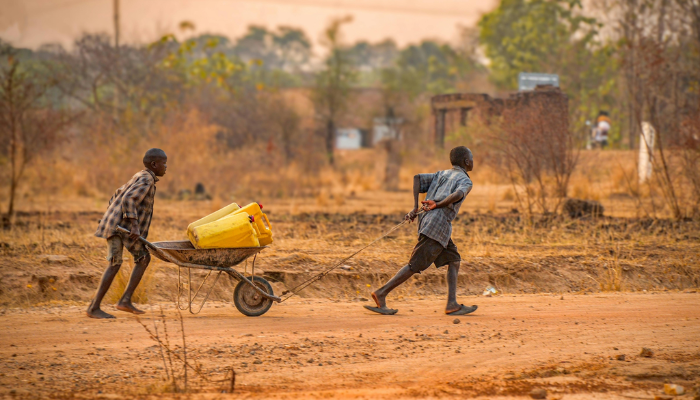
“Nigeria has no business with poverty. With the wealth of human and material resources at our disposal, poverty shouldn’t define our reality.”
– Olusegun Obasanjo (Former President of Nigeria)
The scary, scandalous and literally screaming statistical data of an estimated 139 million Nigerians, representing approximately 61% to 63% of the country’s population, stewing daily in preventable poverty speaks volumes about our aberrant version of democracy. In fact, the painful paradox is that this is playing out in a God-blessed, oil and mineral-rich country!
According to this figure, as reported by the World Bank, it highlights how compounding factors such as high inflation rate and economic disruptions continue to impact households. But there is more to it than meets the eye. With the daily rise in the wave of insecurity, analysts using the root cause approach have traced it to poverty amongst other factors such as political dimensions, ethno- religious indoctrination and the culture of impunity whereby sponsors and negotiators of insurgency still walk our streets as free men! Something urgent must therefore, be done to scuttle the crush the widening wings of poverty.
That the poverty rate of the long-suffering citizens escalates while our political leaders live large; driving in the beast ( sorry, best) of cars, top notch planes and boast of exclusive yachts reminds us of the warnings given by the World Bank the IMF and the Economist Magazine of London back in 2010. They pointed out that the cost of running of government in Nigeria, including their humongous pay packages amounted to one of the highest all over the world.
Definitely, we have to learn lessons from the hands of the leaders of countries with the lowest poverty index across the world That is specifically absolute poverty measured by the international threshold of living on less than $2.15 per day. Most of such countries are concentrated mostly in Europe, North America, and select East Asian nations. These countries, including France, the Netherlands, Ireland, South Korea, Japan
generally, record absolute poverty rates of less than 0.5% of their populations. while Nigeria’s own soars over 61%. This is unjustifiable, is it not? Of course, it is. From the World Bank perspectives, poverty here in Nigeria is measured and categorized in multiple ways: The first is the Monetary Poverty. Both the World Bank and the National Bureau of Statistics (NBS) monitor monetary poverty based on consumption levels. About 82.9 million Nigerians fall below the national poverty line, which measures whether individuals have real per capita expenditures below N137,430 per year.
According to the international extreme poverty line of $2.15 per person per day (2017 PPP), about 30.9% of the population is classified as extremely poor. This again rubbishes our leadership performance.
Another factor for measurement is the Multidimensional Poverty. For instance, the National Multidimensional Poverty Index (MPI) reports that 133 million Nigerians (63% of the population) are multidimensionally poor. This means they experience severe, simultaneous deprivations in key areas beyond just income. These include healthcare and food security.
Other contributory factors are long travel times to seek medical care and high rates of food insecurity. And with regards to living standards there is lack of access to clean energy (relying on dung, wood, or charcoal), poor sanitation, and inadequate housing.
As far as education is concerned, high rates of children out of school and adults without educational completion have worsened the poverty issues.
On its regional impact, poverty disproportionately affects rural areas, where about 75.5% of people live in poverty, that is compared to 31% in urban areas. And geographically, 65% of poor Nigerians currently live in the northern regions, while 35% live in the south. But what really matters are the practical solutions to curb poverty.
Though successive administrations have implemented over 40 poverty alleviation and social intervention programs since 1960, shifting from early agricultural-focused campaigns and rural infrastructure projects to modern direct cash transfers and micro-credit schemes the poverty rate has skyrocketed. But why, you may ask?
It all boils down to lack of proper understanding of what the problems really are, planning without thorough thinking through, not involving the potential beneficiaries in the planning process, working without credible data and politicizing poverty alleviation programs.
As a way forward proactive measures meant against poverty in Nigeria require a holistic and multifaceted approach. It should be focused on human capital development, economic diversification, and targeted social safety nets.
Coming down to the specifics, experts on the economy advocate massive investments, especially in agricultural development, expanding access to quality digital and vocational education for youth, and strengthening grassroots financial inclusion. This is to empower small businesses. There should also be actionable frameworks and proactive initiatives to drive poverty reduction.
These include empowerment: programmes like the iDICE (Investment in Digital and Creative Enterprises) the aim is to train hundreds of thousands of youths, mostly in ICT skills and fund early-stage ventures to stimulate job creation. There should also be the scaling up of transparent, targeted social assistance like conditional cash transfers for vulnerable households. This is to prevent them from selling off productive assets during economic shocks, as we are currently battling with.
The support for SMEs should come by providing access to low-interest, collateral-free loans to informal sector workers and small business owners. Such will boost local economic productivity. And infrastructure development: rehabilitating transportation networks and power grids to reduce the cost of doing business and connect rural agricultural hubs to urban markets.
Resources for exploring and engaging with these economic opportunities include: Track national data and policy guidelines at the National Bureau of Statistics for poverty and employment metrics.it is time to explore small business and innovation support via the Federal Ministry of Information and National Orientation.
There are also suggestions for a thorough review developmental progress and multilateral backing on the World Bank Nigeria portal. Those who are enlightened should act on it and inform the illiterates.
Going forward, it is high time we restructured the leadership architecture to be pro-people and from bottom up. The pay package of the politicians in power should be drastically scaled down to be equivalent of the civil salary scale. The should no more be pension packages for ex – governors who have stolen their states dry for eight odd years. Rather, we need Volunteers in Government, ready to serve selflessly and be placed on the equivalent of civil salary scale. Leadership is not all about how much money a politician can pilfer while in office but how many lives they are able to pull out of the pitiable pit of preventable poverty
As Chinua Achebe (Renowned Novelist and Author) rightly stated: “Nigeria is what it is because its leaders are not what they should be.”

Join BusinessDay whatsapp Channel, to stay up to date
Open In Whatsapp