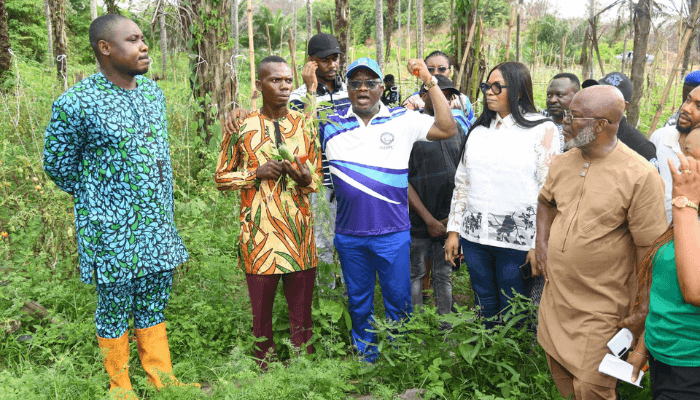
The Livelihood Improvement Family Enterprises in the Niger Delta (LIFE-ND) has emerged as a special purpose vehicle (SPV) created to bring food security and agric revolution in the Niger Delta. It was set up about seven years ago to manage the funds raised by the International Fund for Agricultural Development (IFAD $60m), a UN organ, as well as the Niger Delta Development Commission (NDDC $30m).
The FG/IFAD quota came early to begin the projects in six states of the Niger Delta while the quota from the NDDC began in tranches late 2024 to begin action in the remaining three states.
It has already been admitted that the Niger Delta region is blessed with abundant natural resources, with crude oil and natural gas being the most prominent. Apart from these, the region is endowed with some of Nigeria’s most fertile land. Ironically, according to experts, the region’s inhabitants do not appear to reap the full benefits of nature’s bounty as expected. This is blamed on years of environmental degradation.
Before oil took centre-stage, more than 95% cent of the people in the region were engaged in agriculture. Since Shell first struck oil in Oloibiri in 1956, unquantifiable oil spills have continued to pollute the water and soil while dangerous emissions from gas flares poison the air across the region, destroying the livelihoods of fishermen and farmers.
To make matters worse, the Nigerian nation has come to depend almost entirely on crude oil for economic survival. The result, according to Ifeatu Agbu, a communications expert attached to the NDDC, is inadequate investment in the agricultural sector.
To reverse this trend, the Federal Government and some of its agencies are now making conscious efforts to revive the agricultural sector to enable Nigeria produce enough food to feed its people, supply raw materials to local industries, and still have enough for export.
As part of this effort, IFAD, FG, and the NDDC introduced the LIFE-ND in 2019. The objective of the programme is said to be to enhance income, food security, and job creation for rural youth and women through sustainable Agri-enterprise development in the Niger Delta region.
The $90 million LIFE-ND programme, jointly financed by IFAD, the FG and the NDDC, would promote projects that would shift Niger Deltans away from subsistence farming into commercial and sustainable farming that can lead to empowerment.
According to Abiodun Sanni, the National Project Coordinator of LIFE-ND, the implementation period is structured into two phases of six years each. The project effectively kicked off in 2020. By design, the first phase ran from 2019 to 2025.
So far, he says that there are significant changes in the agricultural practices in the Niger Delta region worth celebrating, stating that the programme is an eloquent testimony of the Federal Government’s concern and determination to create a massive impact in the Niger Delta.
Read also: How LIFE-ND has reduced youth restiveness in Niger Delta
Sanni said that the success recorded in the initial six states had set a high standard that would be replicated in the newly funded states of Akwa Ibom, Imo, and Rivers.
He explained: “For the six states (Abia, Bayelsa, Cross River, Delta, Edo and Ondo – IFAD funded) where LIFE-ND has already taken root, we have seen results that are nothing short of inspiring—10 LGAs per state, 10 communities per LGA, each one a testament to the possibilities when we cultivate the right partnerships and persevere in the face of challenges.”
He went on: “A mid-term assessment of the LIFE-ND programme indicates that many stakeholders are satisfied that the project has impacted more than 50% of its target beneficiaries and has significantly reversed negative narratives about the Niger Delta.
“To further add to the successes recorded so far, the NDDC and IFAD on September 13, 2024, launched the LIFE-ND Project for Akwa Ibom, Imo, and Rivers states to join the six other states of the region already reaping the fruits of the programme.”
At that occasion in Port Harcourt, he stated, Samuel Ogbuku, the NDDC Managing Director, said that the Life-ND programme aligns with the efforts of President Tinubu’s administration, which recently declared a state of emergency on agriculture.
Ogbuku said: “This project is not just ploughing through the fields of agribusiness. It is breaking new ground, cultivating opportunities for wealth and stability. And as we launch this initiative, we are ushering in new possibilities.”
He went on: “In the past, agribusiness seemed out of reach for many. But today, we bridge that gap, opening the doors to entrepreneurship, financial independence, and sustainable livelihoods.”
According to him: “The NDDC proudly stands as a co-sponsor of this initiative, alongside the Federal Ministry of Agriculture and Food Security, with the steadfast support of IFAD.”
Ogbuku said that the LIFE-ND project would transform the lives of over 38,000 direct beneficiaries, but its multiplier effect will surely touch many more across the Niger Delta. He stated: “We are reaffirming our commitment to ensuring that our youth and women not only participate in the economy but lead the charge building businesses that uplift their families, their communities, and their futures.”
He declared: “The partnership with IFAD is a strong vine, one that will continue to grow and bear fruit. With IFAD’s $60 million investment and NDDC’s $30 million contribution, we are fertilising the ground for a brighter future.”
He said that the essence of the programme was to enhance the income and livelihood of the youths of the Niger Delta, provide food security and create jobs on a sustainable basis in the region.
Recently, officials of the NDDC and LIFE-ND inspected agricultural incubation centres in Akwa Ibom, Imo, and Rivers States to evaluate the programme’s performance in rural communities.
Speaking during the inspection of Megalakes Farms in Ogu Town, Rivers State, Winifred Madume, the NDDC Director of Agriculture and Fisheries, said the exercise was a routine inspection aimed at assessing the level of implementation of the programme.
She noted: “This oversight function is to ensure that the training is on track with its mandate. The NDDC’s commitment to meeting its counterpart funding obligations and driving rural economic transformation is in alignment with the agricultural development objectives of President Bola Ahmed Tinubu’s Renewed Hope Agenda.”
Madume explained that the inspection provided an opportunity to engage directly with incubatees across the different batches and identify areas for improvement under the LIFE-ND programme, a collaborative initiative involving the NDDC, the IFAD, the FG, and participating state governments. She added that the three-day inspection covered incubation centres in Delta, Imo and Akwa Ibom States.
Abi Morris, the Special Assistant on Agriculture to the NDDC Managing Director, expressed satisfaction with the level of implementation of the programme and the enthusiasm displayed by the young agripreneurs who have either set up their own enterprise or are undergoing incubation. He made this observation during an inspection of one of the training centres in Sogho, in Khana Local Government Area of Rivers State.
“This programme is a clear demonstration of development in action. It goes beyond training to unlocking livelihoods and reshaping mindsets. The Commission will continue to support initiatives that equip our youth with the skills and resources to succeed. We have taken note of the challenges faced by these young agripreneurs and ensured that necessary adjustments are made,” Morris said.
One of the beneficiaries in Sogho, Rivers State, Nzhu Salome, thanked the NDDC for the initiative, noting that the programme had equipped her with the requisite knowledge and funding to establish her own garri marketing enterprise.
During oversight activities in Imo State, Tonye Frank-Oputu, the NDDC Director II, Agriculture and Fisheries, emphasised the importance of the initiative whilst commending the incubatees for their recorded progress. “The incubatees have shown sheer dedication and have achieved a lot so far. Their progress is clear evidence that the opportunities provided under the LIFE-ND programme are being effectively utilised,” he said.
Also in Imo State, Ibigineh Doreen, an incubatee at Ibiasoegbe in Oru West Local Government Area, commended the programme for significantly enhancing her fish farming venture.
During oversight activities in Akwa Ibom State, Oretan Adebowale, a Director in the Ministry of Agriculture and Fisheries, charged the beneficiaries in Adiasim Ikot Essin in Essien Udim LGA to use the knowledge gained to drive sustainable agriculture in their community and the state at large. “From our interactions and observations, it is evident that the incubation model is efficient.”
One of the incubatees, Ohaka Emmanuel, also thanked the NDDC and the Federal Government for the initiative, expressing gratitude for being selected for the third batch. He said: “This training has given me the opportunity to learn fish production, processing and marketing. I also appreciate my incubator for the knowledge acquired.”
For Victor Antai, the NDDC Executive Director, Projects, the LIFE-ND project is more than just an initiative; it is a concerted effort to address the challenges faced by our communities and to harness the opportunities for growth and development.
He noted: “Our partnership with IFAD has been instrumental in empowering our farmers and enhancing agricultural productivity. This partnership dates back to 2005 when NDDC supported an initiative of the Federal government with a matching fund with IFAD in the sum of $15 million for the Community Based Natural Resource Management Programme – Niger Delta (CBNRMP-ND).”
Speaking on the journey so far, Dede Ekoue, IFAD Country Director, said: “At mid-term, the programme planned to reach 25,000 small holder entrepreneurs and farmers has already reached 14,155 and more.”
She enthused: “LIFE-ND has been selected as one of the projects to share their experience at the level of West and Central Africa, which means something innovative is happening here. One of the innovations is introducing Information Communication Technology (ICT) for supporting rural farming for development.”
According to her, the collaboration with the NDDC on the project has been a huge success, noting: “I would like to reiterate that IFAD remains a steadfast partner in supporting the development of sustainable rural livelihoods in the Niger Delta region and Nigeria as a whole. We are confident that, through continued collaboration and innovation, LIFE-ND will continue to empower rural communities and contribute to a more prosperous, food-secure future for all.
“We appreciate the dedication of NDDC to strengthening partnerships among all stakeholders to transform lives, create prosperity, and foster sustainable development for the people of the Niger Delta and Nigeria as a whole. LIFE-ND is one of IFAD’s best-performing projects, and we are grateful to the NDDC for its efforts to fulfil its financial obligations towards this initiative.”
Most observers believe that already, success stories have continued to spill out of the Niger Delta and more is expected to confirm the rise of food security systems in the Niger Delta beyond oil and gas.

Join BusinessDay whatsapp Channel, to stay up to date
Open In Whatsapp