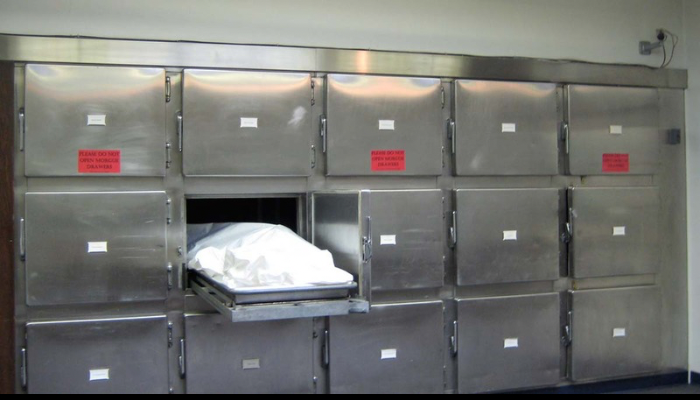
Mortuary (or morgue/funeral home) is a place for storing dead bodies temporarily before identification, autopsy, burial, cremation, or other final disposition, often involving refrigeration/embalmment to slow decomposition.
It is primarily a place for body storage, often connected to hospitals or forensic centres, focused on identification and investigation.
The demand for the services of these providers has witnessed a dramatic rise owing to the growing death rate vis-a-vis the increasing population and a poor infrastructure.
Nigeria’s increasing death rate is further evidenced in the 2010 United Nations World Population Report, which estimates a death rate of 17% every thousand in 2010, up from 15% thousand in 2005.

Thus, this created a big market for scores of mortuary operators, undertakers, casket manufactures and other providers of morgue-related services and products, leading to the privatisation of the death care industry in Nigeria.
However, stories from mortuaries in Nigeria, especially in the South-East region is disturbing.
A place that evokes a sense of solemnity and respect for the dead, has been turned into a slaughter house for organ harvesting and these repulsive stories are coming from privately-owned morgues.
Criminals now hide under the industry to commit heinous crimes.
The police in Imo State recently uncovered a privately-owned mortuary in Umuhu, a community in Ngor-Okpala Local Government Area of the state, where scores of mutilated bodies were found.
Aboki Danjuma, the commissioner of Police in Imo State, said that the police uncovered the illegal mortuary after a tip-off.
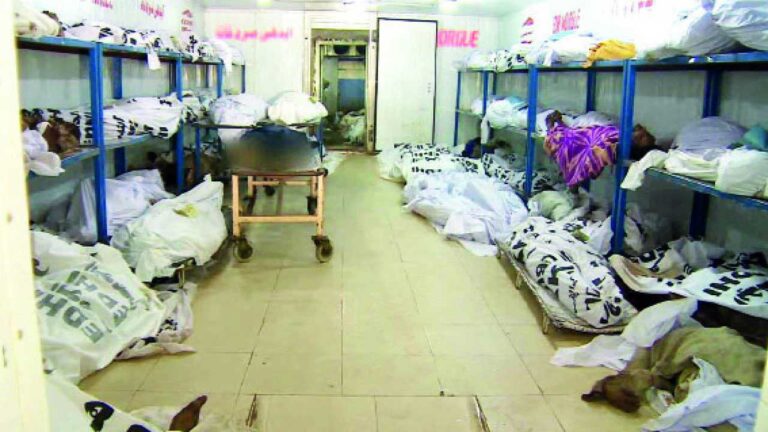
According to Danjuma, “When we visited the place, we saw scattered corpses, mutilated corpses, in this environment. The corpses that we discovered are more than one hundred. And the owner of the mortuary is on the run,” he said.
Read also: Families scramble to verify corpses in Edo mortuary over organ harvesting scare
The commissioner stated that one individual identified as Morocco Oparaugo, the fleeing mortuary owner, had rebuffed several invitations extended to him, prompting the police to declare him wanted.
“And by the information we gathered, they used this place in dumping the corpses for what they called organ harvesting,” he said.
He appealed to families whose loved ones are missing to come forward and ascertain if the bodies of their missing relatives were part of the corpses found in the facility.
Sometime in March, 2025, about three mortuary attendants escaped lynching by irate youths over a dead man’s missing testicle at a facility, located between Afoukwu and Abayi Okoroato village, along the Aba-Ikot Ekpene highway, in Obingwa council area of Abia State.
It was gathered that a family who had deposited their son’s remains at the facility had gone to retrieve him for burial when one of their daughters insisted that the corpse be undressed for observation before they leave the mortuary.
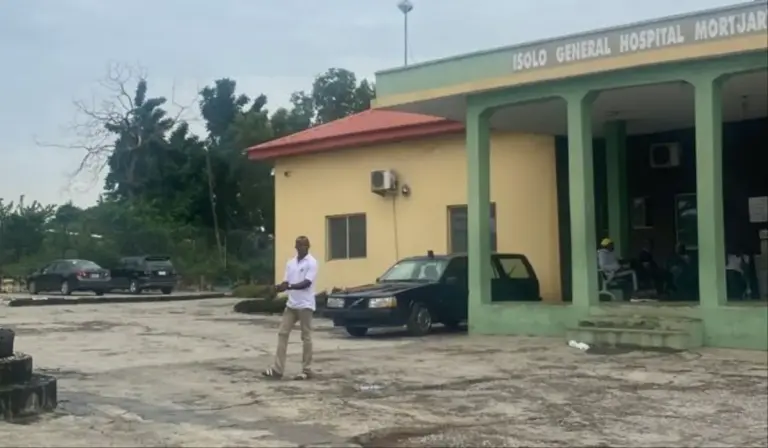
Following the request, the corpse, which was already dressed inside the coffin, was undressed, and the testicle was found missing.
The situation allegedly angered youths of the surrounding communities, who had accompanied the family to the mortuary.
Eyewitnesses said that the attendants attempted to flee the scene, but were apprehended by the irate youths.
It was a theatre of confusion as some of the youths violently attacked the mortuary. Others destroyed the buildings and other properties they could lay their hands on.
Some of the youths said, “We don’t know that this mortuary is involved in such evil business; people have been suspecting him. It is an abomination in Igbo land to sever the body part of a dead person.
“Now, we have seen what he has done and why his business is flourishing. He was operating his mortuary business in that abandoned filling station. He and his attendants will answer for their crimes.”
Some of the families who had deposited their dead ones at the mortuary came to retrieve them, while police officers from the Eastern Ngwa Division, Umuobiakwa, later arrested some of the attendants, who were seized by the rampaging youths.
The Edo State Police Command on the other hand has commenced a full-scale investigation into allegations of unlawful tampering and removal of body parts from a corpse at Akugbe Mortuary, located along Upper Sakponba Road, Benin City.
The incident was reported on December 12, 2025, when family members of the deceased, identified as the late Uyi Enogieru, arrived at the mortuary to claim his body for burial. Upon inspection, the family reportedly discovered that some body parts were missing, triggering outrage and tension at the facility. The situation escalated rapidly, with an irate crowd attempting to lynch a mortuary attendant suspected to be involved in the alleged act.
Police officers from the Ugbekun Division responded swiftly to the distress situation and successfully rescued the suspect from the mob, thereby preventing jungle justice and restoring order at the scene. The suspect has since been taken into custody.
Some citizens who spoke with BusinessDaySunday said that the dastardly acts had been going on for many years now but getting worse in recent times.
According to them, for every one mortuary that is discovered, there are more than nine others engaged in organ harvesting yet to be uncovered.
Kingsley Odo, a technologist based in Onitsha, said that way back in 1998, 1999 when he was in his village in the South East, they used to suspect some of the operatives and owners of private mortuaries of being sinister in their operations.
“This thing did not start today. It is only getting worse. There was this privately-run mortuary in my community in those days, the young man that owned it was weird in his ways. The fences of the mortuary were as high as the heavens, so to speak. Nobody knew what was going on inside there. All of a sudden, the young man became very rich and feared by community people.
Nobody was courageous enough to challenge him, but many people were convinced that more than normal mortuary activities were going on in that facility,” Odo said.
Chijioke Ogbodo, a seasoned broadcast journalist, while reacting to the recent reports emerging from mortuaries in parts of Nigeria, particularly within the South-East, said that it is deeply troubling and demand sober reflection rather than emotional reaction.
He said that mortuaries occupy a sacred and sensitive space in every society. They are meant to preserve dignity in death, provide closure for grieving families, and serve as a bridge between loss and healing, noting that when allegations of organ harvesting, criminal complicity, and abuse surface from such spaces, the collective conscience of society is understandably shaken.
Ogbodo said: “It is important, however, to approach this matter with balance, responsibility, and a commitment to truth.
While not all mortuaries are complicit in criminal acts, documented incidents and credible reports — including past cases reported in Owerri, Imo State, and Aba, Abia State — point to disturbing lapses involving some privately-operated facilities and individuals, who exploited regulatory weaknesses. These reports, whether fully adjudicated or still under investigation, underscore a systemic problem that cannot be ignored.”
As a citizen and public affairs observer, Ogbodo, described the stories as both distressing and embarrassing.
“Distressing because they strike at the core of our shared humanity; embarrassing, because they reveal how weak oversight and poor enforcement can turn essential services into channels for criminal enterprise. Beyond the immediate horror, such stories deepen public distrust in healthcare institutions, fuel fear among families, and damage the moral fabric of society.
“However, it would be unfair and counterproductive to paint the entire mortuary industry with one brush. Many public and private mortuaries across Nigeria operate professionally, ethically, and within the law, often under difficult conditions. The challenge before us is not to demonise an entire sector, but to isolate, expose, and eliminate criminal elements hiding within it.”
He however, noted that calls to ban private mortuary operators entirely may be emotionally satisfying, but they are neither practical nor sustainable.
In his words: “Private participation in healthcare-related services, including mortuary management, fills critical gaps left by overstretched public facilities. In many urban and semi-urban areas, private mortuaries provide essential services that government institutions are unable to meet adequately due to funding, infrastructure, or manpower constraints.”
He observed that a blanket ban, would likely drive the practice underground, worsen capacity shortages, and create new, unregulated black markets — the very conditions that allow abuse to thrive. The issue, therefore, is not private ownership per se, but weak regulation, poor supervision, and compromised enforcement.
He said that regulatory tightening is the more rational and effective response, noting that mortuaries, whether public or private, should be treated as high-risk, high-sensitivity facilities requiring strict licensing, continuous monitoring, and zero tolerance for abuse.
He further said that regulators at both state and federal levels must review existing laws governing mortuary operations.
Many of these regulations according to him, are outdated, poorly enforced, or fragmented across ministries of health, local government authorities, and environmental agencies.
He suggested that a unified regulatory framework is needed — one that clearly defines operational standards, ethical obligations, staffing requirements, record-keeping procedures, and sanctions. Routine inspections should be mandatory and unannounced, not cosmetic exercises conducted after scandals break.
“Technology should also play a role. Digitised corpse registration, traceable documentation, and mandatory reporting systems can significantly reduce opportunities for tampering, disappearance of bodies, or illegal activities.”
One of the most glaring weaknesses exposed by these incidents is the ease with which unqualified individuals gain access to mortuary operations.
In some cases, facilities are licensed without rigorous background checks on owners, managers, or attendants. In others, licenses are obtained legitimately, but abused over time due to lack of follow-up.
Ogbodo noted that licensing must go beyond paperwork. Operators should meet clearly defined professional, ethical, and technical standards.
“Their role requires discipline, ethical grounding, and psychological stability. Proper training, fair remuneration, and clear accountability structures reduce vulnerability to criminal inducement.
“There should also be a publicly accessible registry of licensed mortuaries and operators. Transparency empowers citizens to make informed choices and exposes illegal facilities operating in the shadows”.
On criminal infiltration and industry abuse, he observed that some criminal networks deliberately seek out poorly regulated sectors to operate under cover, noting that Mortuaries, due to their sensitive nature and limited public scrutiny, become attractive targets when oversight is weak.
He said that the reported cases from Owerri and Aba, where mortuary attendants were allegedly implicated in unethical or criminal practices, should be viewed as warning signals rather than isolated embarrassments and called on
law enforcement agencies to work closely with health regulators to treat such cases not merely as professional misconduct, but as organised crime, where evidence supports it.
“Ultimately, the goal is not to instill fear, but to restore trust. Mortuaries should remain places of dignity, not dread. Achieving this requires political will, institutional reform, professional integrity, and public vigilance.
“Nigeria must resist the temptation to respond to outrage with shortcuts. Sustainable reform lies in strong regulation, transparent licensing, professionalization of personnel, and decisive punishment for offenders. When the system is cleaned from within, criminals will find no place to hide.
“Death is inevitable; indignity should not be. The measure of a society is not only how it treats the living, but how it honours the dead,” he said.
Obinna Nwagbara, executive director of Youth and Students Advocates for Development (YSAD), said that private mortuary operators should not be banned, but that they should be well-regulated.
He also said that the law on establishment of mortuaries should be reviewed to address these emerging realities and if there’s no law before now, such should be enacted.
Goodluck Ibem, president general, Coalition of South East Youth Leaders (COSEYL), condemned the rising cases of organ harvesting in mortuaries and called for strict regulations of private operators.
“Mortuaries, by their very nature, are sacred grounds meant to preserve the dignity of the dead and give families closure. It is horrifying that some unscrupulous individuals have commercialised and desecrated these facilities in the most barbaric manner.
“These heinous acts not only violate the rights of the deceased, but also erode public trust and bring shame to the society.”
He demanded the immediate screening and re-accreditation of all private mortuary operators in the South-East region and urged government to ensure that only qualified, vetted, and licensed professionals are allowed to operate mortuary services.
“Regulatory agencies must step up routine inspections, monitoring, and enforcement to ensure compliance with ethical and professional standards.
“Security agencies should investigate these allegations thoroughly, and offenders must face the full weight of the law, including severe punishment as a deterrent to others.
“The Ministries of Health and Justice must work in synergy to establish a regulatory task force to clean up the sector urgently.”
He said that COSEYL would not stand by and watch criminality thrive under the guise of business, stressing that the sanctity of life and even in death, must be respected.
He urged all stakeholders, especially religious, traditional, and community leaders, to join this call for urgent reform in the mortuary sector.

Join BusinessDay whatsapp Channel, to stay up to date
Open In Whatsapp