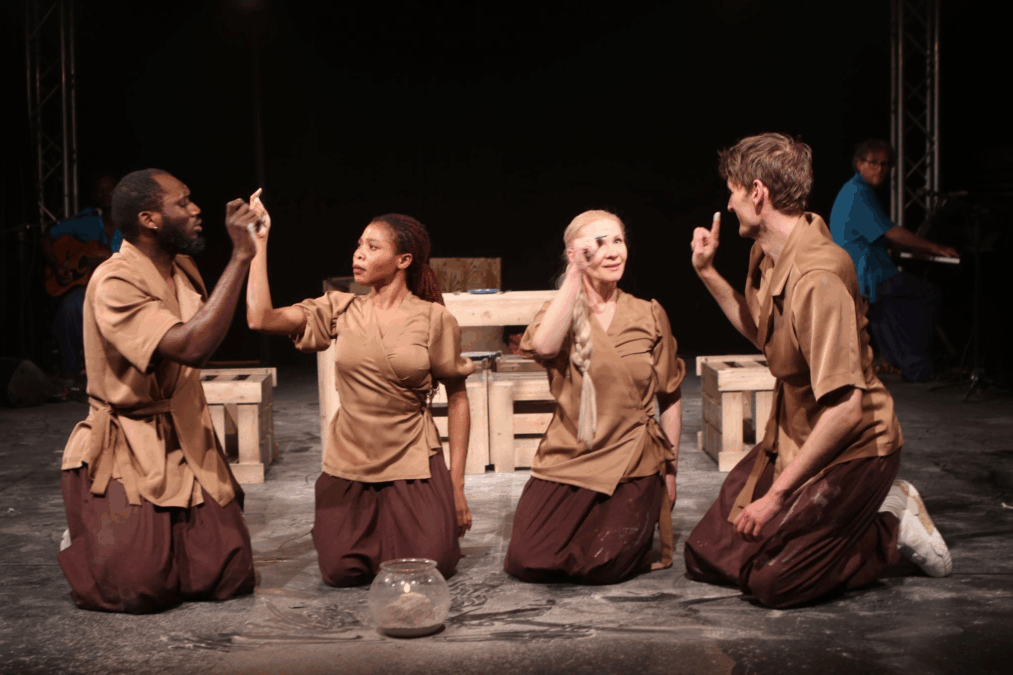
On a warm evening in Marburg, Germany, a bakery became a meeting place for cultures, memories, and conversations about what it means to care for one another.
The occasion was the premiere of Bread and Butter, a new international theatre production created by Kininso Creative (UK/Nigeria) in collaboration with Hessisches Landestheater Marburg (HLTM). While the production takes place inside a bustling bakery, its ambitions stretch far beyond flour, ovens, and freshly baked bread.
What unfolds on stage is a playful and visually engaging performance that asks audiences to consider a surprisingly complex question: What does bread mean to us? For some, bread is comfort. For others, survival. For many communities around the world, it has become an increasingly expensive necessity. Bread and Butter uses this everyday staple as a starting point for exploring ideas of belonging, generosity, inequality, and shared humanity.
Unlike traditional dialogue-driven theatre, the production communicates largely through movement, music, visual imagery, and physical storytelling. This allows the work to travel across cultures and languages with remarkable ease.
Children laughed openly at the comic mishaps of the bakery workers, while adults appeared drawn to the deeper social questions quietly embedded beneath the humour.
At the centre of the story are two bakers, Pan and Can, whose world is filled with creativity, routine, and joy. Their bakery functions almost like a small community where people gather, work, and connect. When they discover that visitors to their bakery have been secretly taking food because of hunger, the story shifts from playful entertainment into something more profound.
Rather than focusing on blame or punishment, the production explores the transformative power of empathy. The characters respond not with judgement, but with understanding.
Through this simple choice, Bread and Butter presents an alternative vision of community—one where dignity, opportunity, and compassion are treated as essential ingredients for social wellbeing.
What makes the work particularly compelling is its refusal to preach. Important social themes emerge naturally through action rather than explanation. Audiences are invited to draw their own conclusions while remaining fully engaged by the production’s energy and inventiveness.
The collaboration itself reflects many of the themes explored on stage. Developed through a partnership between Kininso Creative and Hessisches Landestheater Marburg, the production brought together artists and practitioners from Nigeria and Germany in a process of exchange, experimentation, and collective creation.
The creative vision was led by Joshua Alabi, director and concept creator, alongside Carola Unser-Leichtweiß, the artistic director.
The production was coordinated by Angela Peters, producer and project manager, whose leadership supported the complex international collaboration from development through premiere. Dramaturg Cornelius Edlefsen and theatre pedagogue Michael Pietsch contributed significantly to shaping the narrative structure and audience engagement approach, while Sinmiloluwa Oyewale served as musical director and composer, creating the rich sonic landscape that underpins the performance.
Behind the scenes, technical director Blessing Okunlola, technical assistant and content producer Qoyyum Areoye, administrative manager, Chinenye Chukwudi, communications officer, Caleb Ihenyen, digital technology officer Stephen Olugbenga Alabi, logistics manager, Oloyede Aribilola, social media manager, Omosede West-Erhabor and post-production specialist, Zein-Abeedeen Awaiye, played essential roles in ensuring the successful delivery and documentation of the project across multiple countries and institutions.
On stage, the production was brought vividly to life by an ensemble cast comprising: Tobias Neumann, Aliona Marchenko, Christian Keul, Julius Obende, Chioma Enyinnaya, and Sinmiloluwa Oyewale. Together, they created a dynamic world where music, movement, humour, and physical theatre blended seamlessly. Their performances transformed everyday objects and ordinary situations into moments of wonder, inviting audiences to engage with the story both emotionally and imaginatively.
Director Joshua Alabi has spoken previously about how the idea originated from observations of changing food realities in Nigeria, where bread has become increasingly expensive for many households. Yet the production never confines itself to one location or culture. Instead, it broadens the conversation, encouraging audiences to reflect on the inequalities and challenges that exist within their own communities. The universality may explain why the performance resonated so strongly with audiences in Marburg. While the details of daily life differ across countries, questions about access, fairness, community, and care remain remarkably familiar.
The production’s visual language plays a significant role in this success. Tables become landscapes. Kitchen utensils transform into musical instruments. Dough, flour, and simple household objects are used in imaginative ways that continually surprise the audience. There is a sense of wonder throughout the performance that recalls the pleasure of watching people create something meaningful from ordinary materials.
Yet perhaps the most memorable achievement of Bread and Butter is its ability to create connection. In a time when public discourse often emphasises difference, division, and scarcity, the production offers a quieter but equally powerful proposition: that communities are strongest when people share what they have and create opportunities for others to thrive.
As the audience rose to applaud at the end of the premiere, it was clear that the performance had delivered more than entertainment. It had created a space for reflection, conversation, and encounter. Bread and Butter demonstrates that theatre does not need grand spectacle or complicated narratives to address important issues. Sometimes all it takes is a loaf of bread, a few willing collaborators, and a story that reminds us of our shared humanity.
For Kininso and Hessisches Landestheater Marburg, Bread and Butter stands as more than a successful premiere. It demonstrates the potential of international artistic collaboration to create work that is locally rooted yet globally relevant. Through the collective efforts of artists, producers, educators, technicians, administrators, and performers from Nigeria and Germany, the production offers a powerful reminder that meaningful stories can cross borders, languages, and cultures while remaining deeply human. At its heart, the production asks audiences to consider a simple idea: when people choose empathy over exclusion and generosity over indifference, communities flourish. In that sense, Bread and Butter is not only a story about food. It is a story about the values that sustain us all.

Join BusinessDay whatsapp Channel, to stay up to date
Open In Whatsapp