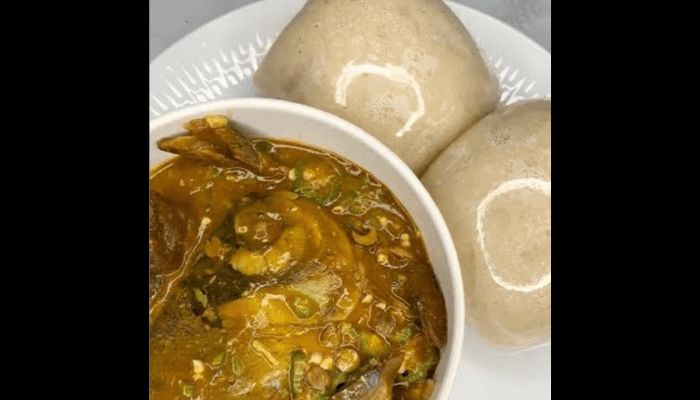
Lafun is also known as white amala and cassava flour.
The flour is a traditional Nigerian swallow made from fermented, dried cassava flour.
Very smooth white looking powder, Lafun has this unique fine texture and a tender sour taste when being eaten.
It is usualky made into a stretchy dough by cooking the flour in hot water and then served with hearty soups like Ila, (Okro Soup), ewedu, gbegiri, egusi or any other NIgerian soup.
It was an exciting culinary discussion on food journalism. The discussion in the newsroom with some Press Club students of the University of Lagos however prompted Mabel Shoyege, a student of English to take a swipe at this Nigerian South Western popular swallow.
What endeared me to Lafun was its easy to prepare technique. Unlike the yam flour Amala, that I have to cook for minutes over hot heat, Lafun cooks well with hot boiling water. Simply making it like my regular eba and seeing it look so fine and smooth, ready to eat with any draw soup sums it up.
Lafun is said to be entirely gluten-free, grain-free, and an excellent source of carbohydrates.
The flour is produced by soaking peeled cassava tubers in water to ferment for three to five days. The fermented chunks are then sun-dried and milled into a fine white powder.
Nutritionally it supports digestive health, regulates blood sugar through resistant starches, and provides essential nutrients like potassium and vitamin C. Because it is also low in calories, and serves as an excellent, filling weight-management meal.
Although gluten-free, the flour has little fiber, with negligible fat and protein. It also provides some Vitamin C, manganese, and resistant starch, which supports gut health.
Looking at its place in the UNESCO global plate is equally valuable. This is because over 30 culinary tradition globally have foundvtheirvplacevon the plate, no Nigerian culinary tradition has positioned itself on this plate.
For instance, Kimchi earned its place on UNESCO’s Representative List of the Intangible Cultural Heritage of Humanity in 2013, not simply because it is a beloved Korean dish, but because kimjang, the centuries-old tradition of preparing and sharing kimchi, represents living knowledge, community cooperation, and cultural identity passed from one generation to another.
By the same standard, Nigeria’s lafun deserves this global recognition.
Lafun is far more than a cassava meal. It is the product of indigenous knowledge, careful fermentation, environmental wisdom, and cultural practices that have sustained many Yoruba communities and other parts of southwestern Nigeria for centuries.
Every stage of its preparation reflects traditional skills that cannot be replaced by machines or textbooks.
The journey begins with fresh cassava roots, which are peeled and soaked in water for three to five days to ferment naturally.
There are no digital thermometers or laboratory instruments involved. Experienced producers determine when fermentation is complete through the distinctive aroma, texture, and appearance of the cassava.
The fermented roots are then carefully sun-dried, another stage that depends on generations of inherited knowledge, before being milled into the fine flour known as lafun.
These are not merely cooking techniques but living traditions transmitted from parents to children, grandparents to grandchildren, through observation, participation, and years of practice.
This intergenerational transfer of knowledge is precisely what UNESCO seeks to safeguard under its Intangible Cultural Heritage (ICH) Convention.
The origin of lafun is deeply rooted in Yorubaland, where cassava became an essential staple after its introduction to West Africa several centuries ago. Over time, various Yoruba communities transformed cassava into several iconic foods, with lafun emerging as one of the most distinctive, owing to its natural fermentation process.
Today, it remains widely consumed across Oyo, Ogun, Osun, Ekiti, Ondo, Lagos, Kwara, and parts of Kogi and beyond the shores of the country, while Nigerian communities in Europe and North America continue to preserve the tradition through African food stores and family kitchens.
Lafun occupies an important place in social and cultural life as families gather to process cassava during harvest seasons, women often lead the production process using knowledge inherited over generations, and local markets.
In this vein, local markets like Bodija and Oje in Ibadan remain centres where traders and consumers assess the quality of lafun by its colour, aroma, texture, and taste.
These community standards reflect a shared cultural understanding that has survived for generations.
Beyond its cultural importance, lafun also offers significant nutritional and health benefits. As a fermented cassava product, it provides easily digestible carbohydrates that serve as an excellent source of energy. The fermentation process helps reduce naturally occurring cyanogenic compounds in cassava, making it safer for consumption while improving digestibility.
Lafun is naturally gluten-free, making it suitable for individuals with gluten intolerance or celiac disease. It is also low in fat and cholesterol-free. When paired with traditional Nigerian soups such as ewedu, gbegiri, efo riro, ogbono, okra, or vegetable soup, lafun becomes part of a nutritionally balanced meal rich in protein, fibre, vitamins, and essential minerals.
Although lafun itself is not particularly high in protein or vitamins, it contributes resistant starch that supports gut health by feeding beneficial intestinal bacteria.
The fermentation process may also introduce beneficial microorganisms that contribute to digestive wellness. These qualities demonstrate how indigenous food processing techniques can promote both food safety and public health.
Nutritionally, lafun consists primarily of complex carbohydrates, providing sustained energy for millions of Nigerians. It contains small amounts of dietary fibre, calcium, potassium, magnesium, and iron, while remaining naturally free from gluten and low in sodium unless additional salt is introduced during preparation.
Its simplicity has made it a dependable staple food for generations.
What makes lafun truly unique, however, is not merely its nutritional profile but the cultural ecosystem surrounding its production. It embodies indigenous food science, environmental sustainability through sun drying, traditional fermentation technology, women’s knowledge systems, local market culture, family cooperation, and culinary identity. These are living expressions of Nigerian heritage worthy of documentation and preservation.
UNESCO does not recognise dishes simply because they are delicious or popular. It recognises living cultural practices that communities identify as part of their heritage, practices that are continuously recreated and transmitted across generations. Lafun satisfies these criteria.
It represents inherited knowledge, community participation, traditional craftsmanship, and cultural continuity that remain vibrant today.
As the world celebrates fermented heritage foods like kimchi, sourdough, and couscous, Nigeria must also champion its own culinary traditions.
Lafun is beyond a meal served with soup; it is a living archive of indigenous knowledge, resilience, identity, and innovation.
Recognising the traditional knowledge and practices surrounding lafun would not only honour Yoruba cultural heritage but also elevate Nigeria’s rich culinary traditions onto the global stage.
The time has come for lafun to move from pot to heritage, and from local kitchens to international recognition as an outstanding example of Africa’s living intangible cultural heritage.

Join BusinessDay whatsapp Channel, to stay up to date
Open In Whatsapp