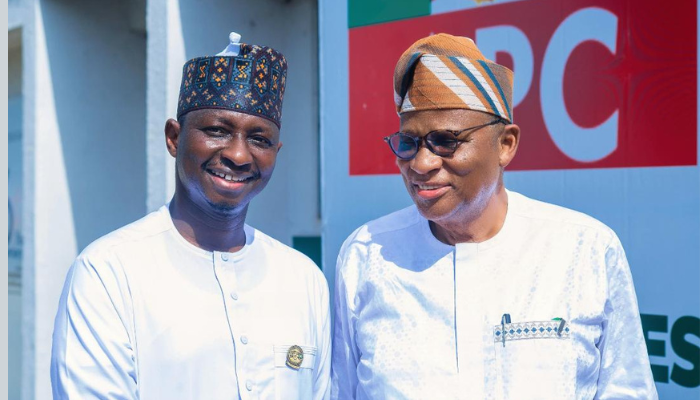
In a country battling rising insecurity, distrust in public institutions and political divisions ahead of the 2027 election, Ibrahim Mohammed Ajia, security officer and All Progressives Congress (APC) stalwart, is urging Nigerians to look beyond politics but to promote security and national unity.
Ajia, a retired officer of the Nigeria Police Force and prominent APC chieftain, spent part of the week moving between security formations and political leadership in Kwara State, delivering a message that blended sympathy, reform advocacy and partisan loyalty. But beneath the ceremonial courtesy visits was a broader attempt to reinforce confidence in President Bola Ahmed Tinubu’s reform agenda, especially within Nigeria’s overstretched security architecture.
For Ajia, the visits were not merely symbolic. They reflected concerns shared by many Nigerians about the state of security institutions, the welfare of personnel and the growing complexity of threats confronting the country.
At the Kwara State Police Command Headquarters in Ilorin, the atmosphere was sombre. Recent attacks in parts of the state had claimed the lives of police officers, underscoring the dangers faced daily by security operatives across Nigeria.
Meeting with the Commissioner of Police, Adekimi Ojo, and members of the command’s management team, Ajia expressed condolences over the loss of personnel, describing the deaths as painful reminders of the sacrifices officers continue to make in defence of the nation.
For the retired officer, the moment was deeply personal.
Read also: APC presidential primary: Turn out in large numbers for Tinubu, Olawande urges Ondo residents
Having spent years within the police institution before retiring in 2017, Ajia understands the pressures confronting rank-and-file officers from poor welfare conditions and delayed promotions to inadequate operational support and uncertain retirement structures.
He argued that genuine police reform must go beyond rhetoric and focus on the human realities facing officers on the frontline.
According to him, improving salaries, pensions, healthcare access, accommodation and career progression would significantly boost morale and strengthen public trust in the police.
Ajia maintained that President Tinubu’s administration recognises the strategic role of the police in maintaining internal security and would continue pursuing reforms aimed at professionalism and operational efficiency.
His position mirrors wider national conversations around police reform that intensified after years of public complaints over welfare gaps, poor working conditions and strained police-community relations.
Yet, Ajia’s intervention also highlighted another pressing issue manpower shortages.
He called for sustained recruitment into the rank-and-file cadre of the Nigeria Police Force, arguing that many officers currently work under enormous pressure due to personnel shortages across communities nationwide.
“Security is everybody’s business,” he said during the visit, stressing that intelligence sharing between citizens and security agencies remains critical to crime prevention.
His comments reflect a growing consensus among security experts that policing can no longer succeed through force alone, but through stronger community collaboration and trust-building.
Beyond domestic concerns, Ajia also placed Nigeria’s insecurity within a broader regional context.
He linked the proliferation of arms across West Africa to the collapse of Libya following the downfall of former Libyan leader Muammar Gaddafi, noting that weapons circulating across the Sahel continue to fuel banditry, terrorism and organised crime in several African countries.
The argument aligns with longstanding security analyses suggesting that instability in the Sahel region has deepened transnational threats across Nigeria’s northern corridors.
From the police command, Ajia proceeded to the Kwara State Command of the Department of State Services (DSS), where discussions centred on intelligence gathering, inter-agency cooperation and national stability.
Meeting with the State Director of the DSS, Michael Oganwu, Ajia praised the agency for its often unseen but strategic contributions to national security.
He stressed that emerging threats require stronger synergy among security agencies and improved coordination between intelligence and law enforcement institutions.
The DSS leadership, in turn, reiterated the importance of citizen cooperation and vigilance in combating criminality and preventing security breaches.
While security dominated much of Ajia’s engagements, politics remained close beneath the surface.
His final stop was with the leadership of the APC in Kwara State, where he reaffirmed loyalty to both the ruling party and the administration of Governor Abdulrahman Abdulrazaq.
For Ajia, politics appears inseparable from service and security. Since retiring from the police force nearly a decade ago, he has steadily built influence within APC structures, aided by longstanding relationships with party leaders and his involvement in strategic party assignments.
He recalled how his appointment to the security committee during the APC National Convention eventually led to his role as Chief Security Officer of the convention’s Situation Room a responsibility that reportedly attracted the attention of the Minister of Defence.
But beyond recounting political milestones, Ajia used the meeting to advocate party cohesion at a time when internal rivalries and succession calculations are already shaping conversations ahead of 2027.
He warned against bitterness and divisive politics, insisting that party stakeholders must prioritise reconciliation, dialogue and collective stability over personal ambition.
His remarks may resonate strongly within the APC, where internal fractures in several states have increasingly threatened party cohesion despite its dominance at the federal level.
“I am not among those politicians who sit back and say it is none of my business simply because they are not contesting elections,” Ajia said.
The statement captures the political identity he appears eager to project that of a party loyalist seeking relevance not necessarily through elective office, but through influence, mobilisation and institutional engagement.
For the Kwara APC leadership, Ajia’s visit reinforced his standing as a dependable ally within the party structure.
Party chairman, Sunday Fagbemi, described him as an experienced loyalist whose continued involvement could help strengthen internal cohesion.
Still, Ajia’s engagements raise broader questions about the evolving relationship between politics and security in Nigeria.
As insecurity continues to shape national discourse and political calculations ahead of another election cycle, retired security officers, political actors and government institutions are increasingly finding common ground around one central issue: the urgent need to rebuild public confidence in the state’s capacity to protect lives and maintain order.
Whether through police reform advocacy, intelligence cooperation or calls for political unity, Ajia’s visits underscored a recurring theme in Nigeria’s democratic journey that security and politics remain deeply intertwined.
And as the countdown to 2027 gradually begins, figures like Ajia appear determined to ensure that conversations around governance are framed not only by electoral ambition, but also by the stability and security of the nation itself

Join BusinessDay whatsapp Channel, to stay up to date
Open In Whatsapp