The political dominance of Rabiu Musa Kwankwaso’s Kwankwasiyya movement in Kano is facing one of its most difficult periods in recent years, with a growing list of influential allies abandoning the camp amid deepening internal disagreements and shifting political alliances ahead of the 2027 general election.
What was once regarded as the state’s most formidable political structure has witnessed a wave of defections involving key figures who helped build and sustain the movement over the years. The departures have fuelled debate over whether Kwankwasiyya is gradually losing its hold on Kano politics or merely undergoing another phase of political realignment.
Among prominent figures who have distanced themselves from the movement are Abdullahi Umar Ganduje, who parted ways with Kwankwaso years ago before becoming one of his fiercest political rivals; Murtala Sule Garo, a former deputy governorship candidate; Sha’aban Ibrahim Sharada, a former House of Representatives member; Kabiru Alhassan Rurum, a former Speaker of the Kano State House of Assembly; Abdulmumin Jibrin, a former federal lawmaker; and, more recently, Rufa’i Sani Hanga, whose latest comments have drawn fresh attention to cracks within the political bloc.
Others who have either exited the movement or openly aligned with rival political platforms include Governor Abba Kabir Yusuf and several former commissioners, local government politicians and grassroots coordinators who once formed the backbone of Kwankwasiyya’s expansive political network across Kano.
The latest indication of discontent came from Rufa’i Sani Hanga, who represents Kano Central Senatorial District in the Senate, as he publicly reflected on what he described as the painful outcome of his years of loyalty to the movement.
Speaking during the Danuwa’ Rano podcast, Hanga said his unwavering commitment eventually left him disappointed.
“I followed the Kwankwasiyya movement with absolute loyalty, but in the end, I was left facing the mockery of my enemies and the tears of those who cared about me,” he said.
Although Hanga avoided mentioning any individual by name, political observers in Kano interpreted the statement as a direct reflection of his deteriorating relationship with the Kwankwasiyya leadership.
His remarks have resonated across the state’s political landscape because Hanga was widely regarded as one of Kwankwaso’s most dependable allies. His emergence as senator in the 2023 elections under the New Nigeria People’s Party (NNPP), which was powered by the Kwankwasiyya movement, reinforced his position within the political family.
However, the relationship appears to have deteriorated following recent developments within the movement.
The immediate trigger for Hanga’s disappointment is believed to be the loss of his senatorial ticket in the National Democratic Congress (NDC) to Nasiru Yusuf Gawuna, a development that surprised many supporters because of Hanga’s longstanding loyalty to Kwankwaso.
Political analysts say the episode reflects a broader restructuring within Kwankwaso’s political organisation as it prepares for another electoral contest.
The emergence of the NDC as Kwankwaso’s new political platform after his exit from the NNPP has further reshaped Kano’s political equation, forcing politicians across the state to reconsider their alliances.
The transition has also generated fresh competition among long-standing loyalists and newcomers seeking political relevance within the new arrangement.
For many observers, Hanga’s comments represent more than personal disappointment. They are viewed as evidence of increasing dissatisfaction among some founding members who believe their years of sacrifice are no longer being recognised.
Several political commentators argue that the growing list of exits from the movement reflects the changing dynamics of Kano politics, where personal ambitions, succession calculations and party restructuring are beginning to outweigh long-standing political loyalties.
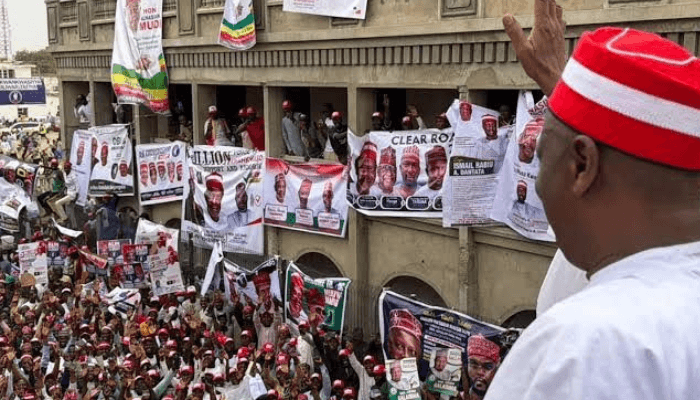
Despite the setbacks, Kwankwaso remains one of Nigeria’s most influential opposition politicians with a loyal grassroots following, particularly in Kano. The Kwankwasiyya movement continues to command significant support among youths and urban voters through its distinctive red-cap identity and extensive political network.
Nevertheless, recent developments suggest that maintaining unity within the movement has become increasingly challenging.
The rivalry between Kwankwaso and Ganduje, once close political associates, marked one of the earliest and most significant fractures within the movement. Since then, successive waves of defections have continued to reshape Kano’s political landscape.
The departure of Abdulmumin Jibrin further underscored the widening divisions. Once among Kwankwaso’s vocal supporters, the former lawmaker eventually aligned with the All Progressives Congress (APC), where he became one of the movement’s outspoken critics.
Kabiru Alhassan Rurum also moved away from the Kwankwasiyya camp after years of political association, while Sha’aban Ibrahim Sharada charted an independent political course before joining rival political interests.
Similarly, Murtala Sule Garo has emerged as a major figure within the APC in Kano, adding to the list of influential politicians who have left Kwankwaso’s fold.
These departures have altered political calculations across Kano’s 44 local government areas, where Kwankwasiyya’s organisational strength has traditionally determined electoral outcomes.
Political observers note that although defections are common in Nigerian politics, the exit of high-profile figures from the same political family within a relatively short period raises questions about internal cohesion.
Some analysts attribute the trend to competition over political tickets and leadership succession, while others believe ideological differences have played only a limited role, with personal political survival becoming the dominant consideration.
Hanga’s latest remarks have therefore intensified speculation about his next political destination.
While he stopped short of announcing any immediate plans, political watchers believe his public expression of disappointment may signal the beginning of another realignment ahead of the 2027 election.
His statement has generated mixed reactions across Kano.
Supporters sympathetic to the senator argue that loyal party members deserve recognition for years of commitment, while defenders of the movement insist that political organisations must evolve and make difficult decisions in selecting candidates.
Others have cautioned against reading too much meaning into Hanga’s comments, noting that disagreements within political movements are not unusual and do not always result in permanent separation.
As political activities gather momentum ahead of the next election cycle, Kano is expected to remain one of Nigeria’s most closely watched battlegrounds.
The state has historically played a decisive role in national elections because of its large voting population, making every political realignment significant.
Whether the recent exits ultimately weaken the Kwankwasiyya movement or simply pave the way for a new generation of loyalists remains to be seen.
For now, Hanga’s emotional reflection has added another chapter to the evolving story of Kano politics, highlighting the strains within a movement that has shaped the state’s political direction for more than a decade.
As of the time of filing this report, neither Rabiu Musa Kwankwaso nor the leadership of the Kwankwasiyya movement had publicly responded to Hanga’s remarks.

Join BusinessDay whatsapp Channel, to stay up to date
Open In Whatsapp