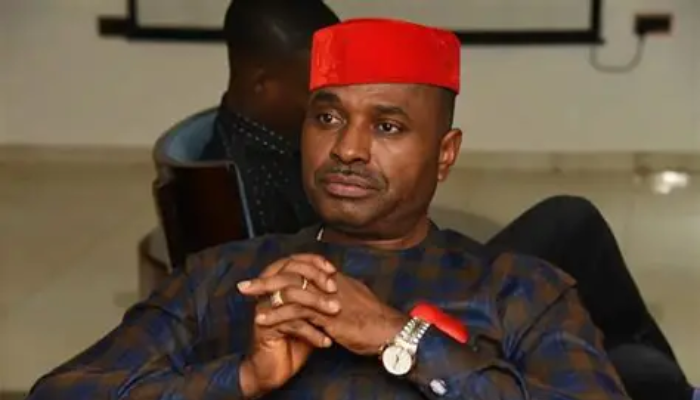
Nollywood star-turned-lawyer and budding politician, Kenneth Okonkwo, is currently being tossed about by strong political headwinds. Inadvertently, he appears submerged in a raging storm, and for almost all the wrong reasons.
He recently lashed out at Peter Obi, the presidential aspirant of the Nigeria Democratic Party (NDC), branding him the mastermind of the party’s allegedly corruption-ridden primaries. He accused Obi of conspiring with others to swindle South-East aspirants seeking elective positions under the party’s platform.
Okonkwo claimed he was on a rescue mission after being approached by Hon. Obunike Ohaegbu, whom he presented allegedly as the chief accuser of Obi and the party leadership in the region. Escalating beyond his previous characterisation of Obi as a “conman,” Okonkwo went further to portray him as a criminal conspirator involved in auctioning party tickets to the highest bidder.
However, Hon. Ohaegbu has since publicly disowned the allegations and completely distanced himself from the claims, leaving Okonkwo politically exposed and increasingly isolated. These matters are now squarely in the public domain.
The Obidient movement, renowned for its aggressive defence of Peter Obi and its relentless attacks on perceived opponents, has subjected Okonkwo to intense public criticism and ridicule. Obi’s legal team has reportedly demanded a retraction and instituted a N5 billion lawsuit against him. Former Imo State Governor, Chief Achike Udenwa, whose name was also dragged into the controversy by Okonkwo, has similarly demanded an unreserved apology and instituted another N5 billion suit.
Ironically, there has been a dramatic twist. Kenneth Okonkwo has now officially resigned from and dissociated himself from the political camp of Alhaji Atiku Abubakar—the very camp for which N10 billion worth of legal battles now hangs over his head. His reason? Atiku’s decision to choose Rotimi Amaechi as his running mate instead of a South-Easterner.
Has this marked the end of Kenneth Okonkwo’s meteoric political rise? Has he wandered into a vicious tunnel that could prematurely end his relatively short but eventful political journey?
When he emerged as one of the fringe spokespersons defending Muhammadu Buhari before the 2015 elections, the Enugu-born actor who rose to national prominence through his iconic role in Living in Bondage began a transition from entertainment into public affairs, legal advocacy and partisan politics.
He quickly established himself as a visible commentator on national issues. Perhaps, dissatisfied with his standing within the Buhari political establishment, he shifted gears and emerged as one of Peter Obi’s most vocal defenders during the 2023 election cycle.
As a prominent spokesperson and media advocate for the Obi movement, Okonkwo became one of its most recognisable voices. Yet, like the political wanderer he now accuses Obi of being, he later parted ways with the Labour Party camp over disagreements concerning strategy, leadership direction and Obi’s handling of the disputed 2023 election outcome.
Following his alignment with the African Democratic Congress coalition and his declaration that Atiku Abubakar represented Nigeria’s best hope, Peter Obi became his favourite punching bag.
Okonkwo repeatedly stated that one of his lifelong political ambitions was to see an Igbo man emerge as either President or Vice President in this democratic dispensation. Since Obi, in his estimation, failed to meet the moment, Atiku’s emergence appeared to offer an alternative route to achieving that regional aspiration.
Then came the rude shock. Atiku picked Rotimi Amaechi, an Ikwerre man who, depending on political convenience, is sometimes projected as Igbo and at other times presented as distinct from the Igbo political bloc. To many South-East political actors, Amaechi’s emergence did not satisfy the demand for South-East representation.
For Kenneth Okonkwo, the music stopped playing. He abandoned ship and immediately withdrew his support for Atiku Abubakar. Is Kenneth Okonkwo entitled to his passion for the political elevation of the Igbo people? Absolutely.
No fair-minded observer can fault the aspiration of any ethnic group to seek greater inclusion in national leadership. However, whether he pursued that cause consistently, sincerely, and without any alleged pecuniary considerations is an entirely different debate.
Recent accusations from former allies that he abandoned the Obi movement because Obi neither “paid his house rent” nor “gave him shishi” have inevitably raised questions about his credibility among some observers. Whether true or false, such allegations have complicated the public perception of his advocacy.
Arguably, the Igbo nation deserves its rightful place in Nigeria’s political architecture. Every geopolitical zone has a legitimate aspiration to national inclusion, and the South-East’s complaints about political exclusion are not without merit. Yet presidential tickets in Nigeria are rarely determined by sentiment alone. Electoral arithmetic, coalition management, regional balancing, party negotiations, candidate compatibility and perceived electoral value all come into play.
Without question, the South-East remains one of Nigeria’s most productive regions economically. The region has made immense contributions to commerce, industry, innovation and national development.
Sustainable national unity requires that every major bloc sees a pathway to leadership. Excluding capable South-East leaders from major political calculations would be both unjust and politically shortsighted. National integration is strengthened when merit and inclusion work together.
The argument, therefore, should never be that the South-East should be ignored. Rather, inclusion should be pursued through broad national coalition-building, not political ultimatums.
While Kenneth Okonkwo takes what appears to be a temporary retreat from the political battlefield, rumours continue to circulate that his withdrawal may be tactical. Whatever the case, this moment offers an opportunity for reflection.
Elevating regional aspirations into a non-negotiable political condition is antithetical to the inclusive Nigeria many seek to build. Politics is fundamentally the art of negotiation, compromise and strategic patience.
Making a South-East vice-presidential slot the ultimate test of commitment narrows strategic options and risks reducing politics to ethnic arithmetic rather than competence, vision and coalition-building.
A vice-presidential position, while symbolically significant, does not automatically translate into political empowerment for an entire region. The experience of Alex Ekwueme remains a useful reminder of that reality.
Kenneth Okonkwo’s political journey reflects a recurring Nigerian dilemma: how to balance legitimate ethnic aspirations with the practical realities of building viable national coalitions.
His latest departure from a political camp may not merely be the story of one man’s disappointment. It may serve as another reminder that in Nigerian politics, the music often stops when principle, ambition, identity and political reality can no longer dance to the same tune.
One hopes Kenneth Okonkwo will take these lessons seriously—and that Nigerians will do the same.

Join BusinessDay whatsapp Channel, to stay up to date
Open In Whatsapp