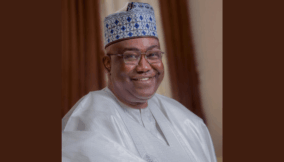
Recently, Olisa Agbakoba, a former president of the Nigerian Bar Association (NBA), spoke with a select group of senior journalists on the goings-on in the country, particularly on the refusal of the government to ensure that the constitution is applied to the letter to boost its revenue. He decried the massive leakages of revenues that were supposed to accrue to the federal government accounts as a result of seeming refusal to apply the necessary section of the constitution. He also spoke on many other national issues. ZEBULON AGOMUO brings the excerpts:
May we know your thought about the efforts of the government to revamp the economy, and why does it seem that things are getting the more difficult for Nigerians despite repeated assurances by the government?
We start from the point that things are quite difficult for Nigerians. We all live in Nigeria; I don’t have to say that the times are very challenging. There are a couple of critical things that make a country run well.
One is Monetary Policy. And I think to the extent that Yemi Cardoso has been in charge, he deserves very high marks. Because when the monetary policy process is stable, even though the currency may be high, you see, the exchange rate has been fairly stable. So, he’s doing his job. The problem is fiscal policy.
Fiscal policy simply means the revenue that the government generates.
So, as it stands now, the government is going about borrowing and borrowing. If you take away what they have to pay to service these loans and other commitments, what is left for all of us is extremely small. So, I decided to interrogate why this is the case. The main thing that we’re looking at is, where does the money go? All the monies we collect, where is it going? Section 162, subsection 1. You see what it says? ‘The federation shall maintain a special account, to be called the federation account, into which shall be paid all revenues collected by the government of Nigeria, of the federation.’ It’s not being followed. So, Ngozi Okonjo-Iweala, in her wisdom, when I look back now, I see a lot of critical good things she did as minister of finance.
She started the Single Treasury Account (TSA). Though unconstitutional, but made sense at the time.
What was the TSA to do? It was simply to do what Section 162 is to do, which is make sure that we collect all our monies and pay them into the federation account. But that’s not happening. And that’s why President Tinubu, acting on our last policy paper on crude oil funds, passed the Executive Order 9, saying that no more deduction by NNPC. But the point is that even that Order 9 is not being followed.
Because NNPC is still deducting between 60percent and 80percent of revenue. So, what they do is, when they get revenue, suppose they get, let us say, $2 billion, they now do what is called deducting OpEx (operating expenses). They deduct it. Then they say, ah, here’s the change. Then they pay it to the federation account. The NIMASA is doing the same. NPA is doing the same. Everybody is doing the same. So, these people are already well-funded. You know what they now do? They now present budgets.
Because the only authority authorised to appropriate money is the National Assembly. So, you see the double-spend. They deduct, contrary to the Constitution. Then they still present a budget to appropriate the very monies they have kept. So, we have lost, like, $200 trillion in the last 10 years. And they think that’s good to continue. We’re not going to go anywhere. And I’m saying that as the presidential elections loom, and you can see all the clatter and all the noise, but not a single politician has ever talked about the state of Nigeria’s poverty. I think that is not right. So, we said, in 2027, where our money goes must be on the ballot. Because if our money is not well accounted for, we should read the current report of the World Bank. Also, read the current report of the Auditor General. It lambasts the way government revenues are collected. So, our recommendation is that all revenues accruing to the Federation shall be paid into the Federation account in gross 9in total, not part). It must be gross, so that it will be clear to everybody that no deductions, costs, charges, or offsets of any nature shall be made prior to such payment. If this happens, our national revenue will jump by at least $20 trillion. And it will take down the need for borrowing. So, you see the importance of this. So, the purpose of this is, let’s revamp our constitutional architecture in respect of the Federation account. So that any penny that comes in or generated on behalf of the Federation must end there. When it ends into the Federation account, the second most important thing for transparency is now the appropriation. So, there will be no padding, no double spending. Because I find it ridiculous that the NNPC, having deducted 60 to 80 percent, because the money goes to them, pays just a fraction to government’s account. I don’t know why the money should actually go to them, but it goes to them.
So, when they receive the money, when they’re looking at it, they say, ah, our budget for next year shall be such and such. They deduct it. The same people deducting also presents a budget to the National Assembly. That’s why we’re broke. That’s it. That’s simple.
These challenges you highlighted, is it as a result of the ignorance of successive governments and administrations to know what the Constitution says? Or is it a deliberate decision on their part just to do the wrong thing, because, you are not the only one reading the Constitution. It’s enshrined in the Constitution. But over the years, these things have not taken effect. What do you think is the major problem here? Lack of knowledge? Or just mere decision not to apply what the Constitution says?
Too much politics. The governance is dominated by politics, and not governance. That’s the problem. I can bet, if we had to run a test on all political officeholders, many of them have not read the Constitution.
Many of them don’t even have a copy of the Constitution. They focus on getting into office. They focus on, will votes be transmitted or not transmitted? Will the Electoral Act favour them or not favour them?
For me, I don’t talk about politics, I talk strictly on policy. But I know that the only conclusion I can draw from the question you’ve raised is they don’t know the Constitution. That’s the reason. So, there is such lack of knowledge. So, we’re looking for a leader in 2027 and absolutely don’t care who that person is.
But he must understand the Constitution. It’s like saying that you’re a preacher. You’re preaching to us, but you don’t know the Bible. And then I ask you, what does Matthew 2:14 say? And you say, well, can I have a copy of the Bible there? They don’t know the Constitution. You’d be very shocked. The absolute lack of knowledge and ignorance of the political class. So, the low level of governance knowledge is what accounts for this.
Are you saying that the present crop of political actors in government lack knowledge in regards to fiscal responsibility? And may I also ask, who are the powerful actors who benefit from the opacity of this system?
Political class. They are the ones who benefit.
The political class are the people who benefit in not following the Constitution. It’s obvious. Because the Constitution ought to be obeyed. Section 1, subsection 3 says that this is the supreme law of the land and has to be obeyed. And we know it’s not being obeyed. The NNPC cannot be deducting 30 percent management fee;, 60percent frontier fund, this and that, and that. Okay, why was the TSA passed? Even though it is unconstitutional. It’s because some ministries and agencies, at that point, government had about over 100,000 accounts. So, TSA then came to say, you can’t do that. Everything must be sent directly into the federation account. So, there’s an awareness. But I don’t know whether that awareness is deep enough to understand that we are bleeding. That’s my point. So, that fiscal policy, the simple way out for them is to borrow. But why don’t they think that rather than borrowing, we can actually generate our own resources and harness it and control it so that the borrowing will not be required. Because if borrowing continues at this level, in the next four years, we will top 200 trillion. But if we tighten this, then in the next four years, we will earn about 100 trillion, reducing the need to borrow. That’s why this fiscal shift; it’s the most important political decision that anyone who wants to be president can take. What is the point of entering Aso Rock and you are broke? What is the point? I don’t see the point. You want to become president because you have the resources to execute development projects for the good of Nigerians, for welfare, for security from all the ravages we are suffering. That would be the utmost intent of anyone who wants to be president. So, anyone who wants to be president, when you see all the political aspirants that want to be president, ask them, what does Section 162 of the Constitution say? If they fail, then they are not qualified to be president.
In your paper, you said that the Constitution did not specify a custodian for the federation account. Are you saying that the custodian is opaque too?
That’s what I’ve said. The constitution says that the federation shall maintain a special account. You see that part? To be called the federation account into which shall be paid…Who is paying? These are the gaps. Who is paying? All revenues collected by government of the federation except blah, blah, blah, blah. So, that’s the gap. So, I’ve said that’s the gap I see in section 162, and please, this is my own opinion. It doesn’t mean that they’re necessarily right. It’s intended to generate policy discussions and debates. So, I say, who is exactly the custodian of the federation account? Where is the federation account? Some say it should be the CBN. I don’t see how it should be the CBN. The CBN is a monetary authority, but the federation account is a fiscal instrument. Monetary is a different thing from fiscal. So, why would CBN be the custodian? So, what this policy document does is not to necessarily claim that it’s 100percent correct, but it’s to generate the sort of question you asked me. Okay, who keeps the account? Who actually, you have a bank account, don’t you? You transfer. You know how much is in your account because you control it because you’re the custodian. So, who is the custodian of the federation account? That’s the question I’m raising. I don’t know. And I’m happy to hear anyone tell me that he knows who that is, the AGF, or the president, or the OAGF, or the CBN. Even the CBN governor, Sanusi Lamido, back then, who was supposedly the custodian, remember when he was suspended? He was suspended because he announced, he can’t find $20 million. So, this is the custodian, the assumed custodian; he was saying ‘I’m not in control.’ So, this is a huge problem. So, this problem should be resolved by those people who want to lead us.
And since we have upcoming elections, let them stop talking about decamping from one party to the other and face governance. That’s the issue. What it overwhelming governments to the point where they forget the very document for which they seek election? I mean, one example of a person who clearly understands what he’s doing is the Abia State governor. Clear. Because nobody will tell you when somebody is performing. So, generally, across the 774 local governments, 36 states, the federal performance in respect of governance is poor. This is an ABC matter. It’s so simple that the first thing I will do when I sit down in the chair of the president, not that I want to sit there, just saying. When I sit down there, I say, where’s our money? That’s what I’ll be asking. Because I have made promises, campaign promises on that. So, where’s our money? Who signs? Who do I talk to? That will be the first question. But it doesn’t seem that is the question they’re asking. So, that is the essence of this policy paper.
The sharing continues and the people are getting poorer while state governors are living large. So, what actually is the advice you would give the government going forward on how to manage public funds?
The advice I would give is make sure all government monies are accounted for by putting it in the traditional account. Because if you don’t do that, then every month when the Minister of Finance gathers the Commissioners of Finance, it is just a sharing bazaar. They’re not asking the serious questions. Even though the Supreme Court has said gross monies must be paid in. So, you see, we need attention to be drawn to this problem. We need their attention to be drawn. So, it’s not enough to go to Abuja and say, ah, there’s a Gulf War. Therefore, oil prices have gone up. Therefore, our FAAC allocation will be more.
So, we’re taking more. When you take that more, how does it affect people on the ground? And that is partly due to the opacity of Section 162. Because, if I wanted to hold my governor to account, I don’t know exactly how much he receives every month. It’s all secret. So, the whole process must be open by this new law that we have proposed.

Join BusinessDay whatsapp Channel, to stay up to date
Open In Whatsapp