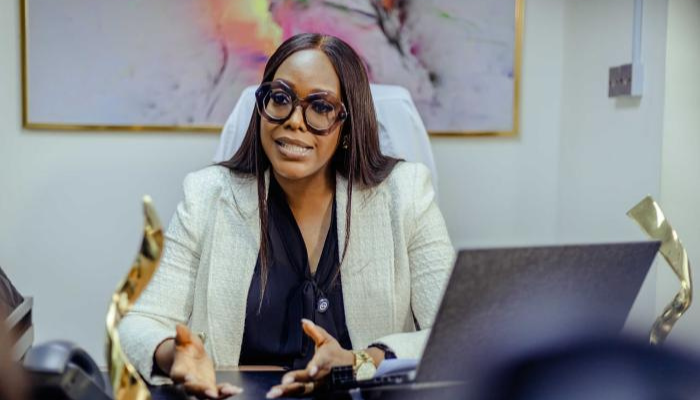
Olayemi O. Dawodu, MD/CEO of Cerba-Lancet Laboratories Nigeria, is a woman defined by vision and strong leadership. In this interview with NGOZI OKPALAKUNNE, Dawodu who is also an anatomic pathologist and a laboratory physician, shared insights into what women naturally bring to leadership. She also reflected on being honored for the fifth time at the Nigeria Healthcare Excellence Awards, (NHEA). Dawodu further highlighted the importance of continuous learning and skill acquisition for women aspiring to leadership, while also addressing key issues of national concern. Excerpts:
Healthcare leadership especially is a male-dominated area. What has been your experience as a woman?
My experience has been shaped by the thoughts around leadership not being defined by gender, but being defined by competence, vision, resilience, and results. That is being result-orientated, so I never really looked at it as, oh, I am a woman. It was a matter of you needed to be competent and you needed to ensure that you up skilled yourself with all that was required to take on the role and to do it excellently well.
What qualities do you believe women naturally bring to leadership? And what stereotypes about women in leadership do you hope your journey helps to challenge?
What do we bring as women? Natural maternal instinct. God has blessed us with that, so it is not something that we need to cultivate. We were blessed with it from birth. And healthcare is a place that needs that nurturing, the care and the compassion that a woman brings to the table. Which, honestly, you cannot compare to our male counterparts. Those are the things I think that we bring to the table. What I would hope that my journey shows is that you can do it as a woman. Again, with a caveat of course, not without ensuring that there is some competence to be able to take on that opportunity or the task that has been given to you. And honestly, learning must be a lifelong desire and skill for any woman that wants to lead.
You must continue to learn and learn and learn and improve yourself every day on whatever challenge or task or position you are given.
Has your leadership journey shaped your perspective today?
It has, yes. It has shaped this in the sense that I believe in that mantra that says be prepared. And of course, I believe in that mantra that says, “Luck is what happens when preparation meets opportunity.” When I look at my journey, for sure, if I was not a pathologist or a laboratory physician, I do not think I would have been able to fit into the role of leading a multinational. And then, as I said, along the way, all of the opportunities that have been availed to me, which I did not know exactly where they were leading me to, also helped significantly. Because in administration, I was able to also have administrative functions that I carried out as the chief resident, like I mentioned, and liaising with the teaching hospital, dealing with older colleagues and professors. So, being in pathology and a laboratory physician, it was like fish and water.
So, what are some of the greatest leadership challenges that you have encountered when you assumed the role?
I think a very big one that also still always exists is managing people. Managing people and their diversity, getting their buy-in into your vision and what you are required to do. It takes a lot of navigating, a lot of wisdom, and, also a lot of unlearning and learning new skills to ensure that you accommodate everyone’s diversity, but also keep us all focused on the objective of why we are here. So, if you ask me, the biggest challenge is managing people.
Looking back, what experiences shaped the leader you are today?
Usually, I would go as far back as my childhood. So, I am a third child in the midst of five children. And so, I am the middle child. And honestly, from when I was a very young age, I was saddled with the responsibility of having to navigate and take responsibility early. Because my older ones were significantly older than I was with six and eight years.
And then I had two younger ones who were closer in age. And it kind of always put me in a position where I took on responsibility quite early. So, for me, I would say leading was quite natural.
Whether it was at home, like I said, and even in school, I participated in quite a bit of sports. And it might sound not connected, but those things all play up together. I mean, for sports, you needed to learn to be a team player.
You needed to learn perseverance and resilience as a sports person. Also, I had leadership roles in primary school, secondary school. Primary school, I was the class captain.
And in secondary school, I was the health prefect in my secondary school. And going on to my residency training, I was the chief resident in my programme. And the chief resident is saddled with the responsibility of looking after the interests of the residents, as well as managing the consultants and professors in the department.
And it had me in a position where I had to liaise with the management of the Lagos University Teaching Hospital, where I trained to take part in administrative meetings and all that. So for me, I think full circle. I’ve been exposed to quite a lot of opportunities to express or imbibe leadership traits that honestly do play out in how I lead currently
Congratulations on winning the Nigerian Healthcare Excellence Awards (NHEA) award for the fifth time. And so, what does this recognition personally mean to you?
The recognition personally for me validates the work that we do at Cerba Lancet every day. The pillars that we rest on – innovation, quality assurance and being patient centred. It makes me personally happy that in our sector and beyond, we are acknowledged. And it also places a sense of responsibility to ensure that we continue to improve and uphold the trust that has been placed in us at Cerba Lancet. So, for me, I think it is a testament to the great work that the team and all the staff at Cerba Lancet are doing every day to ensure that we are giving out reliable and quality results that are providing the correct management and positively impacting the lives of the citizens in Nigeria that we serve.
When people are celebrating this achievement, what do you hope they understand about the work that goes on behind the scenes?
I hope that they acknowledge and, as I said, also celebrate each and every staff that contributes to the kind of operations, the quality and the results that they receive that impacts their lives. So, basically acknowledgement of each and every staff that takes part in us being able to deliver on our mandate of quality results coming out of the organisation. I hope they also are able to acknowledge our systems, our processes, our protocols that are in place that ensures that we are able to repeatedly reproduce accurate results coming out of the organisation and that they know that we are operating this organisation to the highest standard, the international standards that we use in carrying out our services at Cerba Lancet in Nigeria. Those are things that are very important that they are able to acknowledge as well.
How would you define success beyond awards and recognitions?
I would define success as having more impact to a larger population of Nigerians’ lives, preventing complications from non-communicable diseases where we play a very big role with our clients that come in to check their numbers, to know their numbers. Impact is also helping even organisations to have full awareness about the medical status or the health status of their staff so that they can modify their policies to get more productivity from them. And as well, that the nation acknowledges the information and the data and knowledge that we contribute to the body of knowledge and the help that we provide in planning for health care in Nigeria.

Join BusinessDay whatsapp Channel, to stay up to date
Open In Whatsapp