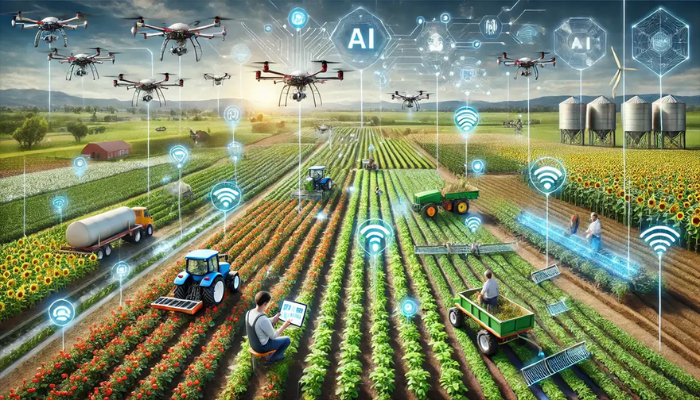
In this digital age new technologies are out there reshaping farming methods, to drastically reduce dependence on man’s physical energy as well as other processes of agriculture. In its essence, using Artificial Intelligence ( AI ) technology boosts farming by improving crop yields, conserving water, and automating tasks through precision agriculture, smart irrigation, as well as early disease detection. These cut across the value chain of agriculture.
When it comes to precision farming the AI uses sensors and satellite data to tailor soil treatments and fertilizer application to exact field sections, cutting waste by up to 40%.
With regards to smart irrigation it combines soil moisture monitors with weather data to water plants only when needed, reducing water usage by 30 percent to 60 percent.
Furthermore, AI has the capacity for pest and disease detection: Analyzes smartphone photos or drone imagery using computer vision tools like Plantix to diagnose crop stress before symptoms spread widely.
It also assists in yield and market forecasting by predicting harvest output volumes and market price swings to help farmers plan distribution and sales.
All these bring us to the practical benefits for growers for lower Input costs. The rargeted chemical and water use saves money on supplies.
Resource Conservation: Minimizes environmental runoff and protects soil health over time. There is therefore, the use of autonomous labor: drones and smart robots to handle repetitive tasks such as weeding and harvesting, especially when manual labor is scarce.
As updated the Consortium of International Agricultural Research Centers has created a mobile phone app that identifies pests and disease. So, as practical applications for AI in farming continue developing two University of Tennessee experts explained how AI technology helps farmers improve production planning, compliance and cost optimization at a Southern Cotton Ginners Association meeting.
These days a farmer can use a tablet from middle of a cornfield.
AI is a powerful tool for farmers, but data security and recommendation reliability still require extra care.
Viewer at a glance
Artificial intelligence is becoming more common on farms for instance in the United States. But it is advisable for the farmers to always verify AI-generated recommendations, and use them with caution.
Artificial intelligence is becoming increasingly common on agricultural operations, and farmers can use it to assist in a variety of on-farm tasks. Both Aaron Smith, professor of agricultural and resource economics specialization and farm bill policy, as well as Sathish Samiappan, associate professor of biosystems engineering and soil science, from the University of Tennessee, presented several examples of how AI is already transforming farms across the Midsouth at the Southern Cotton Ginners Association summer meeting in Florence, Ala.
For production planning considered
One of the most powerful applications Smith described a Kentucky farmer who uses AI to analyze a decade’s worth of production data. According to him: “This report analyses 10 years of precision planting and harvest data across his corn, soybean and wheat on the farm,” Smith said. “It’s based on his John Deere Operation Center precision seeding and harvest records.”
The AI analysis revealed critical insights that could significantly impact profitability for the grower’s operation, including delayed planting costs and specific management recommendations. Smith emphasized the practical value of such analysis.
“How do you take this and turn it into an actionable decision is where I really see that benefit? It can really help you in terms of doing that analysis,” he said. “It can also help you in terms of saving money or giving you an indication of what the probability of a more profitable outcome is.”
On the important issue of compliance support
Smith also demonstrated how AI can help with regulatory compliance, especially regarding pesticide applications. Using a simple example, he showed how farmers can upload herbicide labels and ask specific questions about application timing and conditions.
“Based on the attached label requirements and current weather conditions and time of year, can I spray Liberty on cotton?” he asked. “The program said, ‘Yes, you can likely spray today, but I would target an application from now through late morning rather than waiting until the afternoon.’”
The system automatically pulled in weather data and provided justifications based on temperature, sunlight, rain, wind and weed conditions.
Smith however, cautioned about verification. Asking leading questions can result in off-label recommendations, so he cautions users to be very careful and always refer back to the source label or document. This can be done by asking the program to show the exact source of the information.
Narrowing it down to cost optimization
Smith shared another practical application involving a farmer using AI to optimise input purchasing decisions.
With AI technology biological seed treatments are evolving beyond the hype:
Concerning remote sensing
Samiappan focused on AI applications using imagery from satellites, drones and ground robots. His research looks to make sense of the photos for farmers and use them to recommend future steps, he said.
One breakthrough application involves detecting plant stress before visible symptoms appear.
“We looked at spectral information from cotton leaves, and we were able to detect the infestation of root knot nematodes less than two weeks before any visual symptoms showed up,”
Looking ahead
Smith and Samiappan both noted that AI is still evolving. Samiappan added that while some technologies exist today, AI needs to be operationalized in the coming years for growers’ needs. Smith emphasized the importance of data quality and security, distinguishing between consumer-level AI platforms and enterprise systems that protect proprietary farm data.
As AI continues to develop, both experts see tremendous potential for agriculture. They suggest the importance of understanding how to use these tools effectively while maintaining appropriate oversight and verification of AI-generated recommendations.

Join BusinessDay whatsapp Channel, to stay up to date
Open In Whatsapp