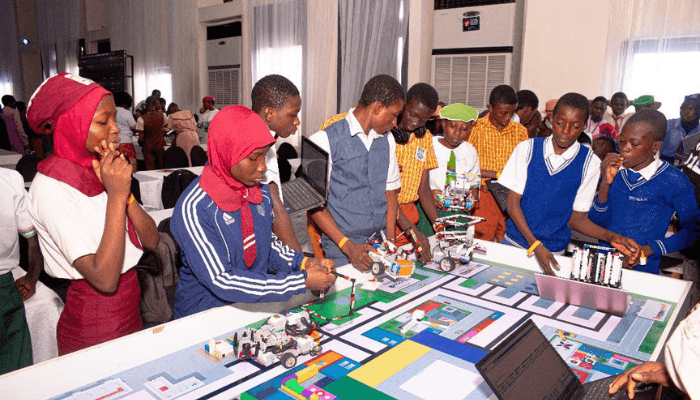
Determined to groom the next generation of resilient, technologically innovative youths for Nigeria and Africa, Arc Lights Foundation hosted the 2026 World Robot Olympiad (WRO) Nigeria National Tournament and the Astro League Africa Games in Lagos.
The event brought together talented students, dedicated coaches, and forward-looking educators from across the nation to foster rigorous teamwork, virtual reality simulations, and hands-on mechanical building, helping students develop critical thinking and collaborative problem-solving.
Abisola Obasanya, founder of the Arc Lights Foundation, said at the event that the true essence of the WRO lies not in the final scores but in the transformative journey of learning.
According to her, the tournament is uniquely designed to mirror real-world business and technological challenges. Recognising that some robots will inevitably fail during testing, the organisers use these moments to teach invaluable life lessons about resilience.
“This is where ideas become solutions, dreams take shape, and future engineers, scientists, entrepreneurs, and technology leaders begin their journey to global impact. Competition for us is not the focus; education is the focus. The change in your life is what we always focus on”, Obasanya said.
She urged participants to troubleshoot, rebuild, and continuously iterate skills that directly translate to future entrepreneurial endeavours and scientific breakthroughs.
Beyond technical acumen, the WRO fosters crucial soft skills, notably through initiatives like “Friendship Night,” which teaches young innovators how to network, collaborate across diverse backgrounds, and exchange ideas globally.
Obasanya further said that a central pillar of the 2026 tournament is its compelling theme: “Robots Meet Culture.” This thematic focus serves as a powerful reminder that while technology is rapidly advancing, it should be harnessed to strengthen and preserve cultural identity rather than replace it.
She said that by presenting their cultural narratives alongside cutting-edge robotics, the children demonstrate the renowned resilience, excellence, and kindness of the Nigerian spirit.
Innovation, according to the founder, is most powerful when it is deeply inspired by culture, adding that the overarching goal is to cultivate a profoundly positive mindset among the youth regarding their country, equipping them to engineer targeted solutions for Africa’s greatest systemic challenges, spanning healthcare, sustainable agriculture, and industrial development.
On his part, Olubowale Sangosanya, founder and CEO of Isecure Academy, while delivering a critical keynote presentation titled “Data Privacy, Digital Footprint Management, and Responsible Use of Technology,” noted that the modern digital space can be highly unsafe for the unprepared.
He introduced the concept of the “fourth pillar of education.” Where traditional curricula relied on reading, writing, and arithmetic, the modern world demands a fourth, non-negotiable pillar: Digital Safety. Children today face a barrage of sophisticated online risks, including cyberbullying, predatory grooming, identity theft, phishing scams, gaming fraud, and the rising threat of AI-generated deception, such as deepfakes.
“A child who understands digital safety is better equipped to navigate the modern world confidently, responsibly, and securely. If you know how to stay safe online, you will not be afraid to use the internet because you know what to do to prevent being compromised,” Sangosanya said.
The conversation expanded beyond individual student safety to address the vulnerabilities of educational institutions. Schools currently house vast amounts of sensitive digital data from student records and examination results to financial data and staff information. A cybersecurity breach could devastate a school’s reputation and severely compromise student welfare. Isecure Academy called upon school leaders to actively integrate cybersecurity awareness into their institutional frameworks, transforming them into cyber-resilient entities.
Furthermore, Sangosanya addressed the rapid proliferation of Artificial Intelligence technologies like ChatGPT and Claude. Framing AI as a “double-edged sword,” he warned against its potential misuse for plagiarism, misinformation, and deepfake manipulation.
However, he stressed that the goal is not to fear AI, but to master it. By teaching children to use AI ethically and responsibly, they can leverage it as a powerful tool to accelerate learning and solve complex socio-economic problems.
Isecure Academy outlined its core mission through four strategic pillars: protecting children from cyber threats, securing school infrastructures, developing unshakeable digital resilience in youth, and preparing the next generation of African cybersecurity professionals. The organisation issued a unified call to action for all stakeholders present:
He urged Teachers to integrate digital citizenship into their daily lesson plans beyond standard academia and called on school leaders to embed comprehensive cybersecurity awareness into the core curriculum.
Sangosanya said that by collectively embracing these digital safety practices, Nigeria and the broader African continent can build a stronger, more secure digital economy, drastically reduce cybercrime, and cultivate a highly skilled workforce ready to dominate the emerging global cybersecurity landscape.

Join BusinessDay whatsapp Channel, to stay up to date
Open In Whatsapp