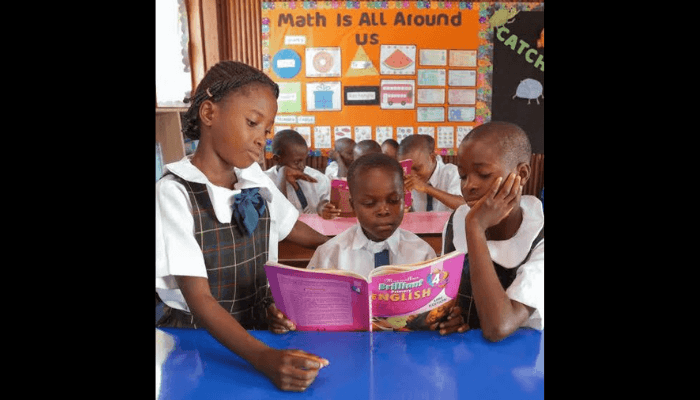
An exemplary Nigerian school, Slum2School Green Academy, has been named to the Top 10 shortlist for the World’s Best School Prizes 2026 for its approach to advancing learning for underserved children in Nigeria.
The school, which is a charity-run kindergarten and primary school in Epe, Lagos State, Nigeria, is advancing learning for 250 underserved children from eight riverine communities through a first-of-its-kind, climate-smart school with an experiential, inquiry-based learning model that helps students gain up to 3 years of learning in a single school year.
Vikas Pota, Founder of T4 Education and the World’s Best School Prizes, said that recognition of Slum2School Green Academy has shown that Nigeria’s schools truly stand among the best in the world.
Pota said that each one of these exemplary schools shortlisted for this global schools’ prize has, in its own unique way, helped prepare young people for a world that has never seemed so uncertain, adding that it is more important than ever that schools grow the leaders needed to face massive challenges from rising conflict and inequality to populism and climate breakdown.
“In their classrooms, every day, these institutions show what works. And governments and schools across the world should learn from their shining examples,” Pota said.
The Founder of T4 Education further said that the winners of the five World’s Best School Prizes – for Community Collaboration, Environmental Action, Innovation, Overcoming Adversity, and Supporting Healthy Lives – will be chosen by an expert Judging Academy based on rigorous criteria.
The Top 3 finalists and winners will be announced in November. In addition, all 50 shortlisted schools across the five Prizes will also take part in a Public Vote, which opened today, to determine the winner of the Community Choice Award.
The winners and shortlisted schools will then be invited to the World Schools Summit in London, UK, on January 16-17, 2027, where they will share their best practices and unique expertise and experience with policymakers and leading figures in global education.
Slum2School Green Academy, realising that a conventional school model would not be viable because of the environmental and logistical constraints, built a Green Academy using locally sourced natural materials such as bamboo and wood, allowing it to integrate with the environment and withstand local conditions.
Designed as a climate-smart, eco-friendly system that is largely self-sustaining, it is a living ecosystem where students learn in classrooms cooled by natural ventilation, drink clean water harvested on-site, participate in waste management and recycling, and grow food in school gardens.
The school’s pedagogy is built around the reality that most students are starting from little or no prior exposure to formal learning, with teaching structured around a blend of project-based, play-based and hands-on learning that allows students to build literacy and numeracy through experience instead of books. Lessons are intentionally designed to connect what the learners live in their day-to-day lives, using visual, physical and experiential approaches. The curriculum deliberately introduces global perspectives through digital tools, storytelling and guided exploration, giving children the chance to see themselves in a wider world, which builds their confidence and curiosity.
Additional resources within the school include a digital lab for computer learning and coding, as well as a library to support reading development.
Through the reimagined model, 96% of students have improved at least one proficiency level in literacy and more than 70% in numeracy. Over 90% are now reading at or approaching grade level, despite the majority starting without foundational skills. Attendance reached 80% within the first academic year.
In terms of environmental impact, the campus operates entirely on solar energy, generating approximately 28,000 kWh annually and eliminating an estimated 10–15 tonnes of carbon emissions. Rainwater harvesting systems provide up to 160,000 litres of clean water each year, waste-to-biogas systems are producing around 1,400 cubic metres of clean cooking gas annually, and student-led stewardship has reduced unmanaged waste on campus by 80%. More than 700 families now benefit from improved water access, sanitation practices and environmental awareness.
What makes the Slum2School Green Academy truly unique is its replicability as a scalable blueprint for Africa’s first network of sustainable, community-centred schools, where educational equity, climate action, and innovation can coexist even in the most challenging contexts.

Join BusinessDay whatsapp Channel, to stay up to date
Open In Whatsapp