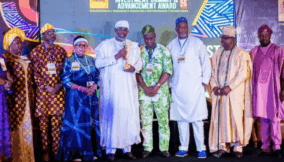
…We are now moving from projection to reality – Aina
At COP26, Nigeria announced its commitment to carbon neutrality by 2060, with a roadmap to reduce emissions and power national development.
Shortly after, Nigeria’s Energy Transition Plan (ETP) was unveiled to highlight the scale of effort required to achieve the 2060 net-zero target whilst also meeting the nation’s energy needs.
Since that announcement, the ETP has been fully approved by the Federal Government under the Climate Change Act 2021, with the Energy Transition Office supporting the Federal Government in the implementation of the ETP.
However, Nigeria is annually faced with the challenges of desertification in the north, floods in the North-central, pollution and erosion in South-South/South East zones and the associated socio-economic consequences alluding to the reality and grave impacts of climate change.
In response to Nigeria’s energy transition challenges, Greenplinth Africa Limited organised a two-day retreat, which was concluded last Wednesday, themed ‘Clean Cooking Access in Africa: Igniting Socio-Economic Change with 80M Clean Cookstoves in Nigeria.’
Chaired by Ibrahim Usman Jibril, Emir of Nasarawa & President, Nasarawa Emirate Council, the retreat included a strategic action for the phased roll-out of the 80M Clean Cookstoves project in Nigeria, and a special media chat aimed at stirring conversations and actionable plans.
Stakeholders at the engagement agreed that successful implementation of the 80 million clean cookstoves initiative would require strong collaboration among governments, investors, development partners, manufacturers, financial institutions, technology providers, community organisations and the media.
They stressed that accelerating access to clean cooking technologies could play a critical role in reducing energy poverty, protecting forests, improving public health outcomes and supporting Nigeria’s transition to a low-carbon economy.
“Today is not about announcing just another project. Today is about declaring a national movement. A movement for clean energy, healthier homes, women’s dignity, household empowerment and climate responsibility,” Babatunde Aina, the Group’s financial officer, Greenplinth Africa Limited, said while describing the project as a national movement aimed at advancing clean energy access, climate responsibility and economic inclusion.
According to Aina, the initiative would transform the way millions of Nigerians cook and live while reducing the environmental and health burdens associated with traditional cooking methods.
He added that the project was designed to deploy clean cookstoves to households free of charge under a structured lease arrangement to ensure accountability and sustained usage by beneficiaries.
According to him, Nigeria cannot afford to remain on the sidelines of the global clean energy transition. He disclosed that Nigeria cannot afford to watch opportunity pass by; adding that the 80 million clean cookstove project offers a different path to a more prosperous country.
“Nigeria cannot afford to leave millions of women and children exposed to avoidable household smoke, unsafe wells, and energy poverty,” Aina said.
Aina, who is also the deputy managing director of GreenPlinth, described the meeting as a strategic retreat to let the world know that “we are moving to the next phase- to give the definitive date of when we are rolling out and the process of rolling out.”
He disclosed that “We are starting with Lagos State on July 21, this year; then the following week, we do the same thing in Benue, then in Niger and last in the series, we do the same thing in Nasarawa State. We are now moving from projection to reality.”
Titilayo Oshodi, special adviser (SA) to Lagos State Governor, Babajide Sanwo-Olu, on Climate Change and Circular Economy, described the project as one of the most promising climate investment opportunities currently attracting global attention.
Oshodi said in a keynote address delivered virtually during the strategic project implementation management retreat and stakeholders’ engagement of the 80M Clean Cookstoves project in Nigeria, that the initiative was generating significant interest from international investors, development institutions and climate finance organisations. She was participating in the London Climate Action Week that just ended.
According to Oshodi, the project offers a practical solution to some of Africa’s most pressing environmental, health and economic challenges while advancing Nigeria’s climate commitments.
“Clean cooking must be recognised not simply as an energy conversation, but as a climate solution, a health intervention, a gender empowerment strategy, an economic inclusion mechanism and a pathway towards sustainable development.”
Oshodi also said that the pilot phase of the project, held in Makoko, presents opportunities for climate finance mobilisation, carbon credit generation, green industrialisation, women’s economic empowerment and job creation.
She explained that Lagos State is currently promoting investment opportunities in clean energy, sustainable mobility, climate resilience and carbon markets as part of its State Determined Contributions framework being showcased during London Climate Action Week.
Ibrahim Usman Jibril, Emir of Nasarawa & President, Nasarawa Emirate Council, described the project as a timely intervention that could help Nigeria harness opportunities in the global carbon market while addressing major public health and environmental challenges.
According to him, millions of people continue to rely on firewood, charcoal and kerosene for cooking despite the associated health risks. He noted that indoor air pollution remains a major public health concern and contributes to millions of deaths globally every year.
“We have a proposed plan, we have a verification system, we have a carbon pathway, and we have a vision that connects household dignity with environmental responsibility. This is the beginning of something very major,” he said.
Jibril, a former minister of environment, who served as chairman of the retreat, commended the choice of Makoko, a waterside community in Lagos, as a strategic location due to its population density and energy challenges.
He, however, urged Greenplinth Africa to collaborate with universities and research institutions to strengthen scientific research, innovation and long-term sustainability of the programme. “For Greenplinth to come up with this initiative, they are not only helping us to get the carbon credits that others are reaping away, but they are helping humanity,” Jibril said.
Jide Alo, a professor of Chemistry, University of Lagos, in a paper presentation on ‘Reversing the perennial negative impact of firewood & kerosene cookstoves on public health and the environment: The Panda cookstove solution,’ said that about 30 percent of household biomass dependence relies on fossil fuels that are used as a core energy source, resulting in severe pollution.
According to him, women and children are mostly at the receiving end of the energy crisis and are vulnerable to smoke inhalation and heavy fuel pollution. “We have an energy crisis. So, it’s a crisis within a crisis,” Alo said.
He added that the 80 million clean cookstove initiative was the world’s largest clean cooking project, aimed at a transformative national economy. “So, what we are saying is that it will prevent up to 1.2 billion tons of CO₂ emissions, generate billions in green revenue, foster a new economy, and significantly enhance public health.”
Salisu Dahiru, in a paper titled, ‘Transforming Lives, Restoring Forests and Powering Nigeria’s Sustainable Future,’ said that the entry point for the clean cookstoves initiative was in the area of the Nigeria Energy Transition Plan, which has been designed to address the challenges of energy poverty, as well as deal with the issue of climate change.
According to him, the Energy Transition Plan aims to shift about 80 percent of the population from traditional biomass to clean fuels as the main energy source for cooking by 2060.
Dahiru, a pioneer director general (DG) of the Nigerian Climate Change Council (NCCC), said that without collaborative support with the 80 million clean cookstove initiative, Nigeria’s desire to achieve its targeted energy transition plan cannot and will not be fulfilled.
“This is for the record. No 80 million cook stoves in Nigeria, no successful completion or implementation of the Nigeria Energy Transition Plan,” he said.
According to him, the initiative presents a verified climate solution and a sustainable revenue stream that offers a better future for participants.
“By protecting forests, by reducing these carbon emissions, as well as other non-carbon obnoxious emissions that affect health, delivering verified impact, generating carbon revenue, and empowering communities,” he said.
Speaking with journalists at the event, he commended GreenPlinth over the project, saying that the strategic session enabled the critical stakeholders to tie all the knots ahead of the rollout in the four states that have already signed an agreement with GreenPlinth.

Join BusinessDay whatsapp Channel, to stay up to date
Open In Whatsapp