The federal government is apparently rattled and miffed by the escalating price of cement as it is calling on cement manufacturers to, as a matter of urgency, reduce the price of the product.
David Umahi, minister of works, who made the call, noted that it is not only that the price hike is piling pressure on infrastructure projects, but also increasing demands for contract variations by contractors handling government projects.
In Nigeria, material inflation is currently structural rather than cyclical. A 50kg bag of cement that was priced between N7,500 and N10,000 in 2025 increased to as much as N13,000 in 2026, with some other construction materials experiencing a 100 percent increase.
Overall, cement prices in Nigeria are currently soaring, reaching as high as N13,000 per 50kg bag, with retail prices hovering between N11,500 and N15,000 in various parts of the country. This steep surge is driven by elevated production and energy costs, and has stalled major construction projects while threatening homeownership dreams.
The latest hike follows recent price adjustments by major manufacturers, including Dangote Cement and BUA Cement, leaving builders, contractors, landlords, and prospective homeowners struggling to cope with rising costs.
Dealers and distributors have expressed frustration over the persistent upward review of cement prices, saying the development is becoming unbearable for both businesses and ordinary Nigerians.
In recent times, the Federal Government has been actively transitioning its federal road networks from traditional asphalt to heavy-duty, reinforced concrete pavements. This policy is being spearheaded by the Federal Ministry of Works with the aim of extending highway lifespans to between 50 and 100 years, drastically reducing the need for continuous, costly maintenance.
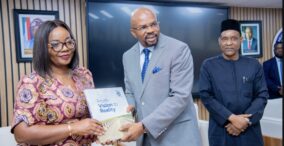
This explains why Umahi, in his keynote speech at a new corporate identity unveiling by Lafarge Africa in Lagos recently, stressed that the federal government would engage cement manufacturers to address the issue of cement prices.
“I insist that Lafarge and other manufacturers of cement should reduce their prices because, according to him, “contractors are chocking me to review their contracts. But nobody is reviewing anybody’s contract. It’s the manufacturers of cement that should review their cost.”
The minister noted the federal government is investing heavily in critical infrastructure across the country, creating opportunities for manufacturers and investors. He therefore urged Lafarge and other industry players to expand their capacity to meet the growing demands of the nation’s infrastructure revolution.
He used the occasion to highlight the remarkable progress being recorded the federal government on infrastructure, citing the Lagos-Calabar Coastal Highway as evidence of the administration’s bold vision and commitment to national transformation.
According to him, “the quality and scale of the project have continued to attract global attention and admiration. When the Dudge Bank came to evaluate our project, they said it was undervalued and that the project is of topmost quality.
Umahi expressed profound appreciation to President Tinubu for providing the leadership and political will driving the country’s infrastructure renaissance, assuring Nigerians that the administration remains firmly on course to restore national prosperity.
Osinbajo sees a solution to housing in planning, not just building more structures
Former Vice President of Nigeria, Yemi Osinbajo, has said that the solution to the housing crisis Nigeria is facing is not just in building more structures, but also in planning for both the present and the future.
The former vice president added that the planning should include legal frameworks and structures that will make it possible for the country to have the number, not just the number of houses, but also the number that matches the rapid rate of the country’s growth.
Explaining the need for legal frameworks in planning for housing, Osinbajo, who spoke at the 35th anniversary dinner hosted by Ubosi Eleh & Co in Lagos, recalled a memo he got from Bola Tinubu, then governor of Lagos State, now the president of Nigeria.
According to him, the memo concerned a survey which showed that the number of low- and middle-income houses was actually declining, suggesting that people were building fewer of them because they preferred to invest instead in stocks and shares at the time.
“One of the reasons the scope was falling was because people were scared that if they invested in houses and rented them out, the tenants would not pay for two years, and so the investors would be stuck for years without earning anything from their investment.
Because of all these, and with them travelling, the magistrates’ courts were taking forever to be able to resolve similar and other tenancies. So, we had to find common-sense solutions to design the mediation centre that we have today, Osinbajo stated.
He noted that magistrates’ courts were only able to deal with about 2,000 cases a year. But the moment the state started using mediation centres for settlement of land and housing, the state was able to deal with 8,000 to 9,000 cases.
He revealed that, presently, there have been over 20,000 cases every single year. “So we have to keep thinking and keep planning,” he advised.
The former vice president advised further that Nigeria must plan for its population, noting that the country has a huge population that is growing at 5 million every single year. He argued that “if a country is growing at 5 million people every year, there is a need for its people to actually sit down and plan.”
Continuing, he said, “I think we have to really pay attention to practically everything, education, healthcare, especially for a country that is growing as quickly as we are. By 2030, there will be at least 85 million children under the age of 7. So there’s no question at all that we must plan for education.”
Osinbajo reasoned that there is no where in the world that a country this size, a country with all of the various inventions, can ever succeed if people are not sitting down and planning everything.
He also advised that as part of the planning, Nigeria has to pay attention to technology, noting that as of 2022, nobody was using AI the way they’re using it now, especially generative AI.
“Now, it’s evident that AI is going to transform all our lives and everything that we do. Someone was saying the other day that he suspected that at least 50 percent of entry-level jobs in finance, law, consulting, and even some new tech jobs will be lost to AI in the next five years, he stated.

Join BusinessDay whatsapp Channel, to stay up to date
Open In Whatsapp