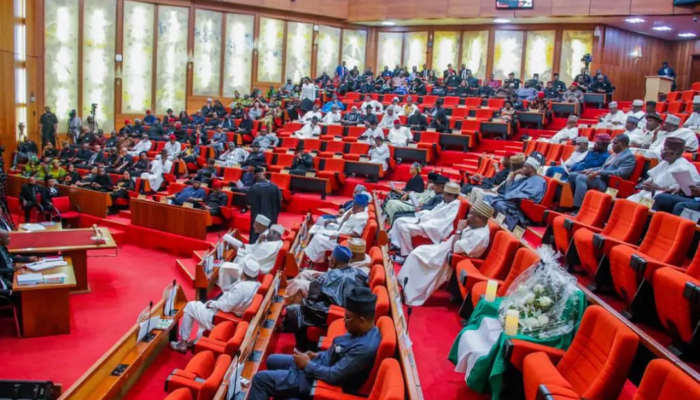
The race for tickets ahead of the 2027 general elections has produced major casualties in the Senate, with several political heavyweights either losing their bids to return, withdrawing under pressure, or being edged out by internal party calculations.
For many of them, it marks the possible end of long and influential legislative careers that shaped national politics for years.
While several senators will quietly leave the Red Chamber after completing their terms, a handful of political titans have seen their influence tested and, in some cases, diminished by the fierce struggle for survival within party structures.
Among the biggest names caught in the storm is Danjuma Goje, former Gombe State governor.
Goje, a two-term governor who moved to the Senate in 2011, had occupied the Gombe-Central seat for four consecutive terms spanning about 15 years.
Read also: Quiet battle for 11th senate presidency begins
One of the most recognisable figures in northern politics and a former Senate Committee Chairman on Appropriations, Goje appeared untouchable politically until the APC primaries delivered a crushing blow to his ambition for a fifth term.
A retired Deputy Commissioner of Police defeated him overwhelmingly, polling 21,793 votes against Goje’s 2,620 votes, a result that stunned many observers and underscored the shifting political dynamics within the ruling party.
In Ogun State, former governor Gbenga Daniel will also be bidding farewell to the Senate after losing out in the political calculations that produced Governor Dapo Abiodun as the consensus candidate for Ogun-East.
Daniel, a two-term governor and influential political figure in Ogun politics, had represented Ogun-East since 2023.
However, the emergence of Abiodun effectively ended his re-election hopes. Although Daniel initially protested the consensus arrangement, he eventually withdrew from the race and directed his supporters to boycott the primary.
The development highlighted the growing influence of governors in determining party structures and succession arrangements ahead of 2027.
Among the most dramatic exits is that of Aminu Tambuwal, a former Speaker of the House of Representatives and ex-governor of Sokoto State.
Tambuwal, one of Nigeria’s most experienced politicians, voluntarily withdrew from the senatorial race under the African Democratic Congress (ADC) to support a younger aspirant in what allies described as a move to preserve party unity in Sokoto State.
Though voluntary, his exit effectively signals the end of his current Senate journey and removes yet another major opposition figure from the 11th Assembly calculations.
In Delta State, Ned Nwoko, businessman-turned-politician, also suffered a major political setback.
Nwoko, who defected from the PDP to the APC ahead of the primaries, reportedly believed joining the ruling party would improve his chances of securing an automatic ticket. Instead, he lost the APC primary to former Delta State governor, Ifeanyi Okowa.
The defeat was particularly symbolic because Nwoko had long cultivated a national political profile beyond the Senate through his public campaigns, media visibility, and political activism.
His loss also reinforced a growing reality in the current political season, that defection to the ruling party no longer guarantees political survival.
Also heading for the exit is the current Deputy Senate Leader, Lola Ashiru.
Despite occupying one of the top leadership positions in the Senate, Ashiru finished third in the APC primary for Kwara South, polling 21,001 votes behind Muheebah Dankaka and Adewoye Olalekan, who emerged as the winner.
His defeat illustrated that even ranking senators with strategic leadership positions are not immune from internal party realignments and grassroots electoral contests.
In Kogi-East, Senator Isa Jibrin, popularly known as “Echocho,” a two-term senator, also lost his return ticket in controversial circumstances.
Jibrin, who chairs the influential Senate Committee on Customs, openly accused Kogi State Governor, Usman Ododo of orchestrating his defeat and vowed to fight back politically.
“What have I done to him? I have supported you, supported your government. I have been very loyal to you. It is now going to be a fight to the finish,” he reportedly declared after the primary.
The loss of Jibrin, a senator known for his influence within Senate committees and Kogi politics, further demonstrates the growing supremacy of governors and state political structures in determining legislative futures.
A similar fate befell Neda Imasuen, who also lost out despite defecting from the Labour Party to the APC.
Beyond outright defeats, several senators are also exiting the Senate following disqualifications linked to internal party disputes and membership controversies.
One of them is Ipalibo Banigo, an ally of FCT Minister Nyesom Wike and a former Deputy Governor of Rivers State and chairperson of the Senate Committee on Health Institutions. Banigo was reportedly disqualified for allegedly not being a financial member of the APC.
Similarly, Senator Benson Agadaga of Bayelsa-East and Senator Garba Maidoki of Kebbi-South also lost out following disqualification controversies.
Osita Isunzo didn’t even bother to contend against his state governor, Hope Uzodinma, who clinched the party ticket.
Collectively, the unfolding developments reveal a major political reset ahead of the 11th National Assembly.
Familiar faces who once dominated Senate debates, committee leadership, and party negotiations are gradually giving way to new entrants backed by governors, party establishments, and shifting alliances.
While some may still find their way into national politics through appointments or fresh alliances, the Senate chamber in 2027 is set to lose a significant number of its old power brokers.

Join BusinessDay whatsapp Channel, to stay up to date
Open In Whatsapp