Education remains one of the most dependable pathways to sustainable development. This belief underpins the ambitious Smart Green School initiative introduced by Governor Peter Ndubuisi Mbah of Enugu State.
Far from being a spontaneous policy idea, as insiders say, the programme reflects a carefully-designed strategy to transform the state’s education system, tackle unemployment, and reduce poverty—starting from the foundational level of primary education.
With the construction of Smart Green Schools across all 260 wards in the state, the government has signaled a bold commitment to equipping young people with the skills required for a modern economy.
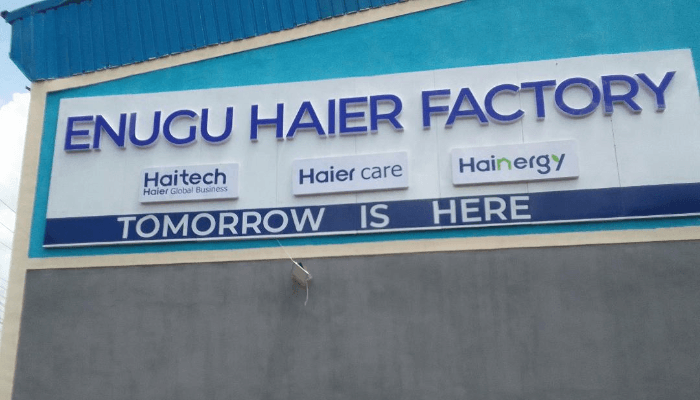
The initiative, however, raised a critical question: how would the state sustainably manage and equip these schools with the necessary digital infrastructure? Addressing this, the state government entered into a strategic partnership with Haier Group, leading to the establishment of a $20 million ICT manufacturing facility known as the Enugu Haier Factory.
The project, a foreign direct investment (FDI), is expected to expand to $30 million in subsequent phases.
At the inauguration, Haier’s Vice President, Sun Yongle, disclosed that the factory would produce a wide range of products including smartphones, tablets, computers, smart boards, Android televisions, and other education and healthcare technologies. It will also venture into renewable energy solutions applicable to electricity, agriculture, and transportation.
The facility has an initial production capacity of 200,000 units annually and is expected to employ over 100 people at the start, with projections to exceed 200 staff as operations expand.
Beyond manufacturing, the company plans to deepen its investment footprint in Enugu by exploring opportunities in agriculture, mining, and transportation, including sesame production, coal development, and tricycle assembly.

Strategically located in the heart of Enugu, the factory is designed to ensure a steady supply of ICT tools required for the Smart Green Schools and modern healthcare facilities.
Already, the state government has placed orders for more than 25,000 all-in-one desktop computers and 300,000 tablets to support the initiative and encourage the factory.
This development complements other ongoing investments in the state, including an electric vehicle assembly plant by the Stallion Group and the Nortra Tractor Assembly Plant and Service Centre by Denmark’s ODK Group.
Governor Mbah described the partnership as a convergence of vision, innovation, and opportunity. According to him, local production of technological devices will significantly reduce reliance on imports, lower costs, and enhance sustainability while building indigenous capacity.
“This initiative will not only support our education system but also serve as a practical training hub for vocational and technical institutions, create jobs, and stimulate small and medium-scale enterprises,” the governor noted.
He added that the project aligns with his administration’s broader goal of growing the state’s economy from $4.4 billion to $30 billion.
The governor also highlighted improving economic indicators, pointing to stabilizing macroeconomic conditions, a strengthening naira, growing foreign reserves, and easing inflationary pressures as signs that Enugu is ready for more investment.
Early assessments of the factory’s performance are promising. Within months of its inauguration, reports indicate that about 20 percent of its projected annual output comprising laptops, tablets, and interactive smart screens has already been produced for deployment in schools using both local and foreign sources materials.
A key innovation from the factory is the interactive smart screen designed for classroom use.
This technology is expected to revolutionize teaching methods by transitioning from traditional instruction to multimedia-based learning.
Teachers can deliver lessons using videos, audio, and presentation tools, thereby improving efficiency, reducing workload, and enhancing students’ understanding.
Notably, the factory’s workforce is made up largely of young Nigerians, reflecting the project’s role in youth empowerment and skills development.
As the Smart Green School initiative gathers momentum, it offers a compelling model of how education, technology, and strategic investment can intersect to drive sustainable development and reshape the future of a generation.

Join BusinessDay whatsapp Channel, to stay up to date
Open In Whatsapp