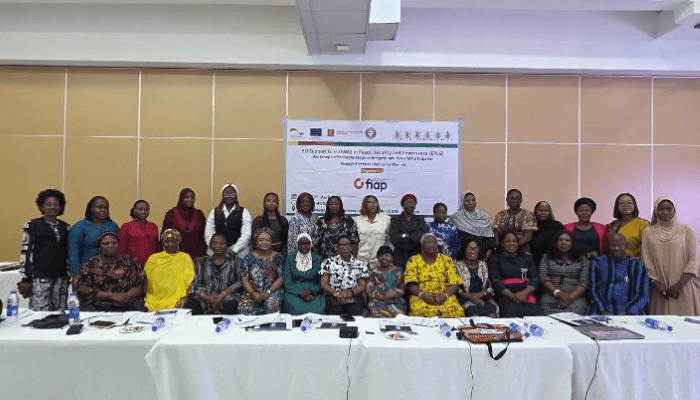
Promoting electoral integrity and advancing voter education for women was a major focus at a three-day workshop held in Lagos.
The forum brought together women leaders, civil society groups, election stakeholders and the media to address barriers to women’s political participation and equip them with tools to make informed choices ahead of the 2027 election.
Organised by the Foundation for the Internationalisation of the Public Administrations (FIAP) with the support of ECOWAS in Peace, Security and Governance (EPSG), the training drew representatives from 25 states and the Federal Capital Territory. Participants shared strategies to curb electoral violence and promote inclusive elections.
Speaking on, “Causes of electoral violence and the role of citizens in prevention”, Consultant, West Africa Network for Peacebuilding (WANEP), Bridget Osakwe emphasised that participation goes beyond voting and encompasses behaviour before, during, and after elections.
Describing elections as high-stakes contests for power and resources, she added that electoral violence is often predictable and driven by underlying tensions such as weak institutions and unresolved grievances.
Explaining further, she said that such underlying tensions can escalate conflicts, emphasising that citizens can be both victims and contributors.
Osakwe stressed that electoral violence is not only physical but also includes psychological intimidation, structural inequalities and manipulation through money and misinformation.
Also, she noted that peaceful participation ensures that electoral outcomes reflect the true will of the people.
To her, peaceful participation promotes respect, tolerance, and lawful engagement.
While stating that electoral processes begin immediately after the emergence of a government, she added that the quality and intention of participation determine electoral outcomes.
Enumerating benefits of peaceful participation, she said it includes: good governance and democratic stability; economic growth; public trust; promotion of tourism and development.
On conflict analysis, Osakwe described it as a systematic process of examining the causes, actors, dynamics, and context of conflict to understand how and why it occurs.
Stating that conflict analysis matters, she affirmed that it helps anticipate risks; enables timely intervention; supports evidence-based decisions; strengthens coordination and promotes prevention over reaction.
However, she emphasised the need for voter education; enforcement of accountability for electoral offences; countering misinformation effectively; and promoting responsible citizen behaviour.
On the other hand, Osakwe cautioned against reinforcing narratives that women oppose each other, emphasising the need for solidarity.
Speaking earlier, Project Coordinator, ESPG/FIAP, Maria Belén Álvaro Sanches highlighted the importance of being practical and action-oriented.
Women and girls, she said, should be kept at the centre of all interventions so as to build a strong network of women across West Africa,
Speaking on “Gender and social inclusion in women’s political participation in Nigeria.” Adeniyi Aremu began with an interactive exercise where participants reflected on the concepts of gender, inclusion, and politics in Nigeria.
Aremu, who is a legal practitioner as well as the Executive Director, Civil Society Organisation for Conflict Resolution in Nigeria (CS-CRIN), linked discussions to: Sustainable Development Goal 5 (Gender Equality); Goal 16 (Peace, Justice, and Strong Institutions; and Goal 17 (Partnerships for the Goals).
He observed that women often seek validation from men in political spaces, adding, “structural barriers make politics male-dominated. Women are sometimes divided due to systemic manipulation.”
The legal practitioner also discussed the proposed Special Seats Bill, which seeks to create 108 additional temporary legislative seats for women.
To enhance women’s participation in politics, he encouraged women to obtain Permanent Voter Cards (PVCs).
Also, he advocated the support of young women in leadership pathways, leveraging social media for political engagement.
On “Community-based conflict prevention during elections”, Adeniyi identified electoral violence to include: coercion against people, property, and institutions, emphasising that it can occur before, during, and after elections.
Enumerating forms of electoral violence, he said they include: inter-party and intra-party violence; violent protests and excessive use of force by security agencies; assassinations and harassment; destruction of materials and voter intimidation.
He emphasised that community-based conflict prevention requires sustained, localised efforts and strong networks.
On the other hand, he stressed the importance of women’s economic empowerment as a pathway to political participation, adding “politics is often driven by money and power, requiring strategic positioning.
“The importance of education and skill development for women beyond politics cannot be overemphasised.
“There is also a need for female mentorship and “godmotherism” to counter existing power structures, building a unified, diverse network of women across Nigeria,” he added
Speaking on ‘Barriers to women and youth participation in politics and how to overcome’, Aisha Ali Tijjani described limited guidance, threats, harassment, and violence as major factors that discourage women from politics.
For the youth, Tijjani, who is a legal practitioner, observed that high nomination fees and campaign costs exclude many young people from engaging in effective political participation.
Other barriers, she said, include: preference for elder leadership; limited access to political training and information; dominance by older politicians.
To address these barriers, Tijjani said: “We need to consider inclusive policies which involve the implementation of gender and youth quotas.
“There is also a need to establish funds for women and youth who are interested in politics.
“Old age dominance in politics should be challenged as it limits fresh perspectives of younger voices and their ideas might be overlooked.
“It totally disconnects youth participation in governance. That is why there is the possibility that policies made might not address younger generations. It also leads to stagnation in the sense that long-term leadership can hinder new leadership development”.
The resistance to change, she said, creates a situation where older leaders are less open to innovation and reform.
She therefore stressed the need to pair young leaders with experienced politicians and added that such efforts would go a long way in supporting youth participation in politics.
Also, she advised that women and youth who are interested in politics can identify with political parties with free nomination forms.
In her words: “Some parties offer discounts for women, youths, and people with disabilities. Take, for instance, APC offers free nomination forms for female aspirants and persons with disabilities, while PDP offers a 50 percent discount for youths aged 25-30 years.”
Speaking earlier, Technical Advisor on Conflict Prevention EPSG/FIAP, Nurat Lawal, explained that the three-day workshop aimed to increase the involvement of women and youth in electoral and civic processes, strengthen knowledge, skills, and capacity for responsible civic engagement and peacebuilding.
Some of the participants who spoke in an interview commended the organisers of the training, describing the three-day event as an eye-opener.

Join BusinessDay whatsapp Channel, to stay up to date
Open In Whatsapp