Memory is humanity’s oldest archive. Long before libraries acquired shelves and catalogues, memory had already been arranging experience into patterns of recall. Long before historians learned to periodise time, memory had already been sequencing events into intelligible narrative. And long before museums learned to preserve objects, memory had already been preserving meaning in ways that are fragile, mobile, and stubbornly persistent. Yet, memory is never stable. It is always under pressure of time, of forgetting, of reinterpretation. And so societies, at decisive moments, return to acts of reconstruction, acts that gather scattered recollections and bind them, however imperfectly, into a form that can endure.
Every culture, therefore, is partly an exercise in remembering itself. This is especially true when a society turns its attention to its icons. For iconic figures do not simply belong to biography. They drift into collective imagination. They become symbols through which communities narrate themselves to themselves. At that point, writing about them becomes a delicate act, too little reverence reduces them; too much reverence dissolves them into myth. The task of the reviewer, then, is not to inflate greatness but to interpret it. Not to canonise the subject but to understand the conditions of their emergence and the meanings of their endurance.
It was from this interpretive burden that I approached El Anatsui: The Man, the Myth, the Legend at 80 and Counting, a monumental festschrift that resists easy classification. At first glance, it appears to be a celebratory volume dedicated to one of the most consequential visual artists of our time. But a closer reading reveals something more intricate; that is, a curated field of memory, assembled from over a hundred voices, each contributing a fragment of recollection, admiration, interpretation, or lived encounter.
To read it is to enter a dense ecology of remembrance in which biography, institutional history, artistic philosophy, and personal testimony interpenetrate. The subject, Emeritus Professor El Anatsui, is not merely described. He is continuously reconstructed through the memories of others. What emerges is not a fixed portrait but a shifting presence, refracted through multiple perspectives. At the centre of this refracted memory stands a paradox: El Anatsui is at once intensely local and profoundly global. A Ghanaian-born artist, who made Nsukka his intellectual and creative home, El has become one of the most influential figures in contemporary art worldwide. From the quiet studios of Nsukka to the luminous halls of major international museums, his practice has travelled far beyond its origins, carrying with it the imprint of place, pedagogy, and persistence.
Yet, what the festschrift captures most powerfully is not the scale of his global recognition but the density of his local penetrating entanglements, i.e., the intellectual ecosystem of Nsukka that shaped him and was, in turn, reshaped by him. In this sense, Nsukka is not merely a geographical reference point; it is a cultural atmosphere, a creative pressure chamber, a site where memory and imagination continuously negotiate form.
Across the pages of the volume, one encounters a striking pattern of metaphorical elevation. Contributors reach instinctively for metaphor in their attempt to contain magnitude. El Anatsui becomes elephant, iroko, colossus, giant, fulcrum, gift, inspiration. These are not casual embellishments; they are linguistic strategies for managing excess. When language encounters scale that resists containment, it turns to symbolism. Metaphor becomes memory’s second language. Nonetheless, repetition also reveals its limits. The celebratory tone, while richly textured, occasionally circles familiar imagery. Admiration accumulates to the point where it risks becoming self-reinforcing. Still, this is not a flaw unique to the volume; it is a structural feature of commemorative writing itself. Communities remember through reiteration. What is repeated becomes what is affirmed. And what is affirmed gradually becomes what is believed.
However, the book is not only an archive of praise; it is also an archive of witnessing. And perhaps its most remarkable feature is the constellation of intellectual oracles who appear within its pages. Eight octogenarian scholars, living legends of our time, figures whose intellectual lives span colonial transition, independence, civil war, reconstruction, and globalisation, stand as witnesses to the life and work of El Anatsui. Their presence transforms the volume in subtle but profound ways. These are not casual contributors. They are custodians of historical depth. Their testimonies carry the density of long duration. When such voices converge around a single subject, orbiting one human planet called El, something unusual happens. Biography begins to resemble historical certification. It is as though memory itself is being double-authenticated by those who remember, and by those who have spent a lifetime interpreting remembrance. The symbolism is difficult to ignore. An artist in his early eighties. Eight intellectual elders approaching or exceeding ninety, a circle of remembrance forms itself around another life; not to enclose it; but to affirm it.
Perhaps, something equally significant about the EL Anatsui book is the construction of a shared cultural mythology. El Anatsui is not only remembered; he is being mythologised. But myth here should not be understood as distortion. It is rather the narrative form through which communities articulate their most valued figures. This myth-making becomes even more pronounced in the panegyrics, arguably one of the most aesthetically compelling sections of the book. Here, language ceases to function merely as description and begins to behave like material. It bends, stretches, shimmers. It acquires texture. It becomes tactile. Contributors do not merely describe El Anatsui; they shape him in linguistic form:
“Wizard with Lithe Fingers.”
“The Quiet Iroko Tree.”
“Soul-Sculptor in the Den of Lions.”
“Bottle Caps Glitter in the Sun.”
“How Can This Continent Be Dark?”
In these compositions, memory becomes sculptural; memory is no longer descriptive; it is performative. The panegyrics demonstrate a rare literary phenomenon, i.e., language attempting to match the texture of visual art.
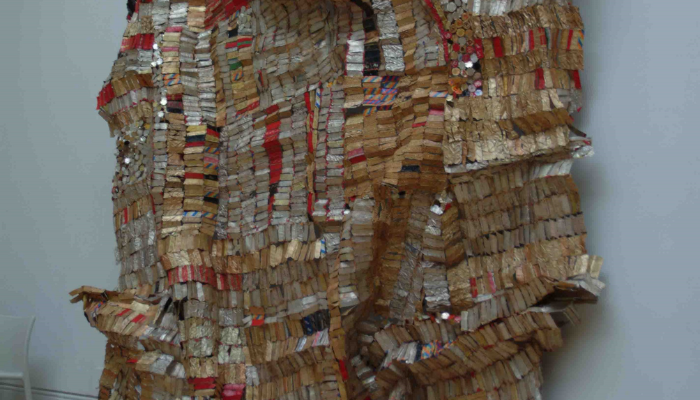
Just as El Anatsui transforms discarded metallic fragments into expansive visual fields, the contributors transform linguistic fragments into concentrated acts of reverence. The effect is not merely poetic; it is epistemic. It suggests that language itself can be reassembled into forms capable of carrying aesthetic weight. Still, the most significant intervention of the volume lies elsewhere, that is, in the sections that turn away from celebration toward intimacy. Here, El Anatsui is no longer icon but interlocutor; no longer myth but man. He appears as colleague, neighbour, mentor, traveller, friend. The symbolic distance collapses.
This shift is crucial. Great figures are often imprisoned by their public reputation. The weight of admiration can become another form of confinement. But in these essays, that confinement is gently dismantled. We encounter the sporting enthusiast, the generous colleague, the patient teacher, the quietly attentive neighbour. These are not embellishments to greatness; they are its grounding conditions. Without them, the icon would float free of human context and lose interpretive depth.
Even more revealing are the testimonies that explore El Anatsui’s intellectual and social plurality beyond sculpture. Here, he emerges as historian of sensibility, listener of music, participant in communal life, chess player, pedagogical force, and intellectual presence within a broader cultural field. The reduction of identity to professional achievement is resisted with quiet insistence. What we encounter instead is the complexity of a life lived across overlapping domains of creativity and thought.
But it is in the ideational heart of the volume that the most sustained intellectual work takes place. The testimonies of mentees and colleagues transform memory into pedagogy. Influence is no longer abstract; it becomes experiential. Statements such as “I was not a fan of El” or “An encounter that changed my practice” signal a shift from admiration to transformation. What is being documented is not merely artistic excellence but pedagogical force, the capacity of a teacher to alter trajectories of perception and practice.
From this emerges a deeper insight. El Anatsui is not only an artist of objects but an artist of conditions. The most enduring work attributed to him may not be found in metal constructions alone, but in the generation of artistic consciousness across multiple generations of practitioners. In this sense, the so-called New Nsukka School is not simply a stylistic formation; it is an intellectual inheritance system, continuously reproduced through mentorship, experimentation, and reinterpretation.
One is tempted to extend this thought further. If sculpture is the transformation of material, then pedagogy is the transformation of minds. And if so, then the New Nsukka School may ultimately stand as El Anatsui’s most expansive work, not fashioned from aluminium or wood, but from human imagination itself, shaped over time through teaching, influence, and intellectual exchange. The essays that address legacy deepen this reflection by situating his practice within broader concerns of ecology, aesthetics, and material ethics. Cerebral discourses on alchemy, refuse, transformation, rhythm, and visual ontology position Anatsui not merely as artist but as thinker of matter. His practice becomes a meditation on residue and renewal.
Long before sustainability became a fashionable academic concept, El Anatsui was already working within an aesthetic of reuse, transformation, and environmental consciousness. Discarded materials become carriers of history. Waste becomes narrative. Objects previously excluded from aesthetic consideration are reintegrated into visual meaning. Memory, in this register, is not only human but material; it resides in matter itself.
The most theoretically ambitious contributions push this further still, situating his work within postcolonial discourse, environmental humanities, and philosophical reflections on materiality. Here, memory becomes conceptual rather than anecdotal. It is understood as an interplay between history, matter, and perception. The artist is no longer simply celebrated; he is interpreted as a thinker of form, time, and transformation.
Interviews in the volume extend this archive of remembrance into oral terrain. They preserve voice before it hardens into text, immediacy before it is absorbed into analysis. In them, memory speaks in a less mediated register, offering insights that are at once personal and communal. Taken together, these layers of testimony, analysis, praise, and reflection converge into something larger than a festschrift. They form a composite memory structure, one that is at once celebratory and analytical, emotional and intellectual, local and global.
The forthcoming unveiling of the book at the University of Nigeria, Nsukka, therefore becomes more than an institutional event. It becomes a public activation of memory. On Wednesday 1 July, 2026, at the Princess Alexandra Auditorium, UNN, Nsukka will not merely host a book launch. It will stage a public act of remembrance. Scholars, traditional rulers, administrators, artists, and students will gather not merely to launch a book, but to affirm a shared cultural inheritance. What will be staged is not only recognition of an individual but recognition of a field of meaning that has grown around him.
In this sense, El Anatsui’s presence in Nsukka is inseparable from the broader cultural trajectories of the university itself. Alongside Chinua Achebe, whose literary imagination projected Nsukka into global consciousness, El Anatsui represents a complementary axis of visibility. Achebe rendered Nsukka audible in world literature; Anatsui renders it visible in world art. Between them, they establish Nsukka as a dual site of global cultural memory, spoken and seen, narrated and sculpted.
And yet, what remains most striking is not the magnitude of recognition but the method of its construction. Greatness, as this volume subtly demonstrates, is not a singular achievement. It is an accumulation of fragments, i.e., encounters, teachings, materials, institutions, friendships, and time assembled into coherence through sustained creative and intellectual labour.
El Anatsui, in his artistic practice, teaches metal to remember. This festschrift, in its own way, teaches memory to assemble itself into enduring form. And perhaps that is its deepest achievement: it does not merely tell us who El Anatsui is; it demonstrates what remembrance can become when a community decides not to let meaning fade.
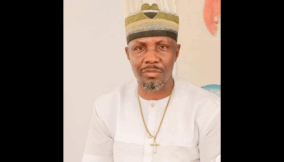
.Agbedo, a professor of Linguistics, University of Nigeria Nsukka, Fellow of Netherlands Institute for Advanced Study, is a public affairs analyst.

Join BusinessDay whatsapp Channel, to stay up to date
Open In Whatsapp