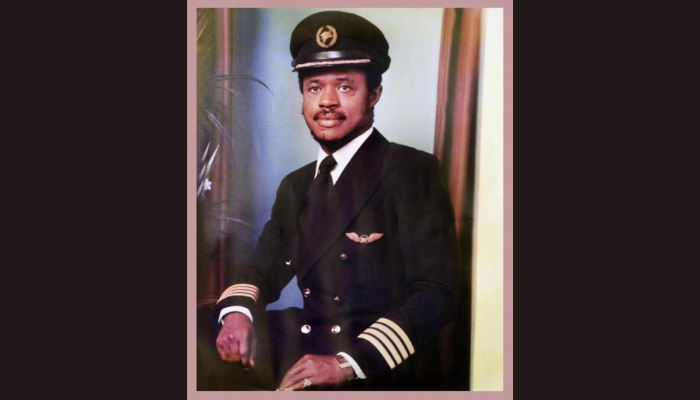
What is the connection between Captain August Okpe, the last surviving most senior pioneer pilot of Nigerian Air Force and Ms. Annabel? This is not a trick question; so, stay with me and let’s unravel the conundrum. Did you know that African civilization did not begin with Egypt alone? Africa has always possessed ingenuity from the beginning of time.
In aviation, there is a story many have never heard. During the devastating Nigeria/Biafra War, 1967-1970, deep in the core heart of Africa, there existed the most clandestine airport. It was one of two busiest air corridors in the world. The O’Hare International Airport in Chicago, Illinois, USA, was the busiest. And hidden in the very innards of Biafran jungle was Uli Airport, the second busiest, codenamed ANNABEL.
Annabel Airport was unlike any other since it operated surreptitiously in the dense tropical jungle but hidden almost in plain sight. Runway lights remained off for camouflage but momentarily switched on in a blink for an airplane to land and quickly switched off immediately thereafter. Equipped with advanced radio navigation aids, as well as updated Low Visibility Procedures (LVP), which were interfaced in tandem synchronization with the Non-Directional Beacons (NDBs) for orientation and guidance to ensure optimum safety in the approach and landing phases of the aircraft.

Flights from multiple countries landed there night after night. It was virtually an all-weather night operations airport. The air traffic was so dense that most times, several aircraft were stacked up in the holding pattern while quite a few were already lined up in the approach sequence consistent with their approved arrival slots. Yet despite the air traffic congestion, accidents were remarkably rare. How was that possible?
The engineers, as well as pilots who made worthy inputs in the design and construction of Annabel, did something extraordinary. They crafted a synergistic system- an algorithm of flight operations that ensured unassailable safety, coordination of personnel, aircraft maintenance and logistics. An entire aviation ecosystem functioned under extreme pressure in humid tropical ambience under discrete lighting system. Thousands of people worked there. Families lived around it. Fuel was transported, aircraft repaired and cargoes unloaded in minutes. And then, the aircraft disappeared again into the thick night.
Was the relationship between the last surviving most senior pioneer pilot of Nigerian Air Force and Annabel ever consummated? Yes, indeed. After the construction of Annabel, the pilot who flight-tested it was Captain August Okpe. The flight was sine qua non to ascertain the operational functionality and viability of the facility. Annabel passed the flight test with flying colours and this was important as it was built as Joint User Airport System catering for both military and civil operations. Almost immediately, large scale operations started. Aircraft brought in the much-needed goods. Food and Medicine arrived. Supplies arrived. All these took place at night under random bombardments from enemy aircraft circling high above it.
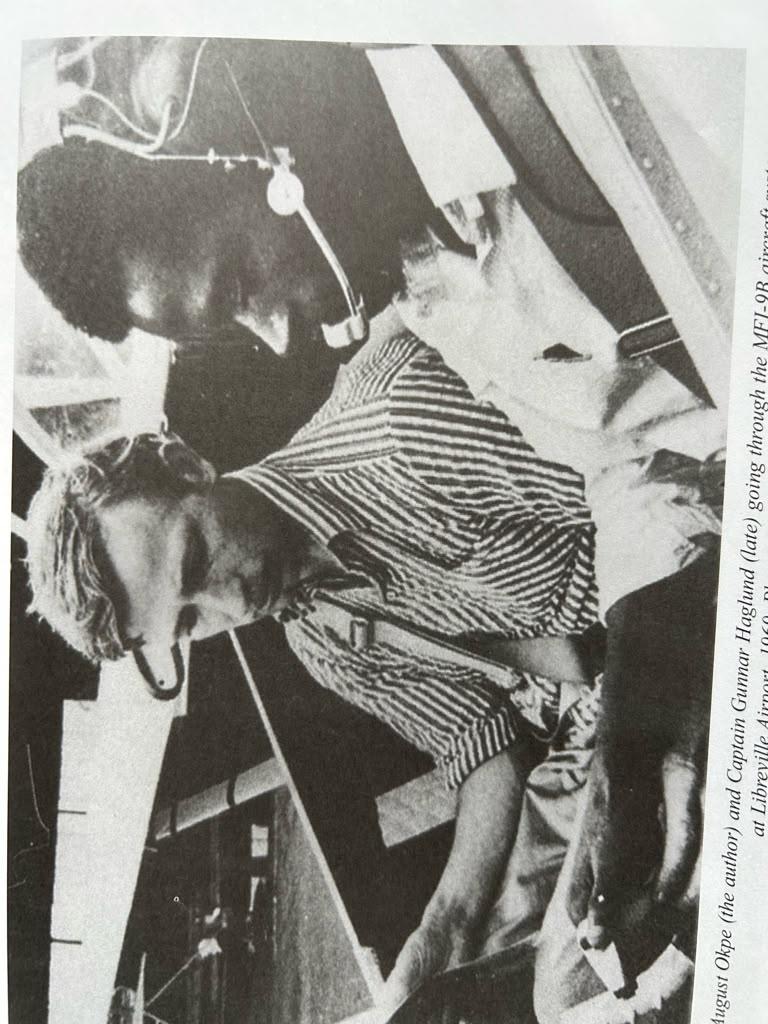
In many ways, the aviation effort very easily exceeded other remarkable chapters in global aviation history. But this time, it was happening in Africa- a wholly African effort of an African story of ingenuity. Ground crews worked silently on the apron. Aircraft maintenance engineers kept aging planes airworthy against all odds. Air Traffic Control Officers coordinated and precision-guided inbound and outbound air traffic. Loadmasters balanced cargoes down to the last kilogram while ordnance specialists handled explosives with precision and care. There were no second chances. Any mistake could be fatal.
Central to all these activities were the pilots- Captain August Okpe and his Squadron of Biafran pilots affectionately called the “Darlings of Annabel;” not because it was easy but for the very reason they made the impossible look routine. Among them were the late Captains Frank Osakwe, Elendu Ukeje, “Bad Weather Bomber;” Nnachi O. Nnachi, “Seasoned Statesman of the Skies” and John Chukwu (Distinguished Service Cross) “Officer and Gentleman.”
Others were the late Captains Emeka Obinwa (Military Cross), Adindu Njoku, Alex Agbafuna, Essien, Emma Ngwu, Squadron Leader Ernest Ike, Inyang; John Obianyor, “Don’t Let the Flower Jam You;” Gp. Capt. Monday Ikpeazu, “Papa;” Captain Gabriel Ebube, “Republic of Benin;” Wing Cmd Uwem Iyoho, “Westland Wessex;” Captain Akahara; Group Captain Osmond Oga, “Nchichi;” Lanky Ogbolu, George Egbuonu, “Georgio;” Oyii, Omene; Oraeki, “Adonis,” et al. My God, so many of our pilots died. May they continue to rest in peace. Amen.
By Divine Grace, these few redoubtable and very valiant Captains survived, viz: Captains Willy Murray-Bruce, “Local Mercenary;” Jimmy Yeates, “Tall & Handsome;” Alfred Anowai, “Lockheed,” et al. They, the living and the dead, were not just pilots; they were part of a highly motivated tactically coordinated air warfare combatants operating under extremely unimaginable and insufferable conditions. Captain Bara Allwell-Brown, alive and well today, and his kid brother, the late Captain Ibikare Allwell-Brown. The intrepid formidable brothers of the skies, needless say, subdued the stratosphere and beyond.
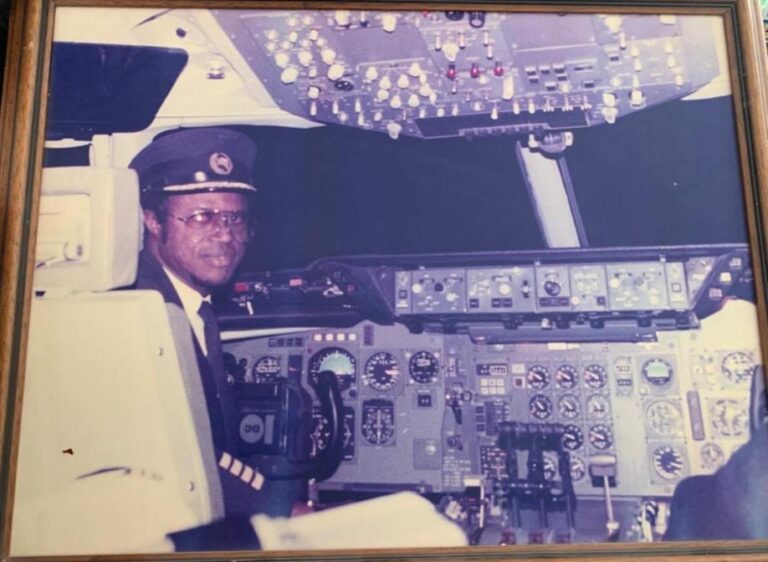
Captain August Okpe in the cockpit of Nigeria Airways plane, 1987
Pilots from different parts of the world arrived; mostly driven by humanitarian conviction inspired by organizations like the Joint Church Aid, Caritas, the Red Cross and the World Council of Churches. Images of starving Biafran children became an unbearable summon for them to take to the skies. Swooping down into Biafra to save lives, they sometimes flew back into contested airspace and uncharted territories. Annabel was so effective that Harold Wilson, the British Prime Minister, resolutely declared, “Annabel must be destroyed.”
But the honour of the beautiful bride was well defended by Captain August Okpe and his Tactical Air Command. The exploits of the ace pilots in the various theatres of war were nothing short of legendary. Captain August Okpe and the combat pilots under his command won world-wide acclaim in their attempt to tip the balance in the war, which the Biafran forces, unfortunately, could not sustain for too long. For that and other meritorious services in the course of his prosecution of the air-war through unconventional military aviation tactics, Captain August Okpe was honoured by Biafra with all the national awards possible at the time including the prestigious Military Cross.
But the end, inexorably, came for the beautiful Annabel on 11th January 1970. That was the day the victorious Nigerian Army violated her. The beguiling, capricious and indomitable Annabel was not playing hard to get. She was hard to get and had given the Nigerian, Russian, British and Egyptian pilots a run for their money. When, eventually, Nigerian soldiers breached her defences, they carried on with that much pent-up frustration-induced venom that found expression in unprecedented mayhem of vengeance. They dug up, gutted and mutilated her tarmac and long runway surface to guarantee no airplane ever landed on her again. Then the soldiers procedurally pillaged and vandalized all airplanes and vehicles at the airport. It was only as an after-thought that whatever was left of a couple of Biafran planes and others were retrieved from the marauding federal troops and later taken to Biafran War Museum in Umuahia for posterity.
The brave Captain August Okpe deemed it unnecessary flying out with his family as it would have been the easiest thing for him to do as Biafran Chief Pilot. He remained behind following which he dutifully reported to the Nigerian 3rd Marine Commando under Colonel Olusegun Obasanjo. He was, thereafter, flown to Lagos through the Port Harcourt Airport to face a menacing Military Tribunal set up by the Federal Military Government under General Yakubu Gowon.
Perhaps, because of his spectacular aerial campaigns and punitive missions (economic damage and strategic bombings of military installations against Nigeria) the Military Tribunal did not recommend him to be reabsorbed into Nigerians Air Force; unlike some of his peers who were recalled. However, President Olusegun Obasanjo granted him a Presidential Pardon vide Government Notice Gazette No. 40 Vol. 90 of 18th May 2006; whereupon his dismissal from the Armed Forces of Nigeria got commuted to retirement with full benefits, rights and privileges with effect from 29th May 2000.
Following his dismissal by the Military Tribunal, Captain August Okpe left for the UK and thence to the US where he obtained his Airline Transport Certification at the Acme School of Aeronautics, Fort Worth, Texas, US. That made him the first Nigerian Pilot to hold both the Military Pilot Licence concurrently with the civil US Airline Transport Pilot Licence. The Licence of Switzerland will later be added to his portfolio. He also attended Cranfield University, Bedfordshire, UK: before returning home to fly planes for Nigeria Airways.
So, when people say Africa had no history of innovation, remember Annabel Airport. Remember Uli. Remember the pilots who landed planes in almost total darkness to defend you. And remember to pray for Captain August Okpe, the last surviving most senior pioneer Pilot of Nigerian Air Force. History is not only what is written in books; it is also what we choose to remember. Kudos to our African brothers who are mostly unsung heroes but deftly resurrected on the pages of Captain August Okpe’s “The Last Flight.” And remember the large number of our Pilots, on both sides of the conflict, who paid the supreme price. Know your history.
. Being Part 2 of Series Honouring Captain August Okpe on his Forthcoming Birthday on August 18, 2026. Eke, Phone: +234 81 3515 9313; Email: [email protected]; writes from Port Harcourt, Rivers State, Nigeria.

Join BusinessDay whatsapp Channel, to stay up to date
Open In Whatsapp