Ibukun Awosika is one woman I am never tired of reading about. She is indeed an inspiration to a lot of people and women in particular. I remember during our annual Inspiring Woman conference, the second one to be precise, she was one of the speakers and she did an excellent job. It only came naturally for me to attend the silver jubilee of her company, The Chair Centre Limited, a Nigerian indigenous Group of Company that specialises in the design, manufacture, installation and maintenance of office furniture and bank-way security doors with resounding experience that spans over twenty-five years.
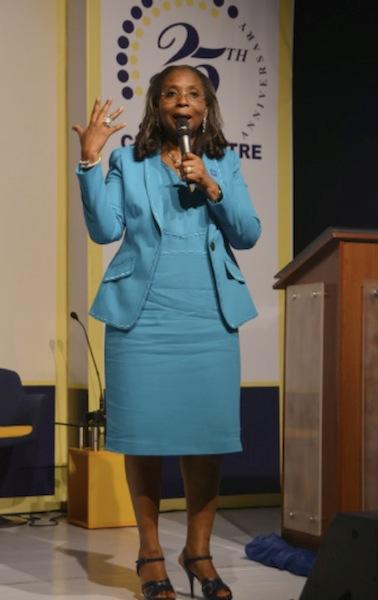
To commemorate her silver jubilee, the company hosted a discussion on an issue that has agitated the mind of Ibukun over the last fifteen years which is crucial for the survival of businesses in Nigeria.
Clients, friends and other stakeholders were invited to a discourse, “Built to last – The Nigerian experience” and it took place on the 24th of June 2014, at Harbor Point, Wilmot Point Road, Victoria Island, Lagos.
The panellists were drawn from institutions that have been able to successfully hand over businesses to a succeeding generation and they included Leadway Assurance, Hygeia Nigeria Limited, First Bank of Nigeria and Telnet.
The special guest of honour for the event was His Excellency, The Governor of Lagos State, Babatunde Raji-Fashola and in his opening remarks, he expressed his passion for the theme of the day and also shared with us his support and relationship with Ibukun who he calls ‘Billy’.
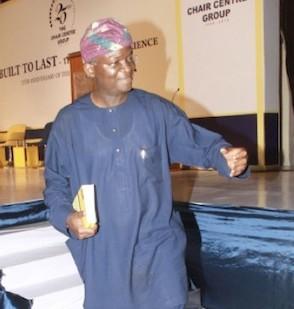
“If you look around the business landscape of Nigeria and what we now have to deal with in terms of developing our economic set up and you take a census of businesses that did not make it, you will understand how this is a tropical issue today as a people than any other thing that has been. I have told people that are younger than me that we used to make batteries at Isolo and they said it could not have been possible and I said it was the case. We used to make car batteries too and at some point, we had achieved about 25-35percent local component into Peugeot vehicles in this country but somehow we have lost all of that and it is because businesses faltered and stumbled.” Fashola says.
After presenting the book written by Ibukun to all, he took us down memory lane “Billy came to my house one day and said ‘what type of furniture are you using? I am going to change it’ then I said to her ‘but I don’t have money’ to which she responded ‘you can pay me later’. I know that is surely not how she does business but, it was the motherly side of her that showed up. Before she had her own children, she was already a mother to all of us. While we were playing football, we knew rice would be available and she would have to deal with her mum’s fury because the bag of rice suddenly just reduced in size apparently, it was budgeted for her family yet, the whole community would come and consume it and somehow, she made us also accept that garri, groundnut and sugar combo was always palatable on the days rice was not available. She had a way of making it taste nice.”
“Billy, I wish I could stay throughout this event but I really must leave you but all the same, you know that I love you and a better half of me, my wife, will remain here to spend the rest of the day with you. Billy is married to my wife’s most favourite cousin and this wasn’t planned so to the glory of God and towards enduring businesses, towards inspiration to the next generation of Nigerians who would venture out into entrepreneurship, I present to you all, Billy’s book, ‘The Girl Entrepreneurs” Fashola said and as we all stood up to applaud him, with a smile on his face, he waved to us all and left immediately for an appointment in Abuja.
The entire event was moderated by the founder and CEO of Eventful, a leading events planning, venue management and consulting company in Lagos, Yewande Zaccheaus. Though she told us she had to compere at the last minute because the one selected to do so was unavoidably absent but it did not look like that at all, Yewande did a fantastic job and if you ask me, I would suggest she takes it up on another level.
It was time for the panel discussion and it was anchored by Doyin Salami, a senior lecturer at Lagos Business School (LBS). However, before the panel started, Doyin made some salient points explaining his view on the theme of the day ‘Built to last’.
In his words ‘The question is how many companies in Nigeria are still doing well two decades after their founders have left? I asked my research assistants to find out how many companies on the African continent have lived for a century or more and it turns out they were less than ten. At the heart of the whole essence of longevity are missed opportunities. Longevity has two dimensions. Longevity means prospering for a minimum of fifty years or more. The second element speaks to intergenerational transfer of success. The first definition speaks to the attainment and retainment of success and the second speaks to intergenerational and maintenance of success. How do we build companies that can prosper for at least fifty years? It is in the continuation that our labour is recognised.”
“80 percent of entrepreneurs fail within the first eighteen months. If you are two years standing and prospering, clap for yourself because many people do not go that far. A successful entrepreneur is that one who falls seven times and rises eight times because it is on the eight time that success finally attends to them. The cost of failure is very high. Only 29percent of businesses globally are still around after a decade. 11 percent fall in the second year and 8percent fall in the third year. Only 30percent of businesses which survive, are able after a second generation to still stay alive. Therefore, longevity is a passion that people have but which a few have attained.” He concludes
The panellists included the Chairman of Hygeia Nigeria Limited, Fola Laoye; Managing Director/CEO, Leadway Assurance, Oye Hassan-Odukale; Executive director First Bank, Tokunbo Abiru; Director at ECOBANK & Leap Africa, and former GMD of Telnet, Nadu Denloye.
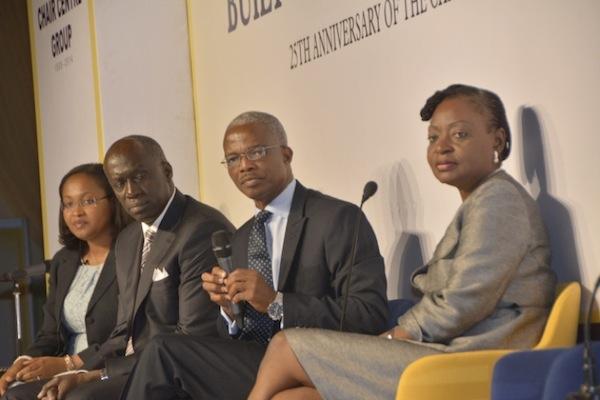
Each of them had their views on what it takes to succeed over a long period of time and how they have also succeeded over the years giving their track records.
Fola started off saying “our business is a thirty year old one now and we have been able to pull through by firstly understanding the market, understanding what the market opportunity presents and also understanding how to serve that market. For us, because we are in healthcare, we make known to all how to access healthcare which is shown in the quality of healthcare that we deliver. Even though we hold on to such platforms, as things evolve, we are equipped to continually understand the market and staying close to it is very key in helping to sustain our organisation.”
“The other thing is the issue of growing capacity within our business and that is something my parents really got involved with perhaps because of their own background as teachers and academicians but, there were strong measures placed to grow and develop our staff from day one and therefore, we have doctors and nurses that have worked with us all of the whole thirty years, we have doctors who started as medical officers and are now at the top of their field in terms of their specialty, staying with us because they were actively developed.” Fola narrates.
For Oye Hassan-Odukale, “we are still a work in progress but so far it has been good. The main thrust for us is to understand the customers, to render services to the customers. There is the general belief that insurance companies don’t pay claims but we as an insurance company pay our claims and we do it promptly. Our staff are very key to us, we make sure they are groomed. When I saw the title ‘Built to Last’, personally, I felt I wasn’t qualified but as a company, we are because by God’s grace we are over forty years old. I am in the second generation and for me, it’s only when the third generation management takes over that I can really say I have done well. We are preparing for the next generation. I can’t say I am successful until I have that third generation in place and it will come.” Hassan explains.
Nadu Denloye’s views on the same topic were quite similar. For her, “We are twenty eight years still counting. My co-founder unfortunately passed on last year but one thing he had always said is that when we are six feet underneath the ground, Telnet should still stand. It is natural that some companies would fail, it’s like a biological circle, as a human being, you grow in stages and then when you are old, you die, it is the same thing actually in terms of business but, being able to maintain that upward lift and transcend the curve is a difficult challenge. In technology, it is so dynamic and there are always changes happening, It is crucial to be able to transcend the curve. In our time and generation, being a technology company, it’s about competence, recruiting and retaining bright staff. How do you motivate them? The leadership ability seen in the Group Managing Director that succeeded me qualified him to be at the helm of affairs.”
“My late co-founder always saw opportunities. We started small but he kept thinking big. Beyond vision, you have got to have competence. Knowing the opportunity and being savvy to all that is there. We knew what we wanted and where we were going, it helped us operate a transparent environment. Telnet was non gender sensitive, non-ethnic biased and we had a culture of allowing people to be who they could be, we had an environment that encouraged learning and growth. Beyond that, we wanted to build a quality company. We elevated the national status and the black man as a whole. We wanted to build a Nigerian company with a difference that this black man can do it and we showed that it was possible.” She quips.
Next to speak was Tokunbo Abiru and according to him “I represent a company that is built to last because First Bank is 120 years old. Our success is hinged on the bedrock of the bank which is found in the vision statement. Our brand essence of being “Dependably Dynamic” stands firmly on our four pillars of success: Leadership, Safety & Security, Enterprise and Service Excellence.”
“In leadership, which is what has helped us thus far, we have a standing structure. It is not an organisation where just one person can determine the future of anybody even in terms of employment of staff, there is a process that must be followed whether you are coming in as an officer or even at a managerial level. We have a very strong risk management structure on ground. The structure can be likened to building an institution that will stand. We also have a board that is diverse. There are different board committees. We have executive committees. In terms of enterprise, in over 120years of existence, losses only occurred in 1990 and 1991. We have consistently recorded profit for over a hundred years.” Tokunbo narrates.
I must say that it was indeed an enlightening discuss and wrapping it up was the assiduous industrialist and celebrant of the day Ibukun who ended the program saying “The theme came out of the fact that I looked at businesses that I knew while growing up and found out that today, nothing exists of them. I said to myself, ‘I started this journey November 1988 and the company officially started 3rd of January 1989 after my 26th birthday. If I die and the business doesn’t continue, then I have wasted my time because I have spent the best years of my life building the business. We speak of unemployment but we lose jobs everyday and from every enterprise that dies, jobs are lost. All that has been discussed will be used in Lagos Business School (LBS) and I also spoke to the Economic Summit Group and I am told that their research team will look deeply into this. We must turn our great entrepreneurial energy to create long lasting institutions.” She concludes.
A cheque of 10million naira was presented to First Bank of Nigeria Micro Finance bank to help support 100 start-up entrepreneurs.
KEMI AJUMOBI

Join BusinessDay whatsapp Channel, to stay up to date
Open In Whatsapp