In today’s fast-paced world where many creative hands seek to be multidisciplinary in their practice, there is a talent who sticks to his calling, or rather, ‘what he knows best’.
Welcome to the creative world of Tosin Junaid, a Nigerian visual artist whose medium is simply photography.
Yes, photography. But Junaid has taken his photography a notch higher and has carved a niche for himself. He uses portraiture as a tool to explore memory, identity, and cultural preservation.
“My work examines the gradual erosion of African identity through westernization, questioning how inherited traditions, aesthetics, and ways of being are reshaped or forgotten in the pursuit of modernity,” he says.
The above were evident in his latest series, which he entitled ‘Ara Rántí’, literarily translated as ‘The Body Remembers’, amid other subtitles such as: Eda, Ẹ̀wà Pupa, Hands That Remember and Instrument and Flesh.
The exhibition was well-attended across the many locations it held world over. From Hands That Remember at Atirira Gallery Lagos in 2023, to Circular Art Space in 2024 and RSBA Royal Society of Artist Birmingham in 2025, the Ara Rántí series exhibitions were mind-blowing, amid commendations of the artist’s great mastering of his craft.
As well, the attendants at the Nikon Middle East & Africa Partnership – Creative Arts Workshop were intrigued by Junaid’s works.
Explaining the series, Junaid says that it explores the idea that memory does not reside solely in the mind, but also within the body. He further buttressed his point saying that the human body holds traces of ancestry, culture, tradition, and lived experience, even when those memories are no longer consciously recognised.
“Through portraiture, symbolism, and the human form, Ara Rántí examines how identity is preserved across generations, and how cultural memory endures despite the forces of modernisation, globalisation, and westernization,” he explains.
The body of work, according to him, proposes that the body itself is an archive, one that remembers stories, traditions, and histories long after they have faded from everyday life.
Speaking on the subtitles, he notes that Eda is a Yoruba word meaning “creation” or “the created being.” “It reflects on origin, the idea that before culture is learned or altered, there is an essential self. It is about humanity in its most fundamental state, a reminder of where identity begins,” he says.
On Ẹ̀wà Pupa, which means “Red Beauty,” the artist uses red to represent vitality, ancestry, life force, and continuity. According to him, Ẹ̀wà Pupa speaks to a beauty not defined by modern standards, but by heritage, presence, and the enduring spirit carried through generations.
Hands That Remember, on the other hand, speaks to inherited knowledge, amid highlighting the fact that long before history was written down, tradition was passed through touch, craft, ritual, and practice. Hence, the hands in the series, symbolise memory stored in people, in gestures, in generations and not in books, the artist discloses.
But the Instruments & Flesh explores the relationship between culture and the body. While instruments represent tradition, music, ceremony, and collective identity; the flesh, according to the artist, represents individual human experience. “Together, they propose that culture is not separate from us. It lives through our bodies, our movements, our existence,” he says.
But Junaid also expresses his boldness with a bit of nudity in some works especially the Instruments and Flesh subtitle.
But the nudity, according to him, is intentional and symbolic, not provocative.
“For me, the unclothed body represents the one thing that remains unchanged regardless of time, geography, religion, or cultural influence”.
Even when clothing, fashion, and social markers evolve, Junaid insists that the body does not, and when the visual layers are removed, the work returns the viewer to something fundamental and universal.
“In Instruments and Flesh particularly, the exposed body emphasises the inseparability of culture and humanity. Beneath everything we acquire throughout life, there is an essential self that precedes and survives those influences,” he says.
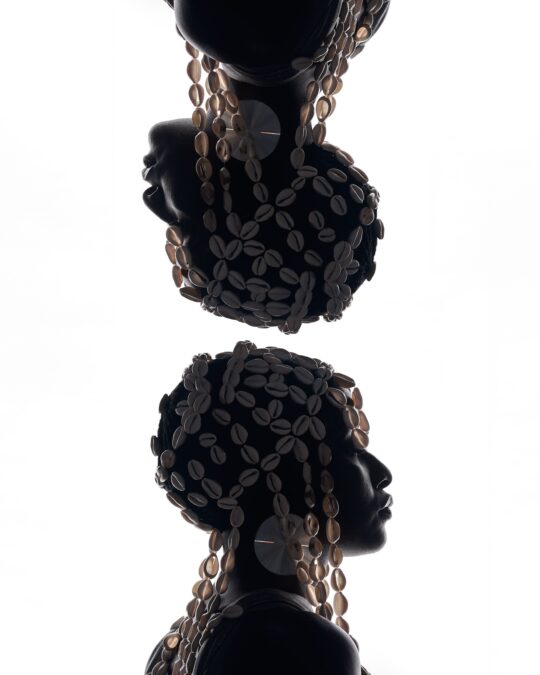
But on close review of the series, the sheer creative ingenuity of Junaid speaks volumes on mastery of his craft as some works are simply intriguing considering the incredible techniques. In the Eda subtitle, the two beaded heads with one turned upside-down say it all.
Explaining the technique and process, Junaid says the image was created entirely through photography, not digital generation. “It involved photographing the subject in multiple positions and carefully combining the images in post-production,” he explains his technique, which he says allows him to create a visual metaphor for duality, reflection, and the coexistence of different states of identity within a single individual.
Offering more technical details, he says that the upside-down head introduces tension and questioning, reflecting the broader themes of the series: the negotiation between what is remembered and what is forgotten, what is inherited and what is adopted.
Meanwhile the entire works in the series were created in his studio in Lagos, Nigeria, a location he says is essential for creating the works.
“The work needed to emerge directly from the environment and culture that inspired it”.
But while the series is rooted in a specific cultural context, its questions around identity, memory, belonging, and transformation, according to him, are universal.
Of course, the artist is happy exhibiting the works as “the intention is for Ara Rántí to be exhibited as a complete body of work”. As well, the photographs are designed to exist in conversation with one another, each piece contributing a different perspective on memory, identity, and cultural continuity.
“An exhibition setting allows viewers to experience the full narrative and engage with the questions the work raises,” he says.
But one question begging for an answer, especially for those who think Junaid is beyond his camera is: why only photography?
The answer is simple. “Photography is my chosen medium because of its unique relationship with reality,” he enthuses. “Unlike many other art forms, photography begins with something that physically exists in front of the camera, and that tension between reality and interpretation is what interests me most”.
If that is not convincing enough, Junaid notes that portrait photography allows him to explore identity in a direct and intimate way.
“Through lighting, composition, symbolism, and expression, I construct images that exist somewhere between documentation and imagination, records and reinterpretations of culture, memory, and self,” he says further on his love for photography.
Obviously, Junaid’s practice is rooted in African storytelling that seeks not only to document people, but to preserve fragments of identity that risk disappearing with time with each image becoming an act of remembrance — reclaiming beauty, dignity, and cultural consciousness within a rapidly westernized world.
With all the above going for him, Ara Rántí, his latest creative offering, drew many to the different locations the exhibit held across the United Kingdom and Nigeria, who were delighted seeing the works and also appreciated Junaid’s ingenuity.

Join BusinessDay whatsapp Channel, to stay up to date
Open In Whatsapp