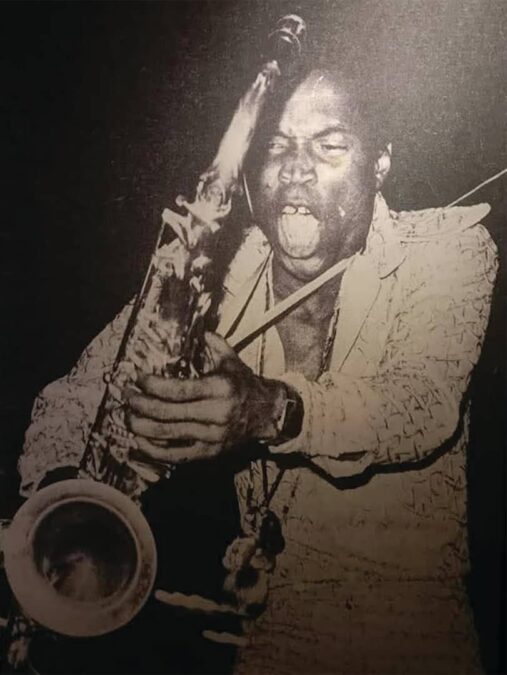
At the 1978 Berliner Jazztage, Fela Kuti did not simply perform; he staged a political, spiritual and musical confrontation that marked both the peak and the breaking point of Africa 70.
By the time Fela Anikulapo Kuti walked onto the stage of the Berlin Philharmonie in 1978, he was no longer merely Nigeria’s most dangerous musician. He had become a moving republic, a wounded prophet, a bandleader at the head of one of the fiercest ensembles in modern music, and a political dissident whose sound had already outgrown the nightclub, the studio and the nation-state.
The performance, staged as part of the Berliner Jazztage, now known as the Berlin Jazz Festival, has since acquired almost mythical significance. The official Berliner Festspiele archive lists the concert as taking place at the Philharmonie on November 4, 1978. It describes it as both the “high point” and the “end” of the Afrobeat big band Africa 70, founded by Fela and Tony Allen.
That description is not an exaggeration. Berlin 1978 was Fela at full voltage: musically expansive, politically combative, visually radical and spiritually theatrical. It was also the night when one of the greatest bands ever assembled around an African popular musician approached the end of its original life.
A Band at the Edge of History
Fela arrived in Berlin carrying the turbulence of Lagos on his body.
Only a year earlier, in 1977, Nigerian soldiers had attacked and destroyed Kalakuta Republic, Fela’s communal home, studio and symbolic breakaway state. The assault followed the release of Zombie, his blistering musical attack on the mentality of military obedience. The raid left Fela brutalised and his mother, the nationalist and women’s rights figure Funmilayo Ransome-Kuti, fatally injured.
So, when he appeared before a European jazz audience in 1978, Fela was not entering the hall as an exotic African guest invited to decorate a festival. He was coming as a survivor of state violence, as a man who had turned grief into performance, and as an artist who understood the stage as a courtroom.
Berlin became that courtroom.
The Africa 70 that backed him that night was not just a band; it was an organism. Tony Allen’s drumming carried the elastic intelligence of Afrobeat: never hurried, never static, always opening new pockets inside the groove. The horns cut through the air with declarative force. The guitars locked into interlocking patterns. The percussionists thickened the rhythm until it felt ceremonial. The singers and dancers transformed the stage into a moving Shrine, extending Fela’s Lagos world into the cold architecture of Europe.
The Berliner Festspiele account notes the scale of the spectacle: a 20-musician line-up and 27 dancers, with the dancers’ painted skin presented in honour of the Yoruba goddess Osun. This was not background colour. It was part of Fela’s argument. Africa was not arriving in Berlin to apologise for itself. It was arriving with rhythm, ritual, body, politics and defiance intact.
The Concert as Confrontation
The most striking thing about the Berlin performance is how little Fela seems interested in pleasing the room.
Many performers adapt themselves to international audiences. Fela did the opposite. He brought the full architecture of Afrobeat with him: long-form compositions, extended introductions, political declarations, call-and-response patterns, trance-like grooves and a stage language that refused European expectations of neat jazz virtuosity.
The surviving film, listed by Berliner Festspiele as an 87-minute colour recording, shows the performance as one of Fela’s best-documented concerts. That documentation matters because Fela’s art was never fully captured by studio recordings alone. Afrobeat in performance was a social event. Songs stretched, bodies moved, meanings shifted, and the groove became a form of argument.
In Berlin, the music did not behave like a setlist. It behaved like a procession.
“Pansa Pansa,” one of the most discussed pieces from the performance, opens with the slow ignition that defines Fela’s best live work. The rhythm does not explode at once. It gathers. It tests the room. It lets the drums speak first, then the guitars, then the horns, then the voice. A review by In Sheep’s Clothing Hi-Fi describes the live rendition as driven by an “entrancing afro beat rhythm” and frames it as a warning before Fela leads the audience into what he called the “Underground Spiritual Game.”
That phrase is crucial. Fela was not offering entertainment in the ordinary sense. He was staging initiation. The audience was not merely asked to listen; it was asked to enter a system of feeling, thought and resistance.
Jazz Festival, Afrobeat Insurrection
The irony of the setting is important.
The Berliner Jazztage was a major European jazz institution. Its stage carried prestige. Yet Fela’s performance pushed against the very categories that made such festivals comfortable. Was this jazz? Was it funk? Was it African traditional music? Was it political theatre? Was it ritual?
Fela’s answer was all of it — and more.
Afrobeat had absorbed jazz harmony, highlife, Yoruba rhythm, James Brown-style funk, political chant and street-level Lagos satire. But by 1978, Fela had turned those ingredients into something unmistakably his own. He did not come to Berlin seeking validation from jazz. He came to expand the meaning of what a jazz festival could contain.
This is why the concert remains so important. It placed Afrobeat not at the margins of modern music, but at its centre. Here was an African form with the compositional ambition of jazz, the physical force of funk, the ritual depth of Yoruba performance, and the ideological sharpness of anti-colonial politics.
Fela was not crossing over. He was making the world cross toward him.
A Political Announcement on a European Stage
The Berlin performance also carried a direct political charge. According to Berliner Festspiele, during the concert Fela announced that he intended to stand for election as President of Nigeria, and that the proceeds from his European tour would go toward funding his campaign.
That announcement turned the concert into something larger than a musical appearance. It became a campaign platform, a declaration of sovereignty and an extension of his Movement of the People politics. Fela had long treated music as a weapon, but in Berlin he collapsed the distance between performance and political mobilisation.
For a European audience expecting a concert, this must have been bewildering. Fela was not simply singing about African politics from a safe aesthetic distance. He was telling them that his band, his tour, his art and his political ambition were part of the same struggle.
This is one reason the performance unsettled its setting. It refused the comfort of cultural consumption. It demanded that the audience confront the conditions that produced the music: dictatorship, police violence, colonial afterlives, elite corruption, spiritual resistance and the refusal of African silence.
The Audience That Did Not Know How to Move
One of the most fascinating details in the Berliner Festspiele account is its description of the Berlin audience as baffled and largely unresponsive. The archive notes that the audience sat “completely baffled and unresponsive,” and that the following day’s newspaper reviews were strongly negative.
That detail reveals the distance between Fela’s world and the room into which he had been placed.
Afrobeat requires participation, even when the participation is only internal. It is built on repetition that deepens rather than repeats, on rhythm that persuades the body before the intellect catches up. Fela’s music asks listeners to submit to duration. A song may run for 15, 20 or 30 minutes because the point is not speed; the point is transformation.
A seated, formal European festival audience was not necessarily prepared for that demand. Fela’s Lagos audience knew the codes: the Shrine was not a polite recital space. It was a site of argument, dance, smoke, sweat, mockery, worship and rebellion. Berlin gave Fela prestige, but not necessarily comprehension.
And yet, history has reversed the verdict. What some contemporary reviewers failed to understand now stands as one of the most important visual records of Afrobeat at its imperial height.
The Last Great Africa 70 Moment
Berlin 1978 is also remembered because of what happened after it.
The performance is widely understood as the last major appearance of Fela with the classic Africa 70 configuration. The official Fela timeline notes that after the Berlin Jazz Festival, many musicians, including Tony Allen, quit the band, with reasons including disputes over pay, exhaustion and disagreement over Fela’s increasing political involvement.
This gives the concert a tragic grandeur.
Watching or listening to Berlin 1978 today, one hears not only a band at the peak of its powers, but also a machine close to fracture. The music is disciplined, enormous, confident. But behind it lay the pressures of touring, politics, money, danger and Fela’s increasingly total fusion of art and struggle.
Tony Allen’s departure was especially consequential. Allen was not simply Fela’s drummer; he was one of Afrobeat’s architects. His rhythmic language gave Fela’s compositions their floating propulsion. Without Allen, Fela would continue, and later Egypt 80 would carry the music forward, but Africa 70’s original chemistry would never be exactly the same.
Berlin, then, becomes a farewell that did not announce itself as farewell.
Why the Berlin Performance Still Matters
The 1978 Berliner Jazztage performance matters because it captures Fela in a rare historical position: after martyrdom but before full canonisation; after Kalakuta’s destruction but before the long late-career myth hardened around him; after Zombie had made him a target, but before the original Africa 70 formation dissolved.
It is Fela in motion, not Fela as museum figure.
The performance also matters because it shows Afrobeat as a complete civilisation of sound. Nothing about it is small. The horn lines are architectural. The rhythm section is political infrastructure. The dancers are not accessories; they are carriers of meaning. Fela’s voice is preacher, prosecutor, comic, revolutionary and band commander all at once.
For Nigerian music history, Berlin 1978 is a reminder that Fela’s global stature was not built by compromise. He did not soften Afrobeat for Europe. He did not shorten the sermon. He did not remove the politics. He did not reduce the ritual. He carried the Shrine to the Philharmonie and let the room decide whether it was ready.
The room may not have been ready.
History was.
A Night That Became Larger Than a Concert
Today, the Berlin performance reads like a prophecy of Fela’s afterlife. The world that once struggled to classify him now studies him as one of the major composers and political performers of the 20th century. Berliner Festspiele itself now frames that concert as a landmark: the high point and endpoint of a band already legendary for its explosive artistic and political force.
That is the final power of Berlin 1978.
It was not just a concert by Fela Kuti and Africa 70. It was a collision between Africa and Europe, between ritual and institution, between groove and bureaucracy, between the revolutionary stage and the polite festival seat. It was the sound of a band reaching its summit just before breaking apart. It was the sound of a man who had lost home, mother, safety and peace, yet still stood before the world with a saxophone, a microphone and an army of rhythm.
Fela did not go to Berlin to be understood easily.
He went there to testify.

Join BusinessDay whatsapp Channel, to stay up to date
Open In Whatsapp