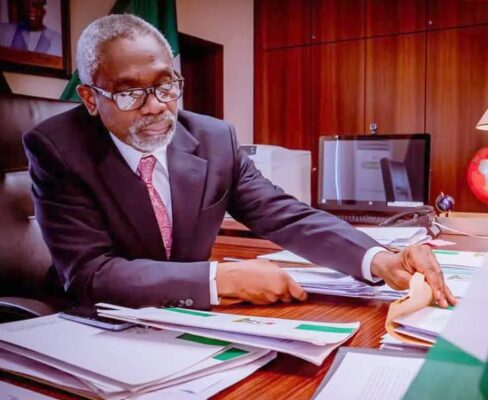
In every presidency, there are offices that attract ceremony and offices that carry consequence. The Chief of Staff belongs firmly to the second category. It is not an elective office. It does not carry the public theatre of cabinet rank, legislative debate or campaign rallies. Yet, in the architecture of presidential power, it is one of the most consequential rooms in government.
That is the room Femi Gbajabiamila now occupies.
As Chief of Staff to President Bola Ahmed Tinubu, Gbajabiamila stands at the intersection of politics, policy, access and execution. His assignment is not simply to sit near power, but to help organise it. It is to manage the presidency’s daily rhythm, coordinate priorities, protect the President’s time, and ensure that the machinery around Nigeria’s most powerful office does not dissolve into noise, rivalry or drift.
For Gbajabiamila, the role is both a culmination and a test. It is the culmination of two decades in the National Assembly, where he moved from opposition politics to majority leadership and eventually to the Speakership of the House of Representatives. But it is also a test because the presidency is a different arena. In parliament, influence is negotiated in the open. In the State House, influence is often measured by discretion, timing and the ability to make power function without always appearing to command it.
From Surulere to the Centre of Power
Gbajabiamila’s political journey has never been accidental. Before becoming Chief of Staff, he had built one of the most durable legislative careers of Nigeria’s Fourth Republic. He represented Surulere I Federal Constituency from 2003 until 2023, a 20-year stretch that gave him unusual institutional memory of Nigeria’s lawmaking process. He served as House Minority Leader, later House Majority Leader, and then Speaker of the House of Representatives from 2019 to 2023.
That long parliamentary apprenticeship matters. Nigeria’s presidency does not govern alone. It must constantly negotiate with the legislature, the party structure, governors, ministers, security institutions, business leaders, labour unions, civil society and the diplomatic community. A Chief of Staff who understands the National Assembly, and who knows the temperament of political negotiation, brings a practical advantage to the presidency.
Read also: I will transform Adamawa into industrial hub, says Guber Hopeful
Gbajabiamila’s legislative years trained him in the difficult grammar of coalition-building. He learned how to count votes, manage ambition, interpret institutional mood and balance the politics of loyalty with the demands of process. Those skills are valuable in a presidency where reform has been ambitious, politics has been demanding, and public patience has often been thin.
The Gatekeeper and the Interpreter
The Chief of Staff is often described as the gatekeeper to the President. That description is accurate but incomplete. A serious Chief of Staff is not merely a scheduler or protocol officer. He is an interpreter of presidential intent. He must understand what the President wants, what the system can deliver, where resistance will come from, and how to convert broad political direction into coordinated state action.
Gbajabiamila’s appointment was an early signal that Tinubu wanted a political operator close to the centre of the administration: someone with legislative experience, party knowledge and long-standing familiarity with the President’s political tradition.
In that sense, Gbajabiamila’s appointment was not merely administrative. It was strategic. Tinubu, a politician known for building structures, placed beside him a man who had spent years navigating one of the most complex political institutions in the country. The message was clear: this presidency would require not only technocrats and ministers, but managers of political flow.
A Presidency in a Season of Difficult Reform
Gbajabiamila’s role must be understood against the wider context of the Tinubu administration. This is not a quiet presidency. Since 2023, Nigeria has been undergoing one of its most consequential economic adjustment phases in decades, marked by fuel subsidy removal, foreign exchange reforms, fiscal pressure, inflationary pain and intense debate over the social cost of reform.
In such an environment, the Chief of Staff’s job becomes more delicate. He must help keep the administration focused when public anger rises. He must manage competing voices within government when reforms generate unintended consequences. He must ensure that ministers, advisers and agencies do not speak in fragments while the President’s agenda requires coherence.
This is where Gbajabiamila’s greatest value may lie: not in public speeches, but in coordination. A presidency can have vision and still fail through poor execution. It can have policy ambition and still suffer from administrative disarray. It can announce reforms and still lose public confidence if communication, sequencing and delivery are weak. The Chief of Staff sits at the pressure point between intention and performance.
The Legislative Mind Inside the Executive Office
What distinguishes Gbajabiamila from many occupants of powerful executive offices is the depth of his legislative background. As Speaker, he operated in an institution where persuasion is as important as authority. Unlike the executive branch, where hierarchy is formal, the legislature requires constant bargaining. Members must be carried along. Committees must be managed. Opposition must be anticipated. Public perception must be shaped.
That background gives Gbajabiamila a particular political instinct. He understands that governance is not only about issuing directives; it is about building acceptance. He knows that even a strong President requires legislative alignment to pass budgets, confirm appointments, advance reforms and sustain political momentum. In a democratic system, power that cannot persuade eventually becomes power that struggles to implement.
His presence in the presidency therefore strengthens the executive-legislative bridge. This does not mean every outcome will be perfect or every political controversy avoided. But it means the President has beside him someone who understands the National Assembly not as an abstract institution, but as a living ecosystem of ambition, loyalty, regional calculation, party interest and public pressure.
The Burden of Proximity
Yet proximity to power carries its own burden. The closer one is to the President, the more one becomes a subject of speculation, suspicion and political interpretation. Gbajabiamila has not been exempt from this. In December 2025, the presidency publicly stated that he remained Chief of Staff and had not been replaced, following speculation about his position.
That episode revealed something important about the office he holds. The Chief of Staff may not be elected, but the role is politically sensitive. Any rumour about it quickly becomes a story about influence, access and internal balance within the presidency. In Nigeria’s political culture, where proximity is often read as power, the person who manages the President’s office inevitably becomes a figure of intense interest.
For Gbajabiamila, the challenge is to remain influential without becoming the story. The best Chiefs of Staff are powerful but disciplined. They know when to intervene and when to disappear. They understand that their authority is delegated, not personal. They must be firm enough to coordinate government, but careful enough not to appear to substitute themselves for the President.
Loyalty, Competence and Restraint
Gbajabiamila’s political identity has long been tied to loyalty, especially within the progressive political family that produced the All Progressives Congress. But loyalty alone is not enough in the office he now holds. The presidency needs loyalty refined by competence. It needs discretion, emotional discipline, strategic patience and the ability to absorb pressure without creating additional crises. The Chief of Staff must know when to speak, when to listen, when to block access, when to open doors and when to tell the President hard truths.
This is the higher test of Gbajabiamila’s current assignment. His legislative résumé is already established. His political loyalty is not in doubt. What history will judge is whether he helped make the presidency more coherent, more disciplined and more effective at a time when Nigeria required not merely politics, but delivery.
A Man Between Power and Performance
The story of Femi Gbajabiamila is therefore not just the story of a former Speaker who became Chief of Staff. It is the story of a politician who moved from the visible theatre of parliament into the guarded engine room of executive power. In the House, he wielded the gavel. In the presidency, he works the levers.
That transition demands a different temperament. The Speaker is seen. The Chief of Staff is sensed. The Speaker persuades publicly. The Chief of Staff coordinates privately. The Speaker presides over debate. The Chief of Staff manages consequence.
Gbajabiamila’s relevance in the Tinubu presidency will ultimately be measured not by how often he appears in photographs or how loudly his name circulates in political gossip, but by how effectively he helps the administration impose order on complexity. Nigeria’s challenges are too large for ornamental power. The country needs a presidency that can connect decision to delivery, reform to relief, and ambition to measurable progress.
In that difficult equation, Femi Gbajabiamila occupies a central place.
He is no longer merely the legislator from Surulere or the former Speaker of the House. He is now one of the principal managers of presidential power in a defining period of Nigeria’s democratic journey. And if the Tinubu administration succeeds in turning reform into results, stabilisation into confidence and politics into performance, Gbajabiamila’s fingerprints will likely be found not in the loudest moments, but in the quiet discipline behind them.

Join BusinessDay whatsapp Channel, to stay up to date
Open In Whatsapp