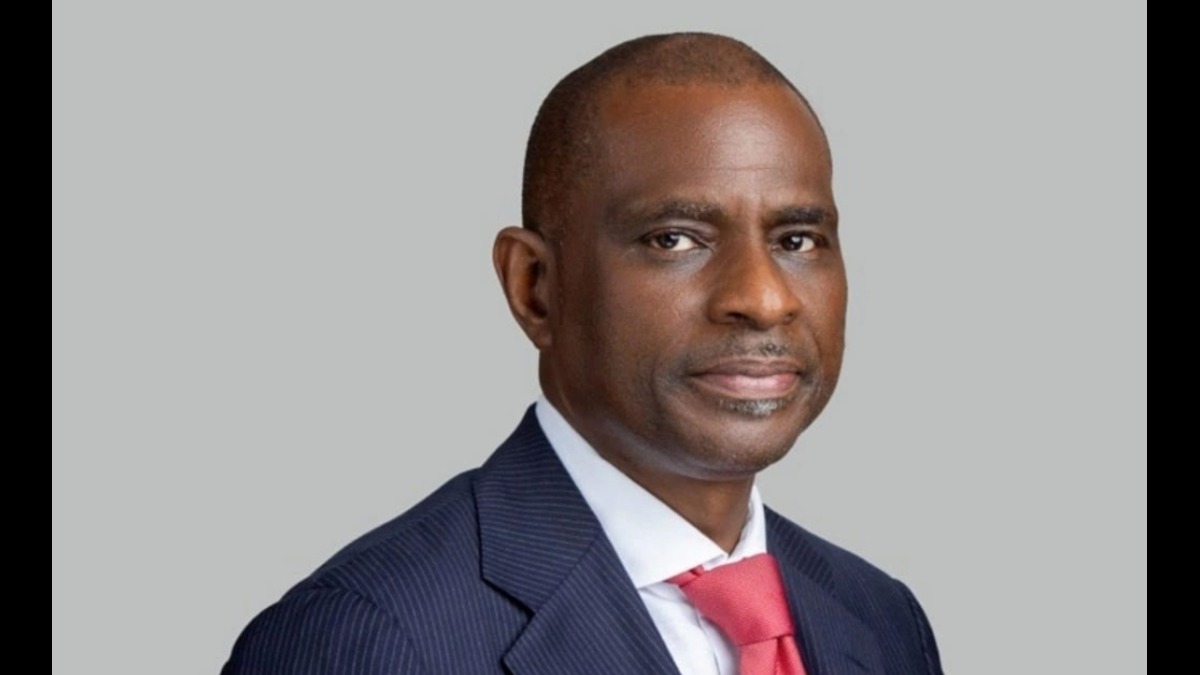
There are executives who thrive in one industry, and then there are the rarer figures who move across sectors and still leave the same signature behind: steadier institutions, sharper execution, stronger governance and a culture that survives their tenure. These are not merely career managers; they are systems builders. They understand that scale without discipline is fragile, that ambition without structure is noise, and that leadership is tested not by visibility alone, but by what remains standing after the applause fades.
Dr. Segun Ogunsanya belongs firmly in that category. Across fast-moving consumer goods, banking, telecommunications and now sovereign investing, he has built a reputation not simply as an effective executive, but as a leader with an institutional instinct — the kind of operator who does not just grow businesses, but strengthens the machinery that makes durable performance possible. That is what makes his current role as chairman of the Nigeria Sovereign Investment Authority especially significant. It is not a ceremonial landing spot at the end of a distinguished corporate career. It is a test of whether one of Nigeria’s most accomplished business leaders can help guide one of its most consequential public institutions into a bigger, stronger and more durable future.
From Executive Breadth to Institutional Depth
Ogunsanya’s career has never followed a narrow line. Trained as an electrical and electronics engineer and also a chartered accountant, he built his leadership profile across multiple sectors before many executives settle into one lane. That dual training already hinted at the kind of leader he would become: one grounded both in systems and in numbers, both in operations and in accountability. Over the decades, that combination would prove unusually valuable.
NSIA’s official profile states that he has more than 35 years of experience spanning telecommunications, consulting, banking and FMCG. Before chairing NSIA, he served as Group Chief Executive Officer and Managing Director of Airtel Africa, having previously led Airtel Nigeria, the Nigerian Bottling Company, Coca-Cola operations in Ghana and Kenya, and retail banking operations at Ecobank Transnational. That breadth matters. It means he did not arrive at sovereign investing from theory alone, nor from the insulated abstractions of policy rhetoric. He came from businesses where execution, distribution, consumer behavior, capital allocation, regulatory navigation and competitive pressure are everyday realities.
That kind of experience often produces one of two outcomes. It can create a restless executive who values motion over direction, or it can produce a disciplined leader who learns to identify the fundamentals that matter across every sector. Ogunsanya’s record suggests the latter. The through-line in his career is not industry loyalty, but institutional seriousness. He appears repeatedly drawn to environments where complexity must be managed, systems must be strengthened and performance must be made sustainable.
More Than Titles, a Consistent Leadership Pattern
What distinguishes Ogunsanya’s story is not simply the number of titles he has held, but the consistency of the themes that follow him. Many executives accumulate impressive positions. Fewer leave behind a discernible philosophy of leadership. In his case, the pattern is striking: disciplined execution, steady growth, governance consciousness and an emphasis on institution over ego.
At Airtel Africa, the company said he led the business through sustained double-digit revenue growth across multiple quarters and helped drive innovation across its markets. But when the company announced his retirement in 2024, what stood out was not just the acknowledgment of commercial performance. Airtel Africa’s board also emphasized his role in launching the company’s first sustainability strategy and named him the inaugural chair of the Airtel Africa Charitable Foundation. That transition was revealing. It suggested that his value was not being measured only in shareholder language or quarterly numbers, but in the broader institutional terms that increasingly define serious leadership in the modern era: long-term relevance, social legitimacy and the ability to embed purpose within performance.
This matters because it separates administrators from builders. An administrator can keep an organization moving. A builder helps define what it stands for, how it behaves and how it survives pressure. Ogunsanya’s career increasingly reads like the record of someone interested in that deeper work.
A Leadership Philosophy Grounded in Human Impact
Ogunsanya himself has often framed his career in human terms rather than purely financial ones. Receiving a Lifetime Achievement Award in 2024, he said his professional journey had been focused on “serving the needs of people across the continent,” especially through digital and financial inclusion. That line is revealing not because it is sentimental, but because it points to an underlying philosophy. It suggests a leader who sees scale not as an end in itself, but as meaningful only when it expands access, solves problems and improves lives.
In many African boardrooms, the language of leadership is often inflated. Executives are described as visionary when they are merely visible, transformational when they merely happened to preside over a period of market expansion, strategic when they simply inherited momentum. Ogunsanya’s record suggests something more grounded and therefore more credible. His work appears shaped by the belief that institutions earn legitimacy when they combine performance with purpose, and that growth becomes durable only when it rests on systems people can trust.
This grounding in human impact is especially relevant in an era when corporations and public institutions alike are being judged not only by balance sheets, but by social value, governance quality and long-term contribution. It positions him as the kind of leader whose instincts may be particularly useful in an institution like NSIA, where financial stewardship and national purpose are inseparable.
Why NSIA Is the Right Platform for This Moment
That philosophy becomes even more important when placed against the mission of the Nigeria Sovereign Investment Authority. NSIA is not an ordinary institution. It sits at the intersection of finance, public trust, national development and intergenerational responsibility. It was established to manage Nigeria’s sovereign wealth through its ring-fenced Stabilisation Fund, Future Generations Fund and Nigeria Infrastructure Fund. Its mandate is not merely to preserve surplus value from hydrocarbon revenues, but to convert finite national resources into long-term resilience.
That is a serious assignment in any country. In Nigeria, it is even more consequential. The country has long wrestled with the challenge of translating natural-resource wealth into broad, durable prosperity. Institutions designed to solve that problem often become weakened by politics, opacity or poor execution. NSIA has stood out precisely because it has resisted that pattern more successfully than many public entities. It is one of the few state-linked institutions routinely discussed with a degree of respect usually reserved for high-performing private-sector firms.
That reputation did not emerge by accident. It was built through a mix of governance discipline, investment rigor and relative insulation from the institutional instability that has undermined many other parts of the public sector. For a leader like Ogunsanya, whose career has emphasized execution and structure, NSIA represents a fitting platform. It is an institution where credibility matters, where discipline is central to the mission, and where the true challenge is not grandstanding, but stewardship.
The Case for NSIA’s Growing Relevance
The authority’s relevance is not theoretical. It has been demonstrated in financial performance and development outcomes alike. In March 2025, NSIA announced that it had remained profitable for 12 consecutive years, with cumulative retained earnings of ₦3.74 trillion at the end of 2024. Its total operating profits, excluding profit shares from associates and joint ventures, rose from ₦1.17 trillion in 2023 to ₦1.86 trillion in 2024. Those numbers matter not simply because they are strong, but because they reinforce the credibility of an institution whose value depends heavily on trust.
Beyond portfolio performance, NSIA has also developed a broader footprint in infrastructure and development. Its impact reporting has pointed to contributions aligned with 15 of the 17 Sustainable Development Goals. In agriculture, the authority said the Presidential Fertiliser Initiative helped revive and establish 84 blending plants, save more than $200 million in foreign exchange, create over 100,000 direct and indirect jobs and deliver 90 million bags of fertiliser. In healthcare, the expansion of NSIA’s MedServe platform has aimed to establish diagnostic centres, oncology centres and catheterization laboratories across the country, building on earlier projects in Lagos, Kano and Umuahia.
These are not minor interventions. They point to a broader institutional model in which sovereign wealth is not treated as passive reserve management alone, but as a strategic instrument for national development. That gives NSIA a relevance that extends beyond finance. It becomes a vehicle through which governance quality, investment competence and developmental ambition can meet.
From Stewardship to Scale
This is where Ogunsanya’s chairmanship becomes more than symbolic. He assumed the role after the new NSIA board was constituted in August 2024, inheriting an institution already regarded as one of Nigeria’s best-governed. The challenge before him is therefore not one of rescue, but of enlargement. How do you preserve credibility while increasing scale? How do you expand ambition without diluting discipline? How do you grow a respected institution in a country where institutions often weaken as they become bigger, more visible and more politically relevant?
That is not a trivial assignment. In fact, it may be harder than turnaround work. Repairing a broken institution can rally support around obvious problems. Expanding a successful one requires a more delicate balance: ambition without recklessness, innovation without mission drift, growth without reputational compromise.
Ogunsanya appears to understand that distinction. At his inauguration, he said the board’s mandate was to enhance the nation’s wealth so that future generations do not inherit poverty. That was not just a ceremonial statement. It positioned the institution’s work in moral as well as economic terms. Months later, he gave that ambition sharper form by setting an explicit target: to help grow the sovereign wealth fund from about $3 billion to $6 billion within his tenure. He argued that such an objective was achievable through stronger investment activity and deeper collaboration with other sovereign funds.
The Meaning of the $6 Billion Ambition
That target matters not only because of its scale, but because of what it signals about his view of the institution. It says he does not see NSIA as a passive custodian of capital. He sees it as a disciplined engine of national value creation. He is not proposing growth for optics; he is framing growth as part of a larger institutional mission.
Just as importantly, he has placed governance at the center of that ambition. In his public remarks, he has described NSIA as unusually transparent, praised the independence of its board and argued that its governance framework has helped make it resistant to fraud and corruption. Those are significant claims in the Nigerian context, where public confidence in institutions is often fragile and where governance failure remains one of the central barriers to development.
But these claims do not exist in a vacuum. External assessments have also pointed to NSIA’s strong capitalization, nil debt position at the end of 2024 and continued inflows from price-based royalties under the Petroleum Industry Act. Historical reporting has likewise noted the institution’s transparency credentials. In other words, the governance story is not merely rhetorical; it is part of the institution’s operational identity. That makes Ogunsanya’s emphasis on governance especially credible. He is not trying to invent a culture from scratch. He is trying to protect and deepen one that already exists.
The Deeper Thread: Systems, Trust and Staying Power
And perhaps that is the deepest thread running through his career. Whether in telecoms, consumer goods or sovereign investing, his leadership style appears built on one central conviction: durable performance is impossible without credible systems. Markets change. Regulation tightens. Currencies swing. Political pressures rise. Competition intensifies. But institutions that are well governed, professionally led and clear about their mandate stand a better chance of surviving all of it.
This is what makes his leadership story relevant beyond one man’s biography. Nigeria does not merely need charismatic executives or celebrated dealmakers. It needs custodians of trust. It needs leaders who understand that the hardest work in any serious economy is not just creating growth, but building structures that can hold it, protect it and transmit it across time. That requires patience, discipline and a temperament more interested in permanence than spectacle.
Ogunsanya’s importance lies in that distinction. He represents a generation of corporate leaders who understand that leadership is not only about expanding enterprises, but about making them harder to break. In societies where institutions are often more fragile than the personalities who lead them, that may be one of the most valuable forms of leadership available.
A Chairman for a Larger National Mission
If NSIA succeeds in doubling its fund, widening its infrastructure footprint and preserving its reputation for governance under his chairmanship, this chapter may become one of the most important in Ogunsanya’s career. He has already led companies that sold products, moved customers and expanded markets. At NSIA, the mission is larger and more enduring. Here, the product is confidence. The market is the future. And the real test of leadership is whether Nigeria can convert today’s resource wealth into tomorrow’s national strength.
That is why this role matters. It brings together the major themes that have defined his career — discipline, execution, institutional thinking and long-term value creation — and applies them to a platform whose stakes are unmistakably national. The challenge is no longer simply to run an enterprise well. It is to help preserve and enlarge one of the country’s most credible instruments of economic stewardship.
On that score, he looks like exactly the kind of chairman the moment demands.

Join BusinessDay whatsapp Channel, to stay up to date
Open In Whatsapp