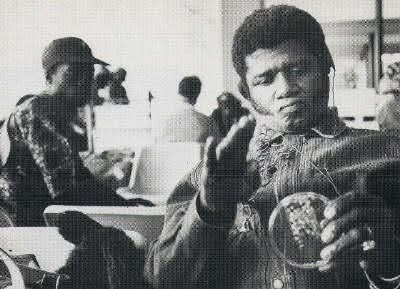
There are many men who passed through Fela Anikulapo-Kuti’s universe. Musicians came. Political admirers came. Opportunists came. But very few entered that world with the peculiar force of Professor Hindu, the Ghanaian magician and healer who did not merely befriend Fela, but became part of the charged mythology around him. In February 1981, Fela invited Professor Kwaku Addaie, also known as Professor Hindu, to Lagos and named him his spiritual adviser. That detail, preserved in Fela’s official chronology, is not just colorful background. It is one of the clearest clues to understanding a phase of Fela’s life in which music, fear, theatre, charisma and belief were becoming almost impossible to separate.
By then, Fela was already far more than a bandleader. He was a cultural insurgent, a political irritant to the Nigerian state, and the commanding intelligence at the center of a republic of symbols he had built around himself. The Shrine was not merely a venue. Kalakuta was not merely a residence. Everything around him had acquired dramatic charge: the women, the choreography, the smoke, the sermons, the danger, the spectacle, the sense that performance itself could become a weapon. In that atmosphere, a figure like Professor Hindu did not look out of place. He looked like someone Fela’s world had been preparing to receive.
The man who fit Fela’s atmosphere
Professor Hindu did not matter because he helped construct Afrobeat’s musical architecture. He mattered because he amplified its aura. Fela’s own timeline records Hindu’s arrival as part of a pivotal year that also saw Afrika 70 become Egypt 80. That is revealing. Fela was drawn to intensity, danger and symbolic force. A magician-healer who claimed access to unseen powers fit naturally into that psychology. Hindu offered more than novelty. He offered metaphysical reinforcement in a life already crowded with visible enemies.
Read also: Dangote Refinery recalls redeployed engineers
Later recollections suggest how deep that influence became. In a 1999 profile, Femi Kuti recalled that Hindu told Fela he could kill people and bring them back to life, and even claimed he could shoot Fela without killing him. Femi said Fela believed him. The same account says Hindu once staged a demonstration with a supposed bulletproof vest on a goat, only for it later to emerge that blanks had been used. Whether one reads that as manipulation, performance, or psychological capture, it shows that Hindu’s role had moved well beyond harmless eccentricity.
More than friendship, less than certainty
Their relationship also points to a more vulnerable dimension of Fela. For all his public fearlessness, he was a man living under recurring siege. The years before Hindu’s arrival had already brought beatings, police harassment, the destruction of Kalakuta, and the trauma surrounding the fatal injuries suffered by his mother after the 1977 military assault. A man under that level of pressure does not seek only courage. He also seeks reassurance, control and psychic shelter. Hindu seems to have entered at exactly that point of need.
That is why Professor Hindu should not be reduced to an eccentric footnote. He occupied a psychologically meaningful place in Fela’s life. He was part adviser, part performer, part symbolic shield. Around Fela, those categories were never cleanly separated. The Kalakuta universe itself blurred art, ritual, politics and theatre. Hindu did not create that fusion. He intensified it.
The performances that fed the legend
Part of Hindu’s power over Fela came from the theatrical extremity of his acts. Accounts from London performances in the early 1980s describe shows that turned magic into something more unnerving. A 2004 Guardian feature recalled a Town & Country Club performance in which Hindu cut his own tongue, produced objects from nowhere, and then appeared to cut a volunteer’s throat before burying him outside the venue in a grave prepared earlier. Two days later, the volunteer was dug up again.
A separate recollection published by Uncut is even more vivid. It describes a freezing night in North London in early 1984 when an audience watched a half-naked man, apparently already subjected to a throat-cutting act onstage, lowered into a shallow grave. Three days later, the same man was exhumed and “re-animated” by Professor Hindu’s incantations and kicks. The writer adds that, whatever the mechanics of the trick, it clearly left the volunteer shaken.
These accounts do not prove literal killing and resurrection. What they do show is that Hindu built his reputation on illusions staged so aggressively that they crossed from entertainment into myth. In Lagos and London alike, that kind of performance would have reinforced the impression that he was not just a conjurer but a man with access to hidden power. For Fela, who already understood the politics of spectacle, that mattered.
Kalakuta’s theatre of belief
This is where Professor Hindu becomes genuinely revealing. He exposes something political biographies of Fela sometimes underplay: Fela’s world was built not only on argument and rhythm, but on atmosphere. He understood that authority could be staged as well as reasoned. He knew that presence could intimidate. He knew that spectacle could persuade. His songs, speeches, costumes and confrontations formed a complete system. Hindu fit inside that system because he increased its sense of danger and metaphysical depth. His presence made Fela’s world feel less like entertainment and more like a charged alternative order, one governed by charisma, ritual and belief.
But the same atmosphere that made Kalakuta artistically potent also made it vulnerable to illusion. A world built partly on symbols can begin to trust symbols too much. That risk becomes impossible to ignore when one arrives at 1984.
The airport gamble that became a prison sentence
On September 4, 1984, Fela was detained at Murtala Muhammed International Airport in Lagos. On November 8, the Exchange Control (Anti-Sabotage) Tribunal convicted him of attempting to export currency unlawfully and sentenced him to five years’ imprisonment. Amnesty International said the prosecution may have been politically motivated and that the trial was unfair. Fela’s official chronology also records the arrest and the cancellation of his upcoming tour.
What makes this episode central to any serious account of Professor Hindu is the way his name became entangled in the story of the arrest itself. In the account provided from Majemite Jaboro’s The Ikoyi Prison Narratives, Fela was preparing to leave for America with Egypt 80 and Professor Hindu as part of a “comprehensive show.” Jaboro says Fela knowingly carried £1,600 through the airport because he wanted to mock the Buhari regime, break the foreign-exchange rule with magic, and then boast in New York that he had beaten the state through supernatural means. When security agents found the money, Fela reportedly asked Hindu to make it disappear. Hindu, in that telling, refused, saying his powers could not be used for personal gain. What was meant to be political theatre collapsed into disaster.
That version aligns with the broader historical picture, even if it does not settle every detail. A scholarly study of the competing accounts notes two different allegations tied to Hindu. In one version, the money allegedly belonged to him and had been hidden in a coat that reached Fela during the airport search. In another, Hindu allegedly told Fela he could make the money vanish if it was handed to him, but the trick failed and the money was discovered. The study is careful to note that these stories conflict and should not be treated as settled fact.
That caution matters. The documented facts are clear: Fela was arrested, prosecuted, convicted and imprisoned in a case Amnesty regarded as politically tainted. Hindu’s exact operational role is far less certain. But even the uncertainty is revealing. His influence had become so powerful, and his presence so controversial, that later explanations of Fela’s downfall could not leave him out.
Where mystique met danger
That is what gives Professor Hindu’s place in the Fela story its tragic edge. Before 1984, he can be read as an amplifier of atmosphere: the magician in the inner court, the man who made Kalakuta feel even more mythic. After 1984, he also becomes part of a darker reading: the symbol of what can happen when charisma outruns judgment, when spiritual assurance is mistaken for practical protection, when a man besieged by a ruthless state begins to believe too deeply in metaphysical immunity.
Read also: Ghana seeks majority private investor for new national carrier
That does not mean Hindu “caused” Fela’s imprisonment in any simple sense. The state did that. The tribunal did that. The political climate of the Buhari era did that. Amnesty’s reporting makes clear that the prosecution itself carried the smell of political motive and procedural unfairness. Still, the Hindu episode matters because it captures a dangerous contradiction inside Fela’s world: the revolutionary who saw power clearly could still be seduced by mystery; the man who named oppression so precisely could still trust a spectacle that offered theatre rather than strategy.
What Hindu revealed about Fela
That contradiction does not diminish Fela. It humanizes him. It reminds us that he was not a machine of perpetual clarity. He was a hunted man, a proud man, a wounded man, and a man who plainly believed that symbolic force was itself a kind of armour. Professor Hindu mattered because he entered precisely at that point of need. He offered reassurance in a language Fela was already primed to understand: ritual, aura, hidden power, control over fear.
So Professor Hindu should be remembered neither as a cartoon mystic nor as a harmless bit of Afrobeat folklore. He was a consequential figure in the emotional and symbolic life of Fela Anikulapo-Kuti. He deepened the spiritual theatre of Kalakuta. He reinforced the mystical register of Fela’s legend. And, through the persistent stories around the 1984 airport arrest, he also became attached to the moment when that mystique met one of its harshest tests.
The magician in Afrobeat history
In the end, Professor Hindu remains memorable not because he outshone Fela, but because he illuminated one of the least comfortable truths about him. Fela’s empire was not built on music alone. It was built on intellect, confrontation, choreography, performance, fearlessness, pain and belief. Hindu stood inside that architecture for a crucial stretch. Fela brought him in, trusted him, elevated him and, in doing so, made him part of Afrobeat history.
The relationship endures because it was never just about friendship. It was about power, faith, vulnerability and the dangerous seduction of thinking that myth can outmaneuver the state.

Join BusinessDay whatsapp Channel, to stay up to date
Open In Whatsapp