Over three decades ago, an ambitious young man wanted the best hospitality education to enable him to excel in his passion and impact the industry at home.
His quest made him repeatedly seek admission to the world’s best hospitality schools, which were in Europe then.
From the highly-rated Swiss schools, his first choice, to those in the Hague, he made extra efforts, but was denied visas as many times as he applied, while the prohibitive cost of the education also hampered his dream.
Today, against all odds, he is a master chef and runs the best hospitality school in Nigeria and West Africa.
The above is the story of Eric Mekwunye, founder, Hospitality Business School (HBS), a Lagos-based internationally rated hotel training school and also president, Nigerian Chefs Association.
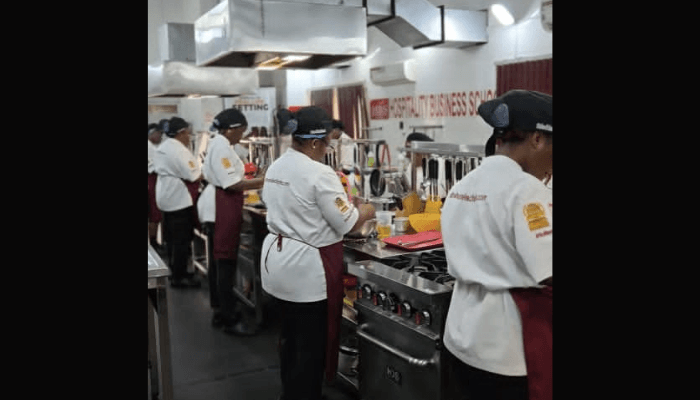
Set on #74, Olowora Road, behind Omole Phase 2 Estate, Lagos, HBS is simply world-class. With three modern kitchens, four well-equipped training halls, a studio, pastries section, lounge, bar, an outdoor grill section, contemporary rooms for room service training, a front desk, among other facilities, the school is set out for functional education.
HBS, the first hospitality-led school to be approved by the Ministry of Education and licensed as a vocational centre, offers professional diplomas, short courses, and certificate courses, with Grand Diploma as its biggest certificate.
“Our focus is on functional education, and not textbooks,” Mekwunye explained, noting that the school exposes students to practical and real-time hotel operations.
Speaking further, he said that HBS was envisioned to groom capacity from within that will fill the skills gap in the hospitality industry.
“We are glad that the skills gap is becoming narrow due to our efforts and the impact our graduates are making out there. Our thorough drilling, emphasis on attention to detail, high-level discipline, and practical experience in the school and with partner hotels have made our graduates sought-after in the last eight years of our existence,” he said.
In line with its focus on grooming and growing the needed capacity in the hospitality industry from within, and even exporting skills, Mekwunye noted that the school drives a hashtag #NoNeedToSeekItAbroad.
“With our sustained quality output, there is really no need to seek capacity abroad. Hotel general managers who have engaged our graduates can attest to their quality. Restaurants, lounges and bars say the same because we are intentional in our training to groom competent hands.
“Whatever you get in any world-class hospitality institution, in any country of your choice, we will match it and do it better,” Mekwunye insisted.
He also insisted that HBS is not born out of money, but lasting impact and empowerment, considering the cost.
“We are affordable. There is a hospitality school in Europe whose current rate for the same programmes we offer here is N120 million.
But the equivalent here is even less than N2 million, and you get additional courses on scholarship worth more than N1 million,” he said.
In addition to the affordability, he disclosed that the students get hands-on training in all the departments and many other projects that are contingent, or rather more related to the Nigerian environment.
Explaining the functional education approach, he noted the school offers the students training across theory, then more emphasis on practical, and also goes beyond the school facilities to secure internships across major hotel chains in the country.
A further boost to the functional education is the opportunity offered to the students with a minimum of three projects to practicalise their training as though in the commercial world or real-time hotel operation.
The first, according to Mekwunye, is Menu Week, which exposes them to what an average hotel consultant, like him, would do for clients, though in a short period of three months.
The second project is pre-opening, which typically runs for three months. It exposes the students to the crucial stages for opening a hotel: from conceptualisation, set up, team assembling and then launch.
“And that day, we constituted them into a team, like a full squad, like a full company. There is a chairman, an MD, HR, an accountant, cooks, kitchen assistant, head chef, all of that”.
It also hopes to introduce a unique breakfast project, where the chefs will be doing omelettes, flipping eggs amid an already wide array of breakfast menu. Some top hotel chefs and media would be invited to taste and review the menu.
However, the hands-on and more relatable projects were evident on July 2, 2026, when the school hosted this year’s edition of the Industrial Cooking Project themed, ‘Wazobia, Unity In Diversity Through Food’. “For me, the team chose it right, because they feel that Nigeria has been on the brink of ethnic and religious bigotry. So, Wazobia can actually be together through food”.
On the menu were indigenous cuisines and beverages. Welcome drinks included zobo and kunun zaki, both from the north, palm wine from the South and pito, while the appetisers were local delicacies like Okpa from the South-East, Garri and Eja from the South-West, shrimp and crab from the South-South, and Ube guacamole and spicy corn on the cob, a creative offering from the South-East.
The main course included: smoky jollof rice and Nigerian fried rice, ofada rice with ayamase sauce from the South-West, ofe oha with eba from the South-East, achicha ede, tuwo shinkafa and miyan gyada from the North, while the dessert was coconut candy truffle made at the pastry station.
According to Mekwunye, unlike where the school sources the raw materials for the students, in the industrial cooking project, the students do it all alone from coming up with their project idea, theme, the menu, raising funds, going to market to source the raw materials, cooking, decorating the venue for their presentation of their menu and finally the presentation, which culminates the industrial cooking project.
That day, the school invites guests and also hotel professionals, who will sample and critique the menu.
Yet, the students are expected to make a final defence of their project as a team days after.
“Yes, they will defend their work. They have to answer crucial questions in clear terms like: What was the stock material in Naira and Kobo given to you? What were their actual figures? What did you use? How many people did you serve? What is your food cost?”
“From pastries, to cuisine, to bar, to outdoor grill, the students come up with their menus; the school will review and approve. They also appoint their head chef and manager. It is teamwork, and they share the success or failure of the projects together”.
The usefulness of the project, according to him, is that even if it gets to 3 am for the approvals, the students must wait because that is what is often obtainable in hotels.
“The thorough drilling, the discipline that comes with it, the high expectations, all combine to bring out the best in the students, who go out there and shine as if they have worked professionally for decades,” he noted.
The above, according to him, has also attracted some worthy endorsements, recognitions for the students and partnerships with some international certification bodies in recent times.
Top among them are: the Canada Skill Council, Food Services Institute in the United States of America, some in France and in the UK, including some that are requesting partnership to raise funds for expansion from the World Bank, which HBS turned down in line with its boutique model.
Yet, some graduates who relocated abroad are also doing the school proud, with some winning major competitions like the Canadian Cooking Competition, one becoming a senior chef at the National Health Service (NHS) in the UK, among others.
Many Nigerian hotels, according to him, are singing praises of the quality training given to HBS students from The Wheatbaker, Radisson Hotel Group, even to restaurants where their graduates rise rapidly to senior positions.
HBS has also been recognised as the Best Hospitality School in Nigeria and Africa in recent times.
In all, Mekwunye noted that the things that set the schools apart from others in the country include: its intentionality, focus on functional education, preference of boutique model even when there is a need for expansion and less emphasis on money, but closing gaps and empowerment.

Join BusinessDay whatsapp Channel, to stay up to date
Open In Whatsapp