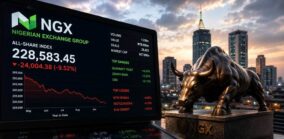
The hawkish stance of last week’s US Federal Open Market Committee (FOMC) meeting where 88 percent of committee members favoured an interest rate hike before end 2015 signposts possible decline in foreign portfolio investment (PFI) into Nigerian market; with a subsequent negative pressure on bonds and equities markets pricing, analysts have said.
The implication is that investors might exit the Nigerian markets for higher yields on the instruments.
“Recent moves by the US Fed signaling its intention to raise interest rates will further alter the dynamics of global fund flows. This may lead to a reversal of capital inflows into the Nigerian capital markets, with possible knock-on effects on (through a further weakening of) the local currency and by extension the continued downward pressure on (depletion of) our external reserves,” Victor Ndukauba, assistant vice president at Afrinvest (West Africa) told investor.
Since the conclusion of the Nigeria’s general elections, foreign portfolio investors (FPIs) into the equities market have traded with caution while there have been rise in yields in the fixed income market space as foreign investors price in Nigeria’s political and economic risk.
In the four months to April 2015, foreign portfolio investments in Nigerian equities rose remarkably, with total transactions increasing by 12.41% from N184.02 billion in March to N206.86 billion in April.
Foreign portfolio investors’ inflows, on the other hand accounted for 26.20% of total transactions while the outflows accounted for 24.05% of the total transactions in April 2015.
Speaking further, Ndukauba said that given that the foreign investors were attracted by the attractive yields (which compensates for the inherent risks associated with the country), a rates hike – potentially coinciding with a further currency devaluation – would inexorably spur foreign capital flight.
“Regardless, we do not envisage such a knee-jerk reaction as the odds favour a gradual rate increase, whilst forward guidance by the US Fed has successfully built expectations of an increase in rates, hence dampening the prospects for significant volatility in the short term,” he added.
While further stressing that Nigeria’s financial market still faces other considerable headwinds, the investment analysts noted that the perceived silence of (supposed inactivity/lack of zest by) Nigeria’s new helmsman regarding his economic policy direction/thrust coupled with the failure to constitute a cabinet highlight the many uncertainties which investors are wary of.
“The exchange rate remains another area of key concern, with the prospects of a further devaluation of the naira in the near term (within 2015) thought to be rather high, given the sustained pressure in the forex market, weak external buffers and relatively low crude oil prices,” the investment analyst noted.
Tola Odukoya, managing director, Dunn Loren Merrifield Asset Management & Research Company told BusinessDay that “It will have a negative impact as foreign portfolio investments to Nigeria will most certainly drop significantly. Therefore, there may be more downward pressure on equity prices while bond yields will increase owing to the decline in bond prices”.
He also foresees a similar pressure on the naira as a result. “Therefore a likely devaluation of the domestic currency may not surprise me in view of our weak oil prices and sustained decline in foreign reserves,” Odukoya said.
Dunn Loren Merrifield analysts observed that amidst activities by domestic institutional investors, the fixed income market experienced mixed reactions as there were both buying and selling pressures as a result of: elevated system liquidity; outcome of midweek auctions and net Cash Reserve Ratio (CRR) credit. Consequently, yields rose by an average of 20 basis points across most tenors on a week-on-week comparism.
As demand for Nigerian equities declined at the Nigerian bourse against supply last week, prices of stocks crashed, leading to about N124billion in eroded values.
With the US Fed interest stance, analysts foresee global asset managers interest in US economy as it stands to offer a modest risk-adjusted return on government securities.
“A strong and clearer indication following the U.S. Fed meeting that interest rate would be raise by end of 2015 has capital flow implication for both emerging and frontier markets, Nigeria inclusive”, said Abiodun Keripe, head, research & strategy, Elixir Investment Partners Limited.
According to him, “Capital investment into emerging and frontier markets should on the back of the US FOMC decision begin to slowdown as global asset managers perceive the U.S as offering a modest risk-adjusted return on government securities.”
Emerging and Frontier markets have benefited from the expansionary policy stance of the U.S since after the 2008/2009 financial crisis. This expansionary stance includes low interest rate environment and the quantitative easing (QE) programme which ended 2014/2015.
The committee expects that, with appropriate policy accommodation, economic activity will expand at a moderate pace, with labour market indicators continuing to move toward levels the committee judges consistent with its dual mandate of maximum employment and price stability.
“I however do not think the Nigerian market will suffer any significant downward re-pricing. This is so because interest rates and yields on FGN securities would still stay above 10% which clearly beats what is available on U.S. Government securities. With a stable exchange rate regime (provided the CBN can achieve it), I see continued interest in the Nigerian financial market”, Keripe added.
“We think much of Fed’s eventual rate hike has been priced into frontier market (FM) and Africa equities since the widely acclaimed ‘Taper Tantrum’ in 2013 (The MSCI Frontier and Africa benchmarks are down -5.8% and -7.1% YTD respectively).
“Further, the increasing strength of the US dollar should moderate downsides to FM’s shares regardless of US interest rates decision post-2015,” according to research analysts at Lagos-based United Capital plc.
The analysts reiterated that current dynamics call for cautious play in naira assets, “with longer term view for equities and gradual build-up of duration for Bonds.”
“Although the risk of FPI flight to safety over 2015 remains significant owing to both domestic and global themes, the fall-out from the Fed meeting appears to create a window (circa 10 weeks by our estimates) for short-term tactical play, barring unforeseen domestic shocks,” United Capital analysts further said.
After a slow start this year, the US FOMC observed that economic activity has been expanding moderately especially in second quarter (Q20 of 2015, with the pace of job gains picking up and unemployment rate steady.
They also observed that growth in household spending has been moderate and the housing sector has also shown some improvement. Over the medium term, US FOMC expects inflation to rise gradually toward target, as the labour market improves further and the transitory effects of earlier declines in energy and import prices dissipate.
Iheanyi Nwachukwu

Join BusinessDay whatsapp Channel, to stay up to date
Open In Whatsapp