A largely peaceful election in which Muhammadu Buhari defeated President Goodluck Jonathan has bolstered investors’ confidence in Nigeria as FPI outflows decreases, writes Josephine Okojie.
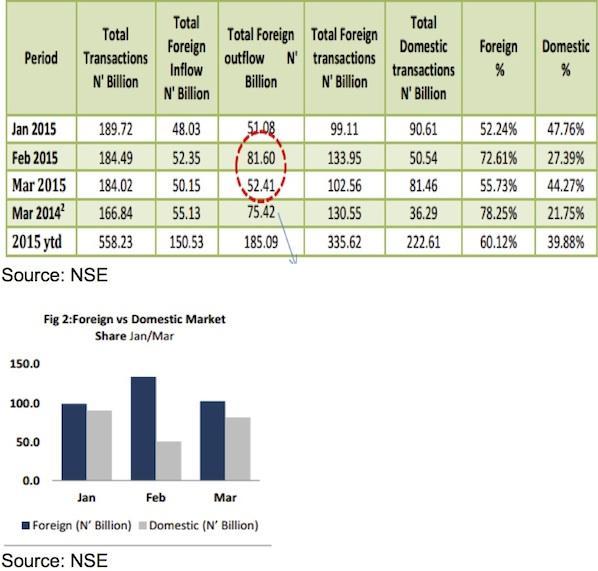
As analysts continue to take a post-mortem of Nigeria’s concluded election season, a recent report by the Nigerian Stock Exchange (NSE) showed that foreign portfolio outflows decreased by N29 billion in the month of March.
Foreign investors sold off Nigerian stocks valued N52.4 billion for the month of March, down 35.8 percent from the previous month and dropped 30.5 percent year-on-year.
Foreign investor sentiments had reached panic mode when the elections were postponed from February 14 to March 28, after security chiefs told the independent National electoral commission (INEC) that it could not guarantee security owing to operations to combat the Sunni jihadist group Boko Haram.
According to Bloomberg, foreign portfolio inflows to Nigeria jumped since last month’s presidential elections, easing pressure on the currency of Africa’s biggest oil producer, Nigeria.
Emmanuel Ukeje, director of financial markets, Central bank of Nigeria (CBN) said “There is more confidence that the economy will grow as the outlook of foreign investors is very upbeat,” in an e-mailed response to questions asked by Bloomberg. “The inflows will be sustained,” he added.
Nigerian stocks and bonds surged after Muhammadu Buhari won last month’s presidential election and Jonathan conceded defeat on March 31, easing investors’ concerns of a disputed result in a country marred by a history of election-related violence.
Nigeria’s benchmark stock index climbed 15 percent to levels not seen since November last year. This is the Nigerian Stock Exchange All Share Index’s longest streak of gains since September 2012.
The naira, which fell to a record high of N228 against the greenback before the election, later dropped to 200 after the elections in March.
“Investors staked N150 billion on the bourse versus a N185 billion foreign outflow, between January and March 2015,” the NSE report said.
“FPI outflows outpaced inflows which were consistent with the same period in 2014. There was a 10.30 percent increase in total transactions in comparison to the same period in 2014”.
On a monthly basis, The Nigerian Stock Exchange polls trading figures from major custodians and market operators on their FPI.
A total of N81.6 billion was recorded as outflow for the month of February up 59.7 percent from the previous month and dropped 22.5 percent year on year. The slide in foreign portfolio investment (FPI), which began in 2013, continued into 2014 and is still being experienced in the first three months of 2015.
Domestic transactions at the nation’s bourse which was N50.54 billion at the end of February 2015 increased to N81.46 billion (about $0.41 billion) at the end of March 2015, up 61.18 percent from February 2015.
Domestic investors conceded about 11.46 percent of trading to foreign investors as foreign transactions decreased from 72.61 percent to 55.73 percent while Domestic transactions increased from 27.39 percent to 44.27 percent over the same period.
The NSE report which helps to measure activities of foreign investors in the nation’s bourse considering how much they influence demand and supply for stocks. A higher FPI activity buttresses market liquidity and activity.

Join BusinessDay whatsapp Channel, to stay up to date
Open In Whatsapp