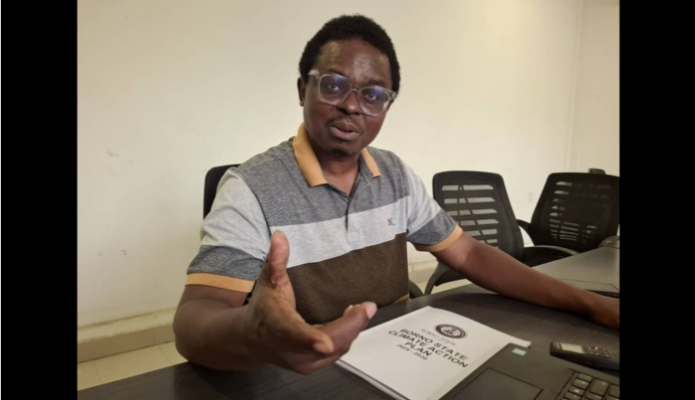
Unico Uduka is advocacy and communication advisor at the International Centre for Energy, Environment and Development (ICEED), and founding member, Nigerian Youth Climate Action Network. In this interview with OLATUNJI OMIRIN, he spoke on how shrinking of the Lake Chad Basin exacerbates insurgency conflicts, the climate change and other issues. Excerpts:
Could you tell us how climate change has contributed to insurgency conflict in the Northeast region?
Absolutely, the climate crisis exacerbates the conflicts or the insurgency, apart from the fact that due to the impact of climate change in the BAY states of Borno, Adamawa and Yobe, the impact is, of course, huge. The epicenter of the climate change crisis is the Bay States. So, because of the impact of climate change, the resources are restricted. For example, the shrinking of the Lake Chad has worsened conflict. People are looking for land farms, water for their farms, the fishing activities have halted. So, it creates that level of conflict within those residents along the Lake Chad Basin. Like I also explained earlier, climate change during conflicts, people, young women, young girls, are not able to go into the forest to look for firewood, when they try to go to the forest, they could be killed, raped or abducted. So, that’s how climate change has exacerbated the conflict. I don’t really subscribe to the fact that insecurity has exacerbated felling of trees, deforestation. Deforestation has been a recurring problem in Nigeria now, because most people in local areas depend on firewood for cooking, whether during insurgency, the problem has been there, most communities have depended so largely on the forest. Which leads to deforestation, more than 85% of households in Nigeria. I can agree and what I can say is that insecurity may have increased the level of felling of trees within the inhabited areas because people, because of fear, are not comfortable moving into forests to get firewood; so, they will resort to felling of trees within the inhabited areas. So, I can say the insecurity has increased, the felling of trees within the environment, within the inhabited areas. Another reason is that the security agencies try to clear the pathway so that they have a good vision that it could have contributed to deforestation, also the number of the carbonization of trees to become charcoal. I’ll agree with that. But like I said, felling of trees and deforestation is a normal norm all through Nigeria regions and even in the south, that is a lot safer if you go to the south, deforestation is happening at an alarming rate. Of course, research has it that Nigeria has lost more than 75% of its forest cover over the past five years, and the forest cover is mostly in the south, not even in the north. So, deforestation, bush burning and desertification is normal In Nigeria.
Many people believe that the shrinking of Lake Chad has contributed greatly to insecurity in the region. What is your take on this?
Absolutely, it’s just using a simple analogy. We are living in this house and we are living in this compound, and everybody was very happy living in this compound, and we had enough, enough space, no issues. Then all of a sudden, people start building houses within this compound, and we have a little space left with our children to play. Over time, a crisis would certainly set in, so when we talk about the conflicts in Lake Chad. It is a massive resource to the member states, apart from the fact that the water was providing people living around that area with irrigation agriculture, it was always providing livelihood to thousands of people through fishing. So, when it shrinks, those livelihoods are lost. The people that earn their livelihood from either fishing or farming, now the people no longer have that kind of income, the shrinking of Lake Chad is sad development.
Do you think weak policy, lack of awareness could be responsible for the alarming rate of desertification and deforestation in the country?
First of all, you cannot tell somebody that has not been provided with an alternative not to cut down trees, so people must cook. People need to cook in their households, and when they don’t have an alternative, they always have no alternative. So, many of them don’t really understand the impact of deforestation to the environment. When we talk about climate change and tell people not to cut trees, they don’t understand the impact of climate change. They’ve not understood, they’ve not appreciated those problems. There are really institutional policy mechanisms in place by the government including anti-deforestation. Almost every state has anti-deforestation law. They have ministries or the Department of Forestry that try to ensure that trees are planted. Those institutions are almost in every state. So, there are even states that have laws that are against deforestation, but then the implementation or execution of those policies are not very strong. And they are not very strong because you cannot forcefully go to a very local community and stop people from going to farm cut trees. Honestly, they have to cook; so, when you’ve not provided an alternative to people, you can’t tell them not to fell trees. The other issue is the high cost of the alternative to firewood, maybe using LPG gas. So, the truth is that there are institutional and policy frameworks that are in place to cook this, but the fact that there is no alternative for people to use. The weakness of the institutions to implement the existing policies and as well as the high cost of alternative fuel and the lack of awareness on the part of community members on the effects of deforestation, these are some of the factors that contribute to the persistent deforestation and desertification especially already overstretched people in the northeast. Research says that smoke from the kitchen is the third highest killer after HIV and malaria. About 95,000 Nigerians, mostly men, women and children die every year due to smoking inhalation from the kitchen. So, many people don’t know the danger associated with it.
Read also: Climate change and Nigeria’s growing food crisis
What have you been doing around climate change response?
Okay, basically, our work in the northeast has centered around response to climate change, impacts and energy access. We started working in the northeast in 2017 when we saw the difference in the need to respond to energy access within the humanitarian context. Of course, energy has been one of the things that has been neglected in the humanitarian response package; so, we saw that gap and decided to fill it. Of course, within the conflict zone, access to energy is really an issue, especially with women and young girls, you will agree that when there was a crisis, most of the people that were affected were women. Women and young girls who went into the forest to look for cooking. What we do here is an interplay of response to energy access, which also is within a context of climate change. So, in a nutshell, we do a booking of energy access and Climate Change Response.
You have been working with CSOs, academies, and other relevant stakeholders to develop actions, plans, and adaptations on climate change, what informed the decision of your organisation to choose Borno State?
Like I said earlier, the North East is the epicenter of climate change in Nigeria, as we all know Borno, Adamawa, and Yobe (BAY states) are very close to the desert; so, the impact of climate change is very high in these three states. So, what we are doing in Borno State is like piloting our response, our overarching response to climate change in the Northeast region. Of course, the project we are currently delivering is supported by the European Union tagged improved sub-national response to climate change in the North East; so, we are piloting it in Borno State. We chose Borno, apart from the fact that the North East is the epicenter; Borno State is the major area of all the Northeast that was hit by Boko Haram conflicts. So, we felt it would be good to start from Borno, but we think, and we hope that we are going to also reach other states in the Northeast. So, that’s why we chose Borno State as a pilot to test this response to climate change. Before now, we had provided what we call efficient cook stoves to local communities in Borno to teach young girls, young boys and women in local communities, on how to use local materials to produce efficient cook stoves. We helped them build a coalition to develop what is now called Borno State climate action response, Borno State climate change action plan is an overarching plan that addresses about six sectoral activities in response to climate change. So, it was led by the Ministry of Environment, co-chaired by the Ministry of Agriculture, we had about 66 members in fact, in total, we had about 66 government ministries, departments, agencies, international organisations, local organisations, academia, media, that came together over a period of one year to develop this policy called Borno State Climate Change Response Plan that has been adopted by the state government, and it became a policy, a framework that was adopted in response to the climate change issues. The action plan has five key areas: climate resilience action, sustainable and climate smart agriculture plan, sustainable water resources management plan, then we have a sustainable forestry plan and Energy Transition Plan and sustainable commerce and industry. The plan is a holistic response on how the state can respond, do budgeting, implementation, project implementation in a climate sensitive manner. So, it’s very robust.
Looking at the efforts put in place at the national and subnational levels, do you think we are making progress to tackle climate change?
Anyway, the Nigerian government is trying its best. Tackling climate change is not something a national government can do in isolation. Because the government, like Nigeria, doesn’t have a climate that only affects them; so, what affects them is the climate of the whole world. But I think the government of Nigeria has done so well institutionally and policy-wise in the area of energy and electricity. They have one called the National Transition Plan, which has laid out steps on how to transition from fossil fuel dependency to renewable energy, both in electricity and other forms of energy. So, like now, Borno State has developed this climate change action plan that will support them in budgeting and planning in a climate sensitive manner, so that the effect of climate change is reduced within the developmental trajectories of the state. So, that’s the most the government can do. The government cannot stop the climate from changing, but policies and institutions have been put in place to ensure that policies and actions are done, and are implemented to cushion the effect of climate change, and that’s the best a government can do.

Join BusinessDay whatsapp Channel, to stay up to date
Open In Whatsapp