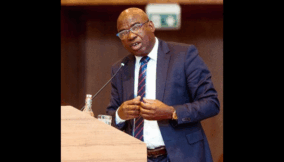
Professor Hillary Inyang, PhD, BCEEM, NNOM, is a geoscientist, poet and science diplomat whose career spans more than four decades across Africa, the United States, Asia and South America. He is a former vice chancellor of the African University of Science and Technology and the Botswana International University of Science and Technology, respectively. He has also held senior academic and research positions in multiple institutions in the United States. In this interview with Ruth Tene Natsa, Inyang speaks on Nigeria’s science, technology and innovation (STI) trajectory, the limits of current policy implementation, the controversy around biotechnology, and why he believes nuclear energy is inevitable for Nigeria’s power stability. Excerpt…
As the author of the STI 2017–2030 roadmap, how far has Nigeria gone in achieving its objectives?
The roadmap itself was well-received at inception. It was approved unanimously by the Federal Executive Council, which signalled strong political endorsement. It was also accompanied by a clear budgetary framework that was meant to guide implementation. However, the gap between approval and execution has been significant. In practical terms, very little has been achieved. The implementation momentum was lost early, largely due to instability in leadership within the supervising ministry. Frequent changes disrupted continuity. Policies of this scale require institutional memory and sustained technical direction. That has been missing.
If I am to quantify progress, I would say Nigeria has achieved no more than about 10 percent of what is required. That is a very low figure for a sector that is central to national development. Science and technology, next only to education, determine productivity levels, economic output and long-term competitiveness. When you compare Nigeria to peer countries on the continent, the picture becomes clearer. Countries such as South Africa, Egypt, Morocco, Algeria and Kenya have moved ahead. They have translated policy into industrial and technological gains. Nigeria, despite its population size, has not done the same. The key metric here is not aggregate GDP, but GDP per capita. Without strengthening science and technology, productivity remains low, and per capita output suffers. That is where Nigeria is lagging.
You recommended biotechnology adoption in the roadmap, particularly for pharmaceuticals. How do you respond to concerns about its safety?
The resistance to biotechnology is understandable but often not grounded in a full appreciation of the realities we face globally. Population growth continues to outpace food production in many regions. Even where production is adequate, distribution remains uneven. It is no longer sufficient to rely solely on natural systems. Human innovation must complement nature. Biotechnology is one of the tools that allows us to do that. It enables the development of crops that can survive drought, poor soils and extreme climates. This is critical for regions like the Sahel and other marginal environments. Opposition tends to generalise. That is not how science works. Each product, whether a crop or a pharmaceutical, must be evaluated individually. If evidence shows that a product is harmful, it should be withdrawn. But it is not scientifically sound to reject an entire field based on isolated concerns.
Biotechnology has already delivered major benefits beyond agriculture. It is used in medicine, prosthetics and emerging therapies. The question should not be whether to adopt it, but how to regulate it responsibly.
There have been claims that some genetically modified crops are carcinogenic. Does this not justify caution?
Caution is always necessary in science, but it must be evidence-based. I have served in advisory roles within the United States, including on environmental policy and technology. These debates are not new. No responsible system should allow carcinogenic products into circulation. That applies across all sectors, not just biotechnology. There are industrial materials that pose health risks, yet they are regulated rather than banned wholesale. The correct approach is case-by-case evaluation. Each crop, each product, must undergo rigorous testing. If it fails, it is removed. If it passes, it is allowed under controlled conditions. Blanket rejection undermines innovation and denies society potential benefits.
You stated that Nigeria’s electricity challenges will persist without nuclear energy. Why do you hold this view?
Nigeria’s energy deficit is structural. Current generation methods have not delivered stable, large-scale power. Hydropower is limited by climate variability. Thermal generation is constrained by infrastructure inefficiencies and gas supply challenges. Nuclear energy offers a high-capacity, stable baseload option. It is not subject to the same fluctuations as renewable sources. Countries that have achieved reliable electricity at scale often include nuclear in their energy mix. However, nuclear energy is not without risks. It requires strong regulatory frameworks, technical expertise and safety culture. It is not something to approach casually. But avoiding it entirely may limit Nigeria’s long-term energy security.
How has the STI roadmap addressed climate change challenges?
Climate change is already affecting Nigeria. The impacts are visible across regions. In the north, desertification is advancing southwards. This affects grazing patterns and contributes to resource conflicts. In the Niger Delta, coastal erosion and changing rainfall patterns are disrupting livelihoods. The roadmap recognised these risks. It emphasised both mitigation and adaptation. Mitigation focuses on reducing emissions and preventing further damage. Adaptation addresses the impacts that are already occurring. Nigeria needs to invest in both. Engineering solutions, policy reforms and economic strategies must work together. Ignoring either side creates vulnerability.
What role does geoengineering play in this context?
Geoengineering is a broad concept. It includes interventions such as carbon capture and storage, as well as modifications to environmental systems to manage climate effects. Its application depends on the sector. In environmental management, it may involve capturing carbon dioxide and storing it in geological formations. In agriculture, it can include soil and crop interventions. Public concern is natural because these interventions affect fundamental systems. But all engineering carries risk. The issue is not risk elimination, which is impossible, but risk management.
What is your assessment of Nigeria’s current performance in science and technology?
The situation is not encouraging. Many laboratories are non-functional. Research institutions are not producing outputs that translate into industry. The link between academia and production is weak. There was a time when agencies developed practical tools for local industries. Today, that capacity has declined. Even basic equipment that could be produced locally is imported. Industrialisation levels are low. Compared to countries like Egypt, South Africa, Morocco and even Ghana, Nigeria has limited manufacturing infrastructure. Research outputs often remain as academic papers without commercial application. The system lacks coordination. The government is not actively sourcing ideas from universities. There is minimal engagement with talent. Without that connection, innovation cannot scale.
A bill proposing 30 percent value addition on local raw materials is under consideration. Is it feasible?
Not under current conditions. Value addition requires infrastructure. It requires processing facilities, logistics systems and quality control mechanisms. These do not emerge overnight. Building them takes time, investment and coordination. I estimate that even with deliberate effort, it would take at least five years to establish the necessary foundation. Universities and research institutes also need upgrading. Equipment, facilities and management systems must improve. There must be clear pathways from research to industry. Without these elements, the policy remains aspirational rather than practical.
You recently stepped down as chairman of NNOM. What informed that decision?
I had committed to serve for one year, and I honoured that commitment. However, I was disappointed by the level of interest in science and technology at the national level. It is the highest intellectual honour in the country. Yet, the broader ecosystem does not reflect the importance of knowledge and innovation; that disconnect is concerning.
What legacy do you hope to leave?
I have worked across multiple domains. In science and technology, my focus has been on environmental sustainability and the integration of scientific knowledge into policy. I have contributed to national frameworks, including environmental and waste management manuals. I have also been recognised with honours such as the NNOM and international awards. But beyond awards, the goal has been impact. I have spent most of my career advancing knowledge that can improve lives.
Whether through science or poetry, the aim has been to communicate and apply ideas in ways that benefit society. Ultimately, history will determine what endures. My role has been to contribute as much as possible within the time available.

Join BusinessDay whatsapp Channel, to stay up to date
Open In Whatsapp