Africa’s strategic importance is rising at a pace unmatched since the end of the Cold War. Once viewed primarily through the lenses of conflict, humanitarian crises and commodity exports, the continent is increasingly recognised as a decisive arena in global competition for critical minerals, maritime trade, industrial investment and geopolitical influence. This transformation demands a broader understanding of national power.
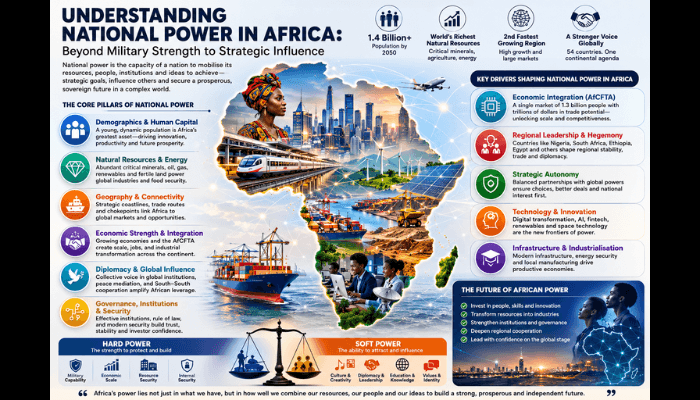
For much of the twentieth century, national power was measured largely by military capability and economic output. While these remain fundamental, they are no longer sufficient indicators of a state’s strategic position. Today’s power is increasingly defined by the ability to combine economic resilience, technological innovation, human capital, diplomatic influence and institutional strength into a coherent national strategy. For Africa, comprehensive national power—not military strength alone—will determine which states shape the continent’s future and command influence internationally.
From military power to comprehensive national power
Traditional concepts of power focused on the size of armed forces, defence spending and industrial production. The twenty-first century has fundamentally altered that equation. Cybersecurity, artificial intelligence, critical mineral supply chains, energy security and digital infrastructure have become as strategically significant as conventional military assets.
This evolution is particularly relevant for Africa. Although few African states possess large conventional militaries, many control resources, markets and geographic positions that have become indispensable to the global economy. Consequently, African governments are increasingly adopting a comprehensive approach that integrates security, economic development, governance and diplomacy into a single framework of national power.
Military capability remains essential, but it increasingly derives its effectiveness from economic capacity, technological sophistication and institutional resilience.
The strategic pillars of African power
Human capital represents Africa’s greatest long-term strategic advantage. By 2050, the continent is expected to account for nearly one-quarter of the world’s population, with the youngest workforce globally. This demographic expansion provides enormous potential for industrial growth, technological innovation and consumer demand. Yet population alone does not create power. Governments must convert demographic growth into productive human capital through education, healthcare, digital skills and employment.
Economic capacity remains the foundation upon which every other component of national power rests. Sustainable economic growth finances defence modernisation, infrastructure, research, healthcare and industrial development. The African Continental Free Trade Area (AfCFTA) is therefore more than a commercial initiative; it is a strategic instrument that expands market size, strengthens regional supply chains and enhances Africa’s collective bargaining power within the global economy.
Technology has become another defining element of state power. Artificial intelligence, cybersecurity, satellite systems, advanced manufacturing and digital finance increasingly shape economic competitiveness and national security. Countries that invest in research, innovation ecosystems and domestic industrial capability will be better positioned to compete in future strategic industries. Those that remain dependent on imported technologies risk falling further behind.
Natural resources provide Africa with another significant strategic advantage. The continent possesses substantial reserves of cobalt, lithium, manganese, platinum, uranium and rare earth elements required for electric vehicles, renewable energy technologies and advanced defence systems. However, exporting raw materials generates limited strategic influence. Greater value will come from processing, refining and manufacturing these resources domestically, allowing African economies to capture more of the industrial value chain.
Geography also enhances Africa’s strategic position. The continent borders the Atlantic Ocean, Indian Ocean, Mediterranean Sea and Red Sea while overseeing critical maritime corridors connecting Europe, Asia and the Middle East. The Gulf of Guinea, Bab el-Mandeb Strait, Mozambique Channel and approaches to the Suez Canal remain vital arteries of global commerce. Countries capable of securing these routes through modern ports, naval capabilities and maritime surveillance will enjoy increasing geopolitical importance.
Finally, governance determines whether national potential is translated into strategic capability. Effective institutions, regulatory certainty, political stability and credible public administration encourage investment, innovation and economic expansion. Weak governance, by contrast, constrains growth regardless of resource wealth or demographic size.
Regional power centres
Africa’s strategic landscape is characterised by several regional powers whose influence extends well beyond their borders.
Nigeria remains the demographic and economic centre of West Africa. Its population, energy resources and leadership role within ECOWAS provide considerable influence, although infrastructure deficits and persistent insecurity continue to constrain its full strategic potential.
South Africa retains the continent’s most diversified industrial economy, sophisticated financial markets and advanced defence manufacturing capability. Despite economic headwinds, it remains an essential diplomatic and commercial actor across Southern Africa.
Egypt combines strategic geography with military capability. Control of the Suez Canal provides global relevance, while its defence modernisation and regional diplomacy position Cairo as a major security actor linking Africa and the Middle East. Ethiopia continues to exercise diplomatic influence through its hosting of the African Union headquarters and its central role in the Horn of Africa, despite domestic political and security challenges.
These countries serve as regional anchors whose economic and political stability directly affects broader continental security.
Strategic autonomy
One of the defining characteristics of contemporary African foreign policy is the pursuit of strategic autonomy. Rather than aligning exclusively with any single global power, many African governments increasingly diversify partnerships across the United States, China, the European Union, Russia, Türkiye, India and Gulf states. This approach enables countries to attract infrastructure investment, defence cooperation, technology transfer and trade without becoming excessively dependent on one external partner.
Strategic autonomy also enhances negotiating leverage. Competition among external powers allows African governments greater flexibility to pursue national development priorities while maintaining political independence. This represents a significant departure from the ideological alignments that characterised much of the Cold War era.
The emerging security environment
Africa’s security challenges are also changing. Conventional interstate warfare has become less prevalent than terrorism, violent extremism, piracy, cyber threats, organised crime and attacks on critical infrastructure. These evolving threats require integrated national responses rather than purely military solutions. Defence forces must increasingly operate alongside intelligence agencies, law enforcement, cyber specialists and economic policymakers. Investment in surveillance technologies, unmanned systems, cybersecurity and domestic defence industries is becoming as important as expanding troop numbers.
Consequently, future military effectiveness will depend on technological integration, intelligence capabilities and regional cooperation rather than force size alone.
Strategic outlook
Africa enters the coming decades with structural advantages few regions can match: a rapidly growing workforce, abundant critical minerals, expanding consumer markets, strategic maritime geography and increasing regional economic integration. These assets have elevated the continent’s importance within global geopolitical competition.
However, national power is not determined by resources alone. It depends upon how effectively governments mobilise economic, technological, military and diplomatic capabilities to achieve national objectives. States that invest in education, industrialisation, innovation and institutional reform while strengthening regional integration through initiatives such as AfCFTA will be best positioned to convert potential into lasting influence.
The future balance of power in Africa will therefore be shaped not simply by military expenditure but by the ability to build resilient economies, develop indigenous technologies, secure strategic infrastructure and maintain effective governance. Comprehensive national power—not military strength alone—will determine which African states emerge as the continent’s principal strategic leaders during the coming decades.

Join BusinessDay whatsapp Channel, to stay up to date
Open In Whatsapp