
As it is common knowledge in our clime, Corporate Social Responsibility (CSR) is often measured by the number of projects commissioned, donations made or ceremonial photographs taken. Yet, the true value of CSR is not found in ribbon-cutting events or publicity campaigns. It is measured by lives transformed, opportunities created and generations empowered.
That is precisely why the Tolaram Science Challenge (TSC), sponsored by Lagos Free Zone (LFZ), stands out as an example of what responsible corporate citizenship should look like. Ten years after its inception, the initiative has evolved from a science competition into a platform for talent discovery, educational advancement and community transformation in the Ibeju-Lekki axis of Lagos State.
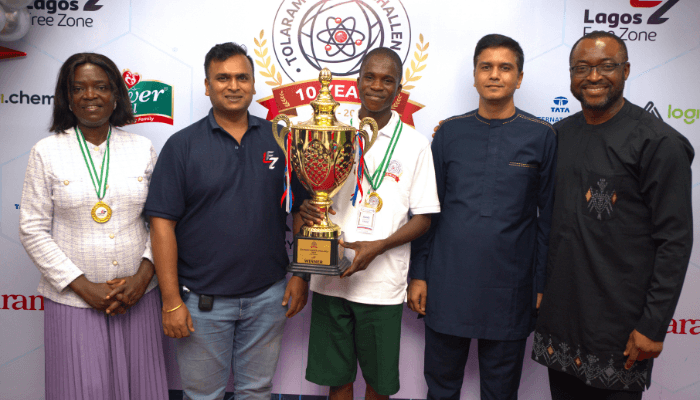
The emergence of Iwerekun Community Senior High School as the winner of the competition for an unprecedented third consecutive time is undoubtedly a significant achievement. But beyond the trophy lies a far more important story (the story of how sustained corporate investment in education can redefine the future of individuals and entire communities).
“These are not isolated success stories, as they demonstrate the multiplier effect of sustained CSR. One empowered student inspires classmates; one scholarship produces a graduate; one graduate becomes an employer; one successful professional mentors another generation, and over time, an entire community changes.”
In an era when many organisations still equate CSR with occasional donations of food items or one-off medical outreaches, the LFZ initiative demonstrates that impactful CSR requires consistency, vision and long-term commitment.
Education remains one of the most effective tools for breaking the cycle of poverty. When companies deliberately invest in schools, teachers and students, they are not merely supporting education; they are investing in human capital, innovation and the future workforce that will eventually drive economic growth.
The TSC illustrates this philosophy well by focusing on Science, Technology, Engineering and Mathematics (STEM); the programme is preparing young Nigerians to compete in an increasingly technology-driven global economy.
Every year, students from 16 secondary schools compete in Physics, Chemistry, Biology, Mathematics and General Knowledge. The competition rewards excellence, encourages critical thinking and promotes teamwork. More importantly, it sends a powerful message to young people that intelligence, curiosity and discipline are worthy of recognition.
That message is especially significant in communities where economic hardship often forces students to abandon education in favour of informal jobs.
Visioner of the programme, Olakunle Fadumiye, captured this reality when he recalled that many students initially preferred fishing and other informal occupations because higher education appeared beyond their reach. Through the competition, however, many discovered that education could open doors they never imagined possible.
This is where purposeful CSR begins to distinguish itself from charity, as charity solves today’s problem but strategic CSR changes tomorrow.
Perhaps the most compelling evidence of the programme’s success came not from corporate executives but from former participants who returned to celebrate the competition’s tenth anniversary.
Their testimonies tell a remarkable story, as Samuel Chiemeka, an alumnus, explained that participating in the competition fundamentally changed how he approached learning and problem-solving. He realised that science was no longer simply about memorising textbooks but about applying knowledge under pressure and thinking creatively.
For Edah Freedom, another alumnus who grew up in Ibeju-Lekki before the area’s rapid industrial transformation, the programme changed his perspective on what was possible. Exposure to mentors, scientists and role models convinced many students that they could aspire to careers previously considered unattainable.
Perhaps most inspiring is the story of Ayenuro Damilola, now studying in the UK and pursuing a career in nursing with ambitions of becoming an emergency medicine physician. She credits the competition with building her confidence, strengthening her decision-making abilities and giving her the courage to pursue opportunities beyond Nigeria’s borders. Today, she also leads business ventures spanning engineering, media marketing and real estate, an indication that the competition nurtured not only academic excellence but also entrepreneurship and leadership.
These are not isolated success stories, as they demonstrate the multiplier effect of sustained CSR. One empowered student inspires classmates; one scholarship produces a graduate; one graduate becomes an employer; one successful professional mentors another generation, and over time, an entire community changes.
This ripple effect is precisely what many CSR programmes fail to achieve because they are designed for immediate visibility rather than lasting impact. The significance of such interventions becomes even greater within the context of Ibeju-Lekki itself.
The corridor has become one of Nigeria’s fastest-growing economic zones, hosting major investments, including the Lagos Free Zone, the Dangote Refinery, Lekki Deep Sea Port and several manufacturing concerns. Billions of dollars have flowed into the area, transforming its physical landscape.
Yet, physical infrastructure alone cannot sustain economic growth. Roads, ports and factories require skilled workers, engineers, technicians, healthcare professionals, scientists, managers and innovators.
Without deliberate investment in education, many host communities risk becoming spectators while outsiders occupy the jobs created by industrialisation.
The TSC directly addresses this challenge by ensuring that young people within the host communities are equipped to participate meaningfully in the economic opportunities emerging around them. This is CSR aligned with economic development.
It benefits the community while simultaneously helping businesses develop a future talent pipeline, as the initiative also strengthens social cohesion.
Communities that witness companies investing genuinely in their welfare are more likely to develop trust, cooperation and peaceful relationships with investors. Such goodwill reduces community unrest, improves security and creates a more stable operating environment for businesses. In other words, responsible CSR is not simply philanthropy; it is smart business.
The programme’s impact extends beyond students to teachers and schools themselves. Officials from Lagos State’s Education District III acknowledged that the competition has improved reading culture, raised academic standards and encouraged healthy competition among schools.
Teachers are motivated to prepare students more thoroughly, as the schools strive for excellence; parents become more engaged in their children’s education, and entire educational ecosystems improve.
The awarding of Unified Tertiary Matriculation Examination (UTME) scholarships to 32 bright students further demonstrates that the programme does not end with competition day. It provides practical support that enables beneficiaries to continue their educational journeys despite financial constraints, a continuity that is essential.
Many brilliant Nigerian students abandon university ambitions not because they lack intelligence but because they lack financial support, and scholarships bridge that gap.
CSR should no longer be viewed as a statutory obligation or public relations exercise. It should become an integral component of business strategy, as every industry has opportunities to make meaningful contributions.
Banks can promote financial literacy and entrepreneurship; telecom companies can expand digital education; healthcare organisations can strengthen rural health services; energy companies can support technical education; manufacturers can establish vocational training centres linked directly to employment opportunities; agribusiness firms can equip young farmers with modern skills, and tech firms can nurture coding, robotics and AI education. Each intervention will strengthen communities while creating future markets and workforces.
In all of these, the government has a role to play. Rather than leaving community development solely to corporate organisations, federal and state governments should create policies that encourage sustained CSR investments.
Tax incentives for impactful educational programmes, public-private partnerships, simplified regulatory processes and formal recognition of outstanding CSR initiatives would encourage more companies to invest meaningfully in their host communities.
Equally important is ensuring that CSR complements rather than replaces the government’s constitutional responsibility to provide quality education, healthcare and infrastructure. Corporate intervention should strengthen public services and not become a substitute for them.
As Lagos Free Zone enters the second decade of the TSC, there is also an opportunity to deepen its impact. Suggestions such as offering internship placements, industrial attachments and National Youth Service Corps opportunities to alumni deserve serious consideration. Linking classroom excellence with workplace experience would create a complete development pathway from secondary school to professional careers, which would transform the initiative from a competition into a lifelong talent development ecosystem.
Finally, the greatest lesson from the Tolaram Science Challenge is that meaningful CSR is not measured by the size of corporate expenditure but by the quality of lives transformed. When companies invest consistently in education, they reduce poverty, inspire ambition, create future leaders and build stronger economies. As communities prosper, businesses benefit, and the nation grows stronger.
At a time when Nigeria is searching for practical solutions to unemployment, youth restiveness and educational decline, the answer may not always lie in grand government programmes. Sometimes, it begins with a company deciding that its responsibility extends beyond profit to people.

Join BusinessDay whatsapp Channel, to stay up to date
Open In Whatsapp