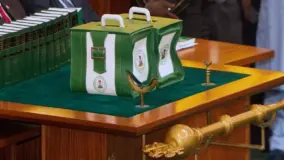
Barring last minute change, both Senate and the House of Representatives are expected to consider and pass the report of the N7,441,175,486,758 Appropriation bill laid before both chambers during Tuesday plenary session.
BusinessDay authoritatively gathered that the National Assembly’s budget was jerked up from N115 billion in 2016 to N125 billion representing N10 billion increment in the 2017 fiscal year.
The 2017 budget details which is to be debated on the floor of both chambers today (Thursday), is N143 billion higher than the N7.289 trillion budget proposal presented by President Buhari to the joint session of the National Assembly on the 14th December, 2017.
In a chat with BusinessDay, Abdulrazak Namdas, chairman, House Committee on Media and Public Affairs who confirmed the N143 billion increase, explained that major chunk of the increase was channeled to federal road projects.
While arguing that the N143 billion increase was justifiable, Namdas (APC-Adamawa), disclosed that the money was realised from the $2 increase in the crude oil benchmark initiated by the National Assembly.
He explained that, “the increment is necessary because so many agencies were seeking for increase and this becomes very important for us to get out of recession.
“I can assure you, this is the best budget ever done in this country. Don’t forget, we held public hearing where inputs of Nigerians were accommodated. We also held regular meetings with the Executive to reflect their priority areas, so it is the people’s budget,” Namdas assures.
While responding to inquiry over the high recurrent expenditure in the budget, he observed that the present administration did not conceive reduction of workers’ salaries and allowances.
Namdas who affirmed that the recurrent expenditure represents about 70 percent of the total federal budget, he assured that the 30 percent allocation to capital expenditure was commendable.
Breakdown of the report laid by Dawaki showed that N434,412,950,249 is for Statutory Transfer; N1,841,345,727,206 is for Debt Service; N177,460,296,707 is for Sinking Fund for maturing bonds; N2,990,920,033,435 is for Recurrent (Non-Debt) Expenditure while N2,174,496,775,867 is for contribution to the development fund for capital expenditure for the year ending 31st December, 2017.
Meanwhile, the breakdown of the N7.298 trillion budget presented by Buhari showed proposed aggregate expenditure of N419.02 billion for Statutory transfers; N1.66 trillion for Debt service; N177.46 billion for Sinking fund to retire certain maturing bonds; N2.98 trillion for Non-debt recurrent expenditure and N2.24 trillion for capital expenditure of N2.24 trillion (including capital in Statutory Transfers).
Analysis of the budget showed increase of N15 billion in Statutory Transfer; N18 billion in Debt Service; N1 billion in Non-Debt Recurrent Expenditure; N16 billion for Capital expenditure while the N177.46 billion proposed do Sinking Fund was retained by the Parliament.

Join BusinessDay whatsapp Channel, to stay up to date
Open In Whatsapp