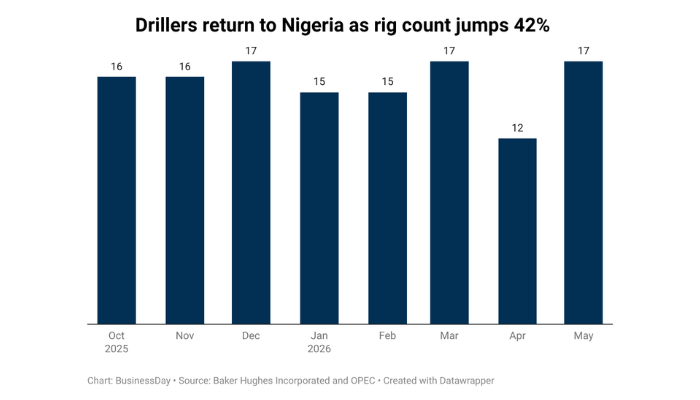
Nigeria’s oil and gas drilling recovery accelerated sharply in May, with the number of active rigs climbing 42 percent from the previous month, raising hopes that operators are once again betting on the country’s long-troubled upstream sector.

Data sourced from Baker Hughes and the Organisation of the Petroleum Exporting Countries (OPEC) showed active rigs climbed to 17 in May from a seven-month low of 12 in April, erasing a slump that had rattled industry watchers who feared another cycle of capital flight from Nigeria’s oil fields.

BusinessDay insights showed the rebound matches the peak rig counts recorded in December 2025 and March 2026, signalling what some analysts now call a structural inflexion point.

“We haven’t seen momentum like this in Nigeria in a long time, and operators are paying attention,” said one senior executive at a Lagos-based independent producer who asked not to be named.

He added, “17 rigs get you stabilisation, maybe modest growth; To get to 1.8 million barrels and hold it there, you need to be closer to 20 rigs consistently, and you need sanctioned projects in the deepwater pipeline. We’re not quite there, but the direction is right.”

Experts said the recovery comes after a bruising stretch for Nigerian crude production that tested the resolve of international oil companies and domestic operators alike.

The country’s deepwater sector, where spending commitments have been rising, is increasingly central to the narrative.

The divestment of Shell Petroleum Development Company of Nigeria Limited (SPDC)’s onshore assets, part of a broader industry retreat from Nigeria’s vulnerable terrestrial fields, has paradoxically freed up capital and management bandwidth for offshore plays where security risks are structurally lower.

TotalEnergies and Equinor are among the operators that have advanced subsea infill drilling campaigns off Nigeria’s coast, contributing to the rig count recovery.

Meanwhile, Seplat Energy and Renaissance Africa Energy, which acquired Shell’s onshore portfolio, have moved aggressively to deploy rigs across legacy fields in Rivers and Bayelsa states.

Security along the Trans Niger Pipeline and the Nembe Creek Trunkline has improved markedly since late 2025, with losses from crude theft falling to their lowest levels in nearly a decade, according to Nigerian National Petroleum Company Limited data.

Simultaneously, the federal government’s Petroleum Industry Act reforms have begun unlocking fiscal terms that make deepwater and onshore blocks more attractive to risk-weary majors.

“The security story in the Niger Delta has changed substantially,” said a managing director of operations at an international E&P firm with assets in the region, who asked not to be named because internal decisions weren’t public. “That was the number-one blocker. When operators can be reasonably confident that the barrels they drill will actually reach the terminal, they drill.”

The Nigerian Upstream Petroleum Regulatory Commission said Thursday that crude oil production averaged 1,530,354 barrels per day in May, nudging past Nigeria’s 1.5-million-barrel OPEC quota for the first time in recent memory and representing 102 percent of its allocation.

When condensate volumes of 170,446 barrels per day are added, total output climbed to 1,700,800 barrels per day, the strongest reading since July 2025.

“Nigeria’s oil production witnessed an upswing in May 2026, averaging 1,530,354 barrels of crude oil and 170,446 barrels of condensates per day,” the regulator said in a statement attributed to Eniola Akinkuotu, head of media and corporate communications, “consolidating Nigeria’s position as Africa’s largest oil producer.”

“Production performance during the review period remained robust, with combined crude oil and condensate output ranging between a low of 1.51 million barrels per day and a peak of 1.86 million barrels per day,” the NUPRC said.

Industry observers have long cited two variables as the swing factors in Nigerian output: security and maintenance. In May, both cooperated.

The regulator said the absence of significant pipeline breaches and facility shutdowns was central to the month’s performance.

“The rise in production is attributable to sustained positive momentum as operations remained stable throughout the reporting period, with no significant pipeline or facility outages recorded,” the NUPRC stated. “Additionally, all previously scheduled turnaround maintenance activities had been completed, contributing to improved operational reliability and production efficiency.”

Bonny Terminal led all production streams with 293,870 barrels per day, followed closely by Forcados at 289,900 barrels per day and Qua Iboe at 173,360 barrels per day. Escravos Oil Terminal added 135,470 barrels per day, while Odudu, also known as the Amenam Blend, rounded out the top five with 63,250 barrels per day.

The spread of volumes across multiple terminals carries its own significance. In past years, a single disruption at Forcados, repeatedly targeted by militants, was enough to crater national output in any given month. The breadth of May’s performance suggests the gains are not concentrated in any single bottleneck, which makes them harder to unravel.

Dipo Oladehinde is a skilled energy analyst with experience across Nigeria's energy sector alongside relevant know-how about Nigeria’s macro economy. He provides a blend of market intelligence, financial analysis, industry insight, micro and macro-level analysis of a wide range of local and international issues as well as informed technical rudiments for policy-making and private directions.

Join BusinessDay whatsapp Channel, to stay up to date

Open In Whatsapp