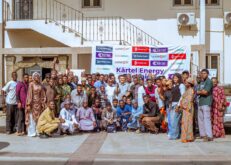
Nigeria has taken a significant step toward resolving one of its most persistent economic bottlenecks, unreliable electricity, with the formal launch of the Green Finance Investment Facility, a blended finance platform designed to mobilise $188 million for distributed renewable energy projects across the country.
The facility, launched in Lagos on May 7, 2026, brings together Barton Heyman Limited, the Rural Electrification Agency, UK PACT, First City Monument Bank, and ARM Harith Infrastructure Investment Limited. Together, they are targeting 191 megawatts of distributed solar capacity to serve homes, businesses, and communities that have long operated on the margins of Nigeria’s strained national grid.
Why it matters
Nigeria is home to roughly 85 million people without reliable electricity access, one of the largest energy-poor populations on the planet. Decades of underinvestment, grid inefficiency, and structural financing gaps have made it nearly impossible for private capital to enter the distributed renewable energy market at scale.
The GFiF is designed specifically to address that problem. Rather than relying on government spending alone, the platform combines sovereign pipelines, results-based funding mechanisms, and commercial capital into a single investable structure. The model is built to reduce perceived risk for private and institutional investors who have historically sat on the sidelines of Nigeria’s energy sector.
Olumide Lala, one of the facility’s architects, described it as a market-driven financing model rather than a development handout. He framed the $188 million raise not as a ceiling but as a starting point, the first phase of what he projects to be a $40 billion effort to finance 20 gigawatts of distributed renewable energy across Nigeria.
Read also: Nigeria’s solar boom is about to get more expensive
The blended finance mechanics
Blended finance structures have gained traction across emerging markets as a tool for de-risking private investment in sectors where returns are uncertain and tenors are long. The GFiF applies that logic directly to Nigeria’s distributed energy market.
Anthony Feyitimi, who spoke at the Lagos launch, outlined how the structure layers different capital types to improve bankability. Concessional funding, including results-based financing from development partners like UK PACT, sits alongside commercial debt and equity, absorbing first-loss risk and creating returns that institutional investors can underwrite.
Simon Field reaffirmed UK PACT’s commitment to the platform, signalling continued development finance support for Nigeria’s clean energy transition.
FCMB’s bet on distributed power
First City Monument Bank is making a notable institutional play here. George Ogbonnaya disclosed that FCMB has committed N100 billion in debt financing to the broader Distributed Access through Renewable Energy Scale-Up programme, known as DARES, which the GFiF is designed to support. The bank has already funded more than 42 mini-grid projects and is working toward connecting over two million households to decentralised power systems.
For a commercial bank to deploy capital at that scale into distributed renewables signals a meaningful shift in how Nigerian financial institutions are beginning to price energy transition risk.
The regulatory and policy backdrop
Abba Aliyu, director-general of the Rural Electrification Agency, acknowledged at the launch that financing barriers, not technology, remain the primary constraint on renewable energy deployment in Nigeria. The GFiF’s pitch to the market is that it can structurally lower those barriers.
Titilayo Oshodi echoed that framing, stressing that coordinated investment, policy consistency, and innovation must move together if Nigeria is to achieve meaningful gains in sustainable energy access. Derek Chime called for deeper collaboration across the energy ecosystem to sustain the momentum.
What comes next
The GFiF’s immediate target, 191 megawatts serving more than one million Nigerians, is modest relative to the country’s scale of need. But the facility’s architects are positioning it as proof of concept: a replicable financing model that, if it performs, could unlock far larger pools of private and institutional capital for Nigeria’s clean energy sector over the coming decade.


Join BusinessDay whatsapp Channel, to stay up to date
Open In Whatsapp