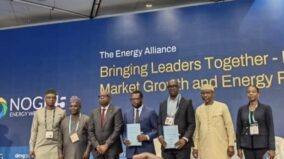
Nigeria’s ambition to become a global gas powerhouse may have received a major boost following the signing of a 15-year gas supply agreement for the country’s first Floating Liquefied Natural Gas (FLNG) project.
The deal was signed between UTM Offshore and the joint venture of the Nigerian National Petroleum Company (NNPC) Limited and Seplat Energy at the ongoing 2026 Nigeria Oil and Gas (NOG) Energy Week in Abuja.
The agreement guarantees the supply of 200 million standard cubic feet of gas per day from the Yoho field to UTM’s proposed $3 billion FLNG facility and removes one of the biggest obstacles to a Final Investment Decision expected later this year.
Beyond the project, the deal could have far-reaching implications for Nigeria’s long-standing ambition to transform its vast gas reserves into export revenues, industrial growth and energy security.
Unlocking stranded gas
Nigeria holds more than 209 trillion cubic feet of proven gas reserves, the largest in Africa, yet much of its offshore gas remains stranded because of the high cost of pipelines and onshore processing infrastructure.
The FLNG model changes that equation. Instead of transporting gas to land-based facilities, floating LNG plants process and liquefy gas offshore before loading it directly onto export vessels.
For Nigeria, this provides a pathway for commercialising offshore gas resources that might otherwise remain undeveloped. If successful, the UTM project could become a template for unlocking stranded gas assets across the Niger Delta and deep offshore basins.
Expanding LNG exports
Nigeria’s LNG exports currently rely almost entirely on the Nigeria LNG facility in Bonny. While NLNG remains one of the country’s biggest foreign exchange earners, expansion has been constrained by security challenges and pipeline disruptions.
By producing LNG offshore, FLNG projects reduce dependence on vulnerable onshore infrastructure and create opportunities for multiple smaller export hubs.
This could help Nigeria capture growing global demand for LNG, particularly in Europe and Asia, while diversifying export revenues away from crude oil.
Supporting the Decade of Gas
The Federal Government’s Decade of Gas initiative seeks to make natural gas the backbone of Nigeria’s industrialisation strategy and transition fuel agenda. However, turning reserves into revenues requires more than policy declarations.
The UTM project has progressed from financing commitments and engineering studies to regulatory approvals and now long-term gas supply arrangements, milestones investors typically view as critical to project bankability.
The latest agreement, therefore, signals that Nigeria’s gas ambitions are beginning to move from policy to execution.
Read also: UTM Offshore secures 15-year gas supply deal, moves $3bn FLNG project closer to FID
Boosting foreign exchange earnings
The facility is expected to produce between 1.8 million and 2.8 million tonnes of LNG annually, depending on the final project configuration.
At current market prices, this could generate billions of dollars in export earnings over the project’s lifespan while creating new sources of government revenue through taxes and royalties.
With crude oil production struggling to consistently meet budget targets, additional gas exports could strengthen Nigeria’s external reserves and fiscal position.
Reducing gas flaring
Nigeria remains one of the world’s largest gas flaring countries, losing significant economic value from gas that is burnt during oil production.
The FLNG project seeks to monetise some of these volumes by converting them into LNG and other products.
Apart from improving government revenues, reducing flaring would support Nigeria’s climate commitments and improve the environmental profile of its hydrocarbon sector.
Domestic benefits
The project could also support domestic energy security. UTM has previously indicated that the larger project configuration could supply about 500,000 tonnes of liquefied petroleum gas annually to the local market.
This would help reduce Nigeria’s dependence on LPG imports and support efforts to deepen the use of cleaner cooking fuels.
The bigger picture
The importance of the latest agreement lies not only in the gas volumes involved but in what it represents.
For decades, Nigeria has been described as a gas-rich country that has struggled to commercialise its resources. The UTM project offers an opportunity to change that narrative.
If it reaches Final Investment Decision and enters production as planned, it could become Nigeria’s most significant gas development since NLNG and establish floating LNG as a viable model for unlocking the country’s offshore gas wealth.
The deal is therefore more than a commercial agreement. It is an important test of whether Nigeria can finally turn its gas potential into economic prosperity.


Join BusinessDay whatsapp Channel, to stay up to date
Open In Whatsapp